What can be done about these Oscars?
From Carrie Rickey's "Flickgrrl" www.philly.com/philly/blogs/flickgrrl What can the Academy do to produce a three-hour awards pageant that engages the short attention spans of the twitterati while still entertaining people who actually like variety shows?
From Carrie Rickey's "Flickgrrl"
www.philly.com/philly/blogs/flickgrrl
What can the Academy do to produce a three-hour awards pageant that engages the short attention spans of the twitterati while still entertaining people who actually like variety shows?
While the 83d annual Academy Awards on Sunday night was an improvement on the snorecasts of yore - I'm thinking of the years that David Letterman and Jon Stewart hosted - it still was, as former emcee Johnny Carson quipped decades ago, "two hours of sparkling entertainment spread out over a four-hour show." Preliminary ratings suggest that about 40 million viewers watched, (a 24.6 household rating/37 share), a slight dip from last year.
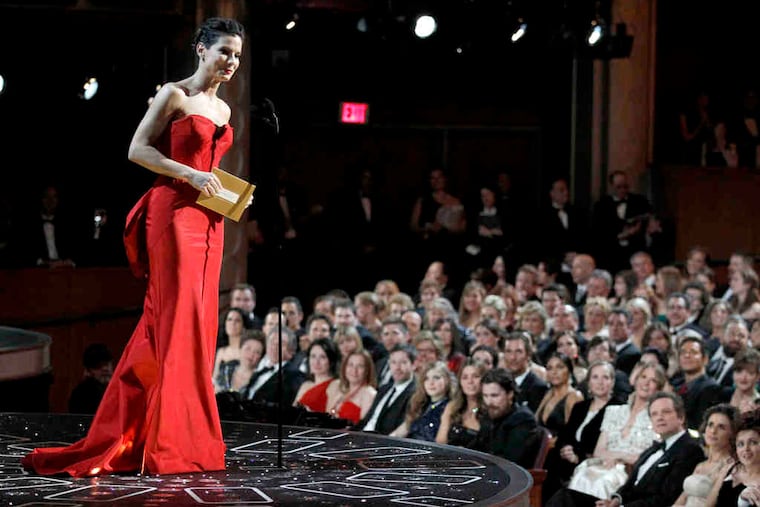
What worked: The opening montage/countdown at the top of the show that used clips from nominated movies to pump the audience up for the contest; abbreviating the musical numbers; the byplay between Robert Downey Jr. and Jude Law; Sandra Bullock's spirited introduction of the best-actor nominees; Steven Spielberg's intro to the best-picture announcement, reminding the audience both of great films that won, and also of equally great films passed over.
Genuinely heartfelt acceptances came from best-actor winner Colin Firth, supporting-actor recipient Christian Bale, screenwriter David Seidler (The King's Speech), Inside Job filmmaker Charles Ferguson (who noted that none of the bankers responsible for the 2007 financial crisis had been indicted), and short-subject winner Luke Matheny, who tossed Jimi Hendrix-scale tresses and quipped, "I should've got a haircut."
And there is the fact that most of the winners were popular films that the audience actually saw: Toy Story 3, Inception, The King's Speech, etc., etc.
What didn't: Cohosts James Franco and Anne Hathaway were like a couple on a bad blind date where he couldn't wait to get out of there while she tried to make it work. (The more he underplayed, the more she overcompensated.) The so-called scenic transitions where presenters talked about the history of a particular award by invoking a movie classic. The red-carpet parade on E! and ABC that make the long night feel endless.
Three suggestions: 1. Get one person to handle hostly duties (preferably Steve Martin or Oprah Winfrey) or a duo with chemistry, like Hugh Jackman and Anne Hathaway, or Whoopi Goldberg and Billy Crystal, or Steve Carell and Tina Fey.
2. Make it interactive. Color commentators (in small box in the corner of the home screen) to kibitz on the gowns, the vibe, the feuds, the history. Show a crawl of selected tweets at the bottom of the screen. In a satirical piece in the Los Angeles Times, Ann Magnuson suggests, "Mick Jagger should perform all the nominated songs, but only if Keith Richards provides simultaneous commentary from the balcony above." Great idea.
3. Include the opinions of real moviegoers. As in the year that Chris Rock hosted (and Million Dollar Baby took best picture), use a man-at-the-multiplex segment to highlight the disconnect between the popcorn films popular at the multiplex and those being honored. Interview civilians and have them say why they liked the nominees.
