Art: Photographs that beg for more
Fred Comegys at Del. Art Museum; at Fabric Workshop, a show of diverse ingenuity.
One rarely encounters a museum exhibition that's too small for its subject, but the Fred Comegys retrospective at the Delaware Art Museum begs to be larger, perhaps even double its size of 68 pictures. Not only is Comegys a top-rank photojournalist, but the show covers a career that has lasted a half-century.
Born in 1941, Comegys works at the News Journal in Wilmington, his birthplace. He began at the paper as a copyboy, but soon moved into the photo darkroom as an assistant. One day the paper needed a head shot of a news subject; because no photographers were available, Comegys was given a battlefield promotion.
He proved to be a natural. From that modest baptism came 50 years' worth of consummate professionalism, some of which, as we can see in this show, metamorphosed into art.
Photojournalism begins as a craft, but when the person behind the lens has an intuitive eye for composition and design and the instinct of just precisely when to release the shutter, the results can transcend documentation.
During his career, which continues, Comegys has photographed everything that crosses a press photographer's path - spot news such as fires and accidents, lots of sports, politics, entertainment, leisure pursuits, and human interest. Regardless of the theme, people are usually his primary interest.
He appears to have photographed just about every celebrity in every walk of life who has come through, or near, Wilmington - high-profile athletes like Phillies pitcher Steve Carlton, movie stars like Gloria Swanson, legendary musicians like Dizzy Gillespie, and political mahoffs like Lyndon Johnson, Ted Kennedy, and, of course, Joe Biden.
He has photographed Klan rallies lit by blazing crosses, nuns playing football, ironworkers aloft (and himself standing nonchalantly on a main cable of the Delaware Memorial Bridge), the Wilmington riots of 1968, a clown reading a newspaper, and a cow eating a campaign poster - the agony, the ecstasy, and the comedy of life.
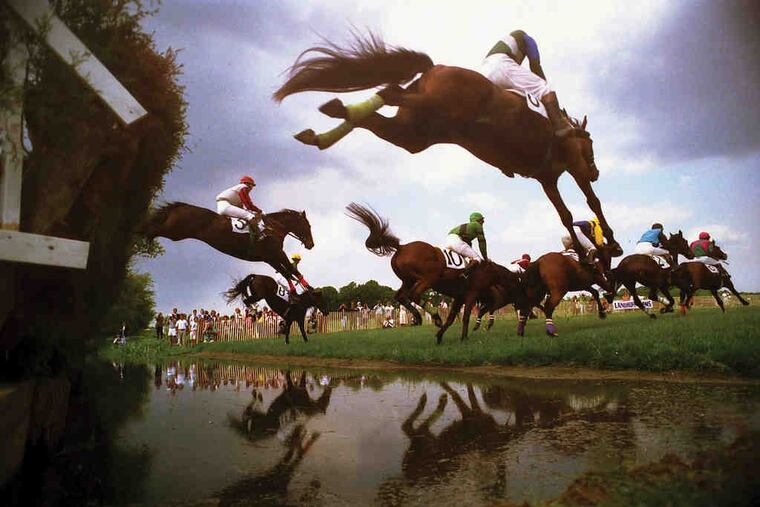
Most of Comegys' pictures record events, but with an aesthetic flair that makes them memorable. One such is a photo of horses clearing a water jump at Willowdale Steeplechase in Kennett Square. He positioned himself at ground level, at the end of a hedge, so the animals seemed to be soaring above him, and us.
Yet he also notices patterns, in coils of steel reinforcing mesh, in the sinuous curves of a roller-coaster. These purely "arty" compositions complement soft-news, human-interest subjects such as city kids bouncing on a discarded mattress, a special-education teacher cradling a disabled child in a swimming pool, a weary Santa Claus, and a close-up of an elderly nun's hands.
This exhibition not only recaps one photographer's prolific career, it's also a capsule catalog of photojournalism at its best. It's particularly engrossing because Comegys has infused his images with vitality, immediacy, and humanity.
That's why one wishes the show could have been larger, and presented in the museum's special exhibitions gallery, instead of being divided between a small room on the first floor and a hallway on the second.
So why isn't it larger? For several reasons, according to curator Heather Campbell Coyle. When Comegys agreed to the project, he wanted it done "sooner rather than later," she said, which meant the show had to be assembled in quick-time.
While it covers the period 1965 to 2010, Coyle didn't know how many photographs she could find, which meant "I didn't know how big it would be."
The uncertainty complicated scheduling because, as it developed, the special exhibitions space was otherwise committed for the current dates. So she had to improvise and edit ruthlessly to fit the show into whatever space was available.
Despite those limitations, the high quality of Comegys' achievement makes itself abundantly evident. The show further affirms that, in the digital age, a splendid photograph can still hold its own against jazzier forms of visual representation.
New American Voices II. Exceptional diversity and cultural synthesis are the keynotes in the second installment of this series at the Fabric Workshop and Museum, which features work by four artists from various parts of the United States representing a broad variety of backgrounds and sources.
The range of historical, geographical, and sociological inputs by these artists-in-residence goes like this:
Jim Drain of Miami extends a traditional handicraft process, knitting, through mechanization and installation. Jiha Moon, a South Korean native living in Atlanta, creates lively mixed-media works that use textiles, painting, and graphic processes to express a mixed Western-Asian symbology.
Texas native Robert Pruitt, who lives in Houston, combines African and African American traditions, historical and contemporary, to produce objects and photographs that illuminate connections and differences. And Bill Smith, an Illinois native who lives in a St. Louis suburb, invents the most artful and fascinating hybrids of art and science I have ever seen.
Each body of work is fully independent of the others, so there isn't any thematic undercurrent to follow. Yet the artists are related in being admirably ingenious not only conceptually but also in their adaptation of familiar materials and in the way they integrate techniques.
Drain, for instance, has transformed sweater forms, knit by machine, into chromatically bold sculptures whose textural richness has to be studied close-up to be fully appreciated.
Moon's screenprints on silk organza, sometimes with paper collage, are playful in the way they mix symbols of popular culture from several Asian countries to achieve energetic fields of colorful activity, fully contemporary in spirit while remaining rooted in Asian aesthetics.
Pruitt's grafting of symbols of inner-city culture, particularly firearms, onto iconic African prototypes results in strange, detoxified hybrids - the guns are elaborately beaded, and in one case incorporated into a traditional headdress.
Finally Smith, whose work is installed down the block in the workshop's New Temporary Contemporary space, marries art to science in a way that makes the inherent wonder of natural processes easy to grasp and magical to behold.
His kinetic "emu-egg" sculptures use elaborate computer-controlled feedback loops to mimic natural systems; try to imagine rhythmically pulsing benthic invertebrates that project video stills.
Art: Picturing a Career
EndText