Galleries: Swarthmore's List Gallery offers Andrea Packard collages inspired by wetlands
What at first may have appeared to be an egregious power grab by a gallery director turns out to have been nothing of the kind. Moreover, when offered a show of her collages at Swarthmore's List Gallery by the college's studio art faculty, List Gallery director Andrea Packard initially demurred, according to Brian Meunier, the art faculty member who proposed Packard's show to his colleagues.
What at first may have appeared to be an egregious power grab by a gallery director turns out to have been nothing of the kind. Moreover, when offered a show of her collages at Swarthmore's List Gallery by the college's studio art faculty, List Gallery director Andrea Packard initially demurred, according to Brian Meunier, the art faculty member who proposed Packard's show to his colleagues.
"I think her work is as good as any of the work that we've shown at the List," Meunier says.
The wetlands of New England and the mid-Atlantic states inspired Packard's collages. Some of her works immediately read as landscapes; others are more abstract, offering the experience of confronting tangly undergrowth up close in the way that Ray Metzker's more recent photographs have done. All of her collages are surprisingly painterly from a distance, considering that they are composed almost entirely of cut and manipulated fabric and that the actual painted areas in them are negligible. Packard combines fabrics in the way that painters paint, often to lyrical effect, though a few of her woollier pieces seem intentionally lumpen and awkward.
As with all of the List's shows, Packard's is exquisitely displayed and lit (I'll assume she did this herself), and, as with a few previous List shows, there are too many similar works on the walls of these two modestly scaled rooms. Much of Packard's work is in the same palette of browns, blues, and greens, and its extreme togetherness here diminishes the individuality of her collages. Her strongest pieces stand out quickly.
A good goodbye
Bambi Gallery is going out in style. For better or worse, the Northern Liberties gallery's final show, of collages by Sienna Freeman and cyanotypes by Gail Cunningham, is its most polished.
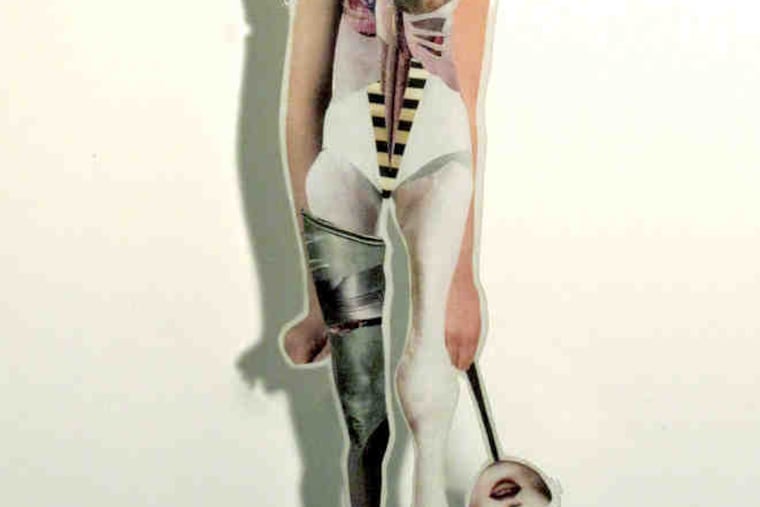
Freeman's cut-paper and cut-photograph collages of women in bondage, posing together or morphing into horses and dogs, explore the transitory nature of memory and emotion. By turns funny and scary, and cast in plastic resin, they suggest a hybrid of Dada, surrealism, and pop art.
Cunningham, a minimalist by contrast to Freeman, arranges cut-paper shapes of buildings from various Philadelphia neighborhoods on watercolor paper treated with light-sensitive chemicals, letting her recollections of those buildings determine their placement in her pictures. Exposed to light, they become blueprints of her memories of the city.
Along the coast
Margo Tassi's watercolor paintings of Nova Scotia coastlines veer from maximal close-ups of outcroppings of rocks to tiny views of distant sea. Her smallest pieces, some of which measure a mere 3 by 3 inches, are the most compelling to me because her touch is more impressionistic than in the large works; they seem to encapsulate a personal experience, whereas the larger paintings can look like studies for parts of paintings.
It's hard not to be impressed by Tassi's complete absorption in this body of work.