Mary Cassatt: 'Godmother of Impressionism'
Mary Cassatt's style of composing lifelike paintings of mothers and children with abstract detail and deliberate brushstrokes solidified her stature in the 19th-century art scene, but this Philadelphia-raised artist's influence travels beyond her maternal subjects.
Mary Cassatt's style of composing lifelike paintings of mothers and children with abstract detail and deliberate brushstrokes solidified her stature in the 19th-century art scene, but this Philadelphia-raised artist's influence travels beyond her maternal subjects.
Kathy Foster, the curator of American Art at the Philadelphia Museum of Art, credits Cassatt, who attended the Pennsylvania Academy of the Fine Arts before moving to Paris, as a "wedge" in bringing Impressionistic paintings to the U.S.
"Mary Cassatt was not a bohemian," Foster said. "But she definitely called the shots in her life."
Upon moving to Paris, Cassatt, who was born into a line of upper-class Pennsylvania Railroad executives, sought to study at the prestigious National School of Fine Arts, but because she was a woman she was forced to pay for private lessons rather than attend classes with men.
"She would have had a better crack at fine-art training in Philadelphia than she did in Paris," Foster said, adding that she insisted on moving to Europe to escape the artistic confinement within her social class.
Cassatt eventually began submitting work to the Salon, the school's annual exhibition, but criticized its prejudice against women, which made her an artistic pariah.
In the late 1870s, Edgar Degas invited her to join the "scandalous and rebellious" Independents, who would become known as the Impressionists, and the two formed a friendship that influenced each other's works, Foster said.
By befriending curators' wives when returning to Philadelphia, Cassatt was able to persuade them to purchase paintings from her Impressionist friends.
Foster said that because of Cassatt's artistic roots in both the U.S. and Paris, her paintings are displayed in several sections of the museum.
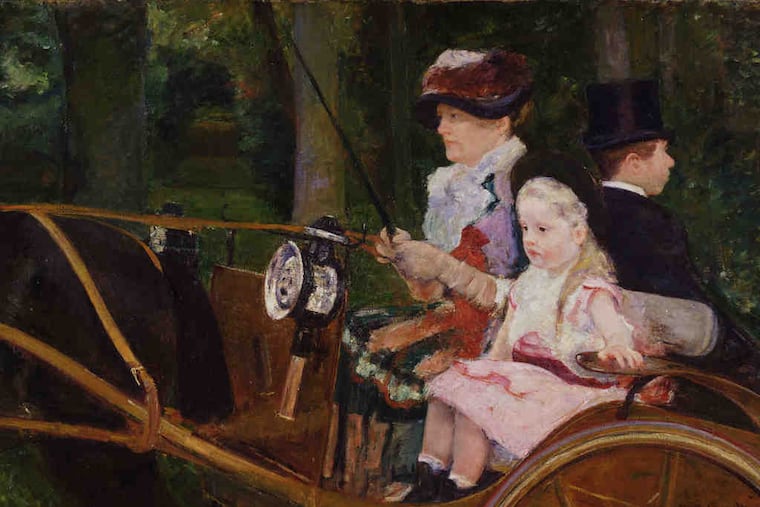
"A Woman and a Girl Driving," an oil-on-canvas painting, is particularly emblematic of Cassatt's influence on women in the art world, Foster said. The snapshotlike painting features Degas' young niece in a horse and carriage, with Cassatt's sister Lydia at the reins - a rarity for a woman in the late 1800s. You'll find this painting in Gallery 153 on the first floor of the museum, in the European Art 1850-1900 collection of the Annenberg Galleries.
Several other Cassatt works, including "Woman with a Pearl Necklace in a Loge," can be found in Gallery 116 and Gallery 108 on the first floor of the Fernberger Family Gallery, part of the museum's American Art collection.
"She was the godmother of Impressionism. Clients saw themselves in Mary Cassatt's paintings, which unlike so many at the time were not focused on prominence or the gods, but modern, public life," Foster said. "And people either loved it or it drove them crazy."
MORE FOR THE GIRLS: Women who love fashion won't want to miss the just-opened exhibit "Roberto Capucci: Art Into Fashion" at the art museum through June 5. Experience the revolutionary silhouettes and inventive use of color of this famed Italian fashion designer and artist, including his Nove Gonne dress, a red silk taffeta gown inspired by the "ripples a stone creates when thrown in water," which was featured in an advertisement for the 1957 Cadillac Series 62 convertible.
The Philadelphia Museum of Art, 26th Street and the Benjamin Franklin Parkway, 10 a.m. to 5 p.m. Tuesday through Sunday, select galleries are open on Fridays until 8:45 p.m., $16 for adults, $14 over 65, $12 for students with ID, free for children 12 and under.