1970s' 'Upstairs, Downstairs' lives
It was supposed to be a failure. Network executives had written off the TV show months before it ever hit the air.
It was supposed to be a failure. Network executives had written off the TV show months before it ever hit the air.
The very concept of the series - about the parallel lives of a rich family and their servants - was a recipe for disaster.
And so began, in the humblest and most inauspicious circumstance, the remarkable rise and rise, and rise, of one of the biggest hits in TV history, Upstairs, Downstairs.
The period melodrama premiered on Britain's commercial channel, ITV, on Oct. 10, 1971. Cocreated by a pair of young actors, Jean Marsh and Eileen Atkins, it wasn't exactly championed by the network, which chose not to give it any promotion.
Things didn't look good: Due to a technicians' strike, the first six episodes were shot in back and white. (The opener was reshot in color in time for the premiere.)
The prognosticators and hand-wringers, including the cast and crew, couldn't have been more wrong. Upstairs, Downstairs sparked something in the public's imagination and it went on to air for five seasons. (It was shown on PBS's Masterpiece Theatre from 1974 through 1977.)
In the four decades since, it has been seen by more than 1 billion in 40 countries.
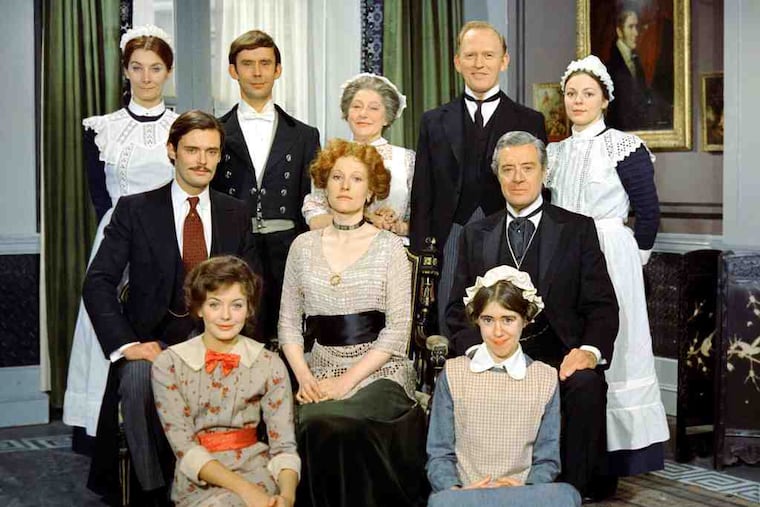
Upstairs, Downstairs spans three decades, from 1903 to 1930, in the lives of the Bellamy family and their servants at 165 Eaton Place in London's fashionable Belgravia district.
Upstairs reside patriarch and member of parliament Richard Bellamy (David Langton); his aristocratic wife, Lady Marjorie (Rachel Gurney); and their two grown children, the wild, boozing, and womanizing military man James (Simon Williams) and the delicate, idealistic if naive Elizabeth (Nicola Pagett).
Their lives are run by a cadre of faithful servants, including the severe, Calvinist butler Angus Hudson (Gordon Jackson), no-nonsense cook Kate Bridges (Angela Baddeley), and house parlour maid Rose Buck (Marsh).
Over the years, viewers were privy to the family's darkest secrets, including adultery, out-of-wedlock pregnancies, and suicide.
But it was those indelible characters that made the show a fan favorite.
The fan base is still as strong as ever - inspiring the BBC to produce a sequel also starring Marsh. (It will air next month on PBS.)
The show's 40th anniversary also is being celebrated with Upstairs, Downstairs: The Complete Series - 40th Anniversary Collection, a 21-disc DVD boxed set out Tuesday. It features 25 hours of new extras, commentary tracks, interviews, and documentaries.
Marsh, 76, continues to be surprised by the show's extraordinary success.
"It's so very strange to be back," she says. "I still haven't quite gotten used to it."
Marsh and Atkins initially conceived Upstairs, Downstairs as a comedy-drama about two maids.
"Eileen and I had parents who had been servants," she says, "and we thought the idea would have immediate appeal to people . . . with similar backgrounds."
The show, the duo felt, filled a vacuum.
"Television hadn't really dealt very much with the working class. There was nothing about the class system," Marsh says from her London home.
"If you saw what was going on upstairs," say, a lavish dinner party, "you didn't see what produced it downstairs. You didn't see the cook, hot and sweaty . . . or somebody washing [up]."
Marsh and Atkins most especially wanted to show how the servants "had their own lives, not just work."
Their fixation on telling servants' stories soon evolved into the conviction that for the program to succeed, it also had to include strong characters from upstairs.
By the end of its first season, Upstairs, Downstairs was an unqualified success.
Lesley-Anne Down played the exquisite upstairs beauty, Georgina, who joined the show in its third season.
"It was surreal" to be asked to star in the show, she says. "I had been an avid fan . . . and everybody in the world wanted that job."
Down, 57, puts the show's appeal down to its ability to tell a sweeping historical tale at the same time as giving us an intimate look at family life.
"The genius of the show was how they took personal stories and interwove them with historical events," she says from Los Angeles, where she has lived for nearly three decades.
One of the show's enduring conflicts had to do with the line that separated owner and servant. Georgina, for one, immediately fell afoul of the senior servants when she talked one of the maids, Daisy, into taking her to her family home.
Marsh, who says she modeled her character partly on her mother, says she always found it peculiar that it was the servants' job, not the family's, to enforce class roles.
One of Rose's jobs, she says, was to "quash Miss Elizabeth's enthusiasm" to identify and mix with the working class.
Marsh has always found the world of Upstairs, Downstairs somewhat alien.
"Rose and the servants actually believed upstairs people were superior to them," she says. "It's something I could never believe."
It's just as well: In BBC's new version, Rose Buck owns her own business.
"Upstairs, Downstairs: