Art: She helped elevate fiber to an art form
Sheila Hicks' innovative work is shown at the Institute of Contemporary Art.
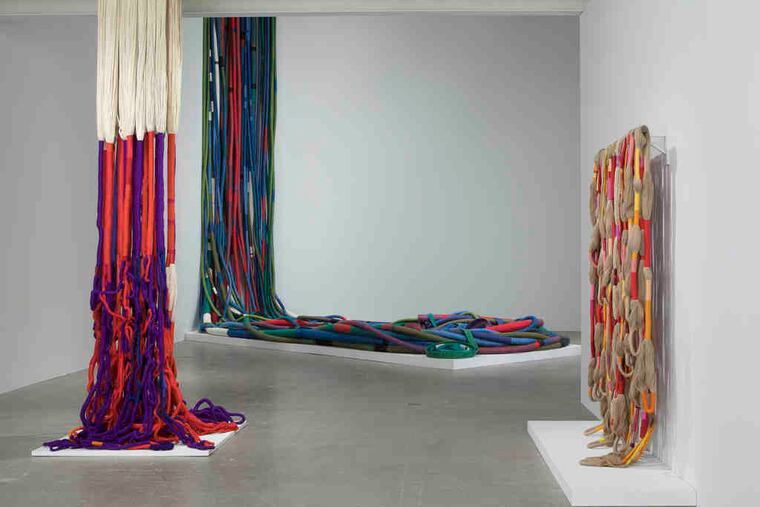
Sheila Hicks is one of a small group of artists who, in our time, ennobled fiber as a high-art medium. They demonstrated that the aesthetic virtues associated with media such as painting and sculpture, and even emotion, could be expressed through objects made of fiber.
Even though the 76-year-old Hicks has been working for more than a half-century and is internationally renowned, you might not have heard of her. That's probably because, though born and educated in the United States, she has lived mostly in France since 1964. (She now also lives part-time in New York City.)
Yet we're in luck, because for the next four months a selection of her strikingly innovative, and occasionally powerful, creations in two and three dimensions is on view at the Institute of Contemporary Art.
Organized by the Addison Gallery of American Art in Andover, Mass., the show is billed as a career retrospective. It doesn't feel quite expansive or deep enough to fulfill that promise, but it's certainly one of the two most exciting museum exhibitions currently in Philadelphia. The other is the collection of "sculpture dresses" by Italian designer Roberto Capucci at the Philadelphia Museum of Art. Both artists deploy color in ways that are sometimes bold and sometimes nuanced, and both also emphasize architectural structure. (More on Capucci later this month.)
Hicks began her career by studying painting at Syracuse University. She spent a summer in Mexico before transferring to Yale University's school of art and architecture. There she was exposed to the rigorous color theories of Bauhaus master Josef Albers and, informally, to the influence of his wife, weaver Anni Albers.
In South America, where she traveled on a Fulbright grant after earning her bachelor of fine arts degree, she discovered pre-Columbian Inca textiles. She returned to Yale for a master's degree and won a second grant, to study painting in France.
But in the summer of 1959, another trip to Mexico drastically altered her career trajectory. She met and married a beekeeper and was exposed to traditional Mexican hand-weaving. Still, she went to France as a painter, but cut her residency short when she discovered she was pregnant.
Back in Mexico, living on a ranch with a husband and an infant daughter, Hicks began to make small fiber constructions on a loom she improvised from a painting stretcher. She was to make many of these small, experimental pieces, which she calls "minimes," as the decades passed.
This is where the ICA exhibition begins, with a display of 62 minimes, each as different from the others as species of exotic butterflies, and all framed like drawings.
A typical example is Blue Letter, a rough square in related shades of blue wool in which subtly contrasting textures create tension and movement, as in a miniature landscape. The Museum of Modern Art bought it in 1960, when Hicks was just a year out of graduate school.
Her Mexican idyll didn't last because the deep impression that French culture had made on her eventually pulled her back. In 1964, she took her daughter and decamped for Paris; to support herself, she negotiated a regular stipend from Knoll Associates to supply textile designs.
In Europe, her career eventually took off; she began to receive commissions and exhibit in important fiber events such as the Lausanne biennale.
What concerns us at the ICA is how she translated her ideas into reliefs and to sculptures, which come in three types - freestanding, wall-mounted, and hanging from the ceiling.
Some pieces, like a lunette-shaped relief in champagne-colored silk made for the interior of an Air France 747, generate a shimmering surface movement through cross-hatched squares.
Other pieces employ a signature Hicks technique - tight, intermittent banding of hanks of raw linen. In these pigtail-like constructions, one detects a compression/release dynamic as well as color interactions of the kind that Albers used in his Homage to the Square paintings.
The tubular pigtails are sometimes gathered into panel-like hangings that one is tempted to read as paintings. However, their sculptural character is far more pronounced, and the color combinations more effusive. The Principal Wife, with its wrappings of pink, orange, scarlet, and burgundy against the coffee-colored linen, is especially luscious.
Perhaps the most sensuous of all Hicks' sculptures in the exhibition is a freestanding, bell-shaped cascade of fibers called Menhir; it looks like an immense head of hair.
In this Hicks displays her mastery of suggestive color-mixing. Menhir is generally olive-green, but with brown threads and other colors mixed in. There's some banding, too, in silver, copper, purple, and blue, especially around the base.
Menhir has a pronounced sheen, like a glistening waterfall, and its color seems to shift as one moves around it. The bell-curve form couldn't be more elemental, but the effect of its color-weaving is particularly enchanting because it's so complex.
Hicks has executed many site-specific commissions around the world; the exhibition features one that's breathtaking in its scale and boldness. It's a hanging sculpture, a Yosemite Falls of multicolored, tubular "firehoses," lent by Target Corp. of Minneapolis.
At Target headquarters, it was installed on a wall as a loose over-and-under knot; at the ICA, Hicks has hung it in a corner of the two-story gallery space, so it plunges to the floor and spills out in a series of coils, hence the waterfall analogy.
A museum retrospective in a relatively small space can't do justice to this aspect of Hicks' production, which is why this show feels a bit short of a retrospective. The exhibition catalog (Yale University Press, $65) helps to fill in the blanks.
Hicks does have a permanent presence in the city, four pieces in the collection of the Philadelphia Museum of Art, plus a major work, an assemblage of hospital garments, Turmoil in Full Bloom, that's stored there. This piece was reconstructed during a lecture Hicks gave at the museum last month.
Unfortunately, none of the Hicks works is on view. It's too bad the museum couldn't have put them out, especially during this month's Philadelphia International Festival of the Arts.
In an interview for the Archives of American Art in 2004, Hicks observed that she made Turmoil because "textiles have been relegated to a secondary role in our society, to a material that was merely functional or decorative. I wanted to . . . show what an artist can do with these incredible materials."
This, essentially, is what Hicks has done throughout her career - she has shown that fiber art can provoke emotional responses in people who might otherwise take the medium for granted.
Art: Sculptural Fiber
"Sheila Hicks: 50 Years" continues at the Institute of Contemporary Art, 36th and Sansom Streets, through Aug. 7. Hours: 11 a.m. to 8 p.m. Wednesdays, 11 to 6 Thursdays and Fridays, 11 to 5 Saturdays and Sundays. Free. Information 215-898-7108 or www.icaphila.org.
EndText