Holocaust survivors share pain for posterity
Itka Zygmuntowicz remembers everything. Every agonizing detail. Years, decades were stripped away when she read from her own book of poetry recently at a Holocaust survivors reunion at the National Museum of American Jewish History:
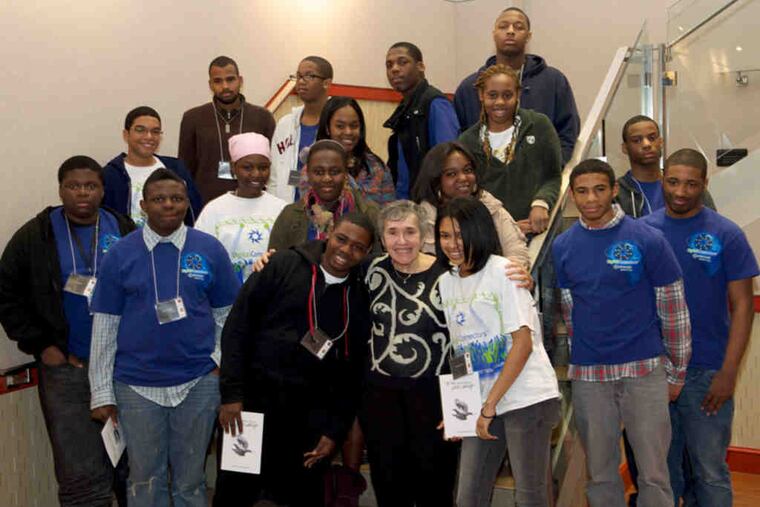
Itka Zygmuntowicz remembers everything. Every agonizing detail. Years, decades were stripped away when she read from her own book of poetry recently at a Holocaust survivors reunion at the National Museum of American Jewish History:
A number is tattooed for life on my arm
On my mind, my heart, my soul.
I remember the killing center of Auschwitz
And the six million voices that call.
Do not forget us!
Zygmuntowicz, 85, a native of Poland, was one of about three dozen elderly men and women who had once been interviewed as part of Steven Spielberg's Survivors of the Shoah project, conducted from 1994 to 1999.
The project, which became the USC Shoah Foundation Institute for Visual History and Education, still resonates deeply for Spielberg. As part of Holocaust Remembrance, the director will be in Philadelphia Monday to present the Ambassador for Humanity Award to Comcast chief executive officer Brian Roberts for his company's technology and education initiatives.
As Spielberg was completing production of his iconic Academy Award-winning film, Schindler's List, in the '90s, he was often approached by aging survivors of the Holocaust begging to tell their own stories to him.
"These survivors wanted to be sure that their memories would not be forgotten," Spielberg said by e-mail. "I wondered then whether we actually could get the names of all the survivors around the world, and send camera crews to those countries to record and preserve their testimonies."
"Today, our archive is one of the largest video digital libraries in the world, with 52,000 testimonies in 32 languages from 56 countries," says Spielberg. That archive includes 262 tapings in the Delaware Valley, and more than 1,100 throughout Pennsylvania and 16 surrounding states.
Spielberg knew how limited his window of opportunity was with these elderly witnesses to history. "We were in a race against time - the clock was ticking. My hope was that these eyewitness accounts could have a profound effect on education, and that the survivors could become teachers of humanity for generations to come."
At the survivor's reunion here in March, two of Zygmuntowicz's three adult sons were with her. "These are my gift - my reward - my way of telling Hitler that he didn't win. I did," said Zygmuntowicz.
A child survivor, now 71-year-old Roland Turk of Melrose Park, another Shoah witness, dimly recalls running from town to town and into the mountains of his native France with his mother during the Nazi occupation from 1942 to 1945. The sounds of dogs barking as the mother and son were stalked by Nazi soldiers still resonate.
"I was very young, and the remembering for the testimony was extremely painful," Turk recalled. "But I wanted and needed to tell my story so that my children and their children would know it." After the war, Turk, a retired social worker, was one of the lucky ones. His father, who had gone to England to fight with the Allies, was reunited with his mother, and the family emigrated to the United States in 1951.
"But you never forget," he said. "Forgetting is not possible."
The testimonies tell the first-person stories of Jewish, homosexual, and Jehovah's Witness survivors, along with liberators and other victims and rescuers.
The entire experience has been deeply personal for Spielberg, who remembers how his grandmother once taught English to European immigrant survivors. "One day, one of the younger students showed me how he could do 'magic' by turning one of the tattooed concentration-camp numbers from a 6 to a 9 by bending his forearm. That made an unforgettable impression on me," Spielberg said.
With all the testimonies collected, digitized, and fully searchable, the mission of the foundation now is to use them. They must not, Spielberg has often emphasized, just be stored in vaults. Not when they are such powerful, unforgettable teaching tools.
"When viewers can see an actual person, an eyewitness, speaking to them on those tapes, it brings history into reality."
That happened in March, when Comcast partnered with the USC Shoah Foundation Institute in a pilot program designed to link technology and the Holocaust. Over two long days at the Honickman Learning Center Comcast technology lab in North Philadelphia, 17 area high school students volunteered to test I-Witness, an institute application that allows students in classrooms to watch and respond to Holocaust testimonies.
In 2009, the Comcast Corp. launched its Digital Connectors program, designed to make technology accessible to underserved youngsters across the country.
According to Sherry Bard, project director of educational programs for the institute, the Philadelphia program marked the first time that students anywhere had that hands-on experience.
"It was amazing - I learned so much!" says Ernie Ross Jr., 16, a sophomore at New Media Technology Charter School. "I've been picked on, and I've felt prejudice myself because I'm short. But that's nothing compared to what those people went through."
An Eagle Scout who also has studied world cultures, Ross initially learned that weekend about the historical and social context of pre-World War II Europe from veteran Holocaust educator Elaine Culbertson, chairwoman of the Pennsylvania Holocaust Education Council.
"Our theme was resistance, and the many forms it takes," said Culbertson, herself a daughter of survivors. "The youngsters needed to understand that resistance takes many forms, and that sometimes it may just be smuggling bread to someone who is starving. It's not always about violence."
For John Spanier, 17, a student at Bok Technical School, the learning curve about the Holocaust, and other more recent genocides, such as in Rwanda, was steep. "I only knew a little, and I felt so much emotion when I watched the testimonies."
Like other students, Spanier was especially moved when Zygmuntowicz shared her story of losing her family at Auschwitz.
And 18-year-old Yalonda Cooper, a graduating senior at Benjamin Franklin High, summed up the impact of the weekend immersion.
"My mother is a Jehovah's Witness, and Hitler killed Jehovah's Witnesses. Itka could have been my mother."
The high school senior insisted that she'll never forget those testimonies - or Zygmuntowicz's tattoo.
"Maybe it's good that it will always be there for the world to see. That way, the rest of us won't forget."
Comcast chief to get Ambassador for Humanity Award
Comcast chairman and chief executive Brian Roberts will receive the USC Shoah Foundation Institute's highest honor, the Ambassador for Humanity Award, from director Steven Spielberg at a gala Monday at the Loews Philadelphia Hotel.
Previous honorees include former president Bill Clinton, actor Kirk Douglas, Wallis Annenberg, and Jeffrey Katzenberg. The award honors individuals who embody the institute's values and mission through the educational use of its testimonies.
"Brian Roberts has been a longtime advocate of finding and developing innovative avenues to reach and educate young people," Spielberg said in announcing the award. "He and Comcast have a strong commitment to enhancing digital literacy in schools and communities across America."
Roberts remembers well the person who introduced his father, Ralph Roberts, to cable television - the late Dan Aaron. "Dan was a Holocaust refugee, and his world was forever altered by his family's experience," says Roberts. "Dan worked alongside my father building Comcast."
Roberts also recalls taking two of his three children to Yad Vashem in Jerusalem, a memorial to the six million murdered in the Holocaust and to the numerous Jewish communities destroyed.
"That experience was the best way to help them understand the horror and suffering of the Holocaust, and the importance of learning about tolerance, diversity, and respect."
Comcast will show 10 of Spielberg's films about the Holocaust free to the company's 23 million subscribers on its website through May 25.