Touring the world of bicycling and bicycle-builders
Dream car. Dream house. Dream lover. Just about everyone has an idealized, fantasy lust-object. Some thing, or romanticized notion of a human being, assembled from the greatest parts and attributes out there. Few of us, though, get to realize that dream.
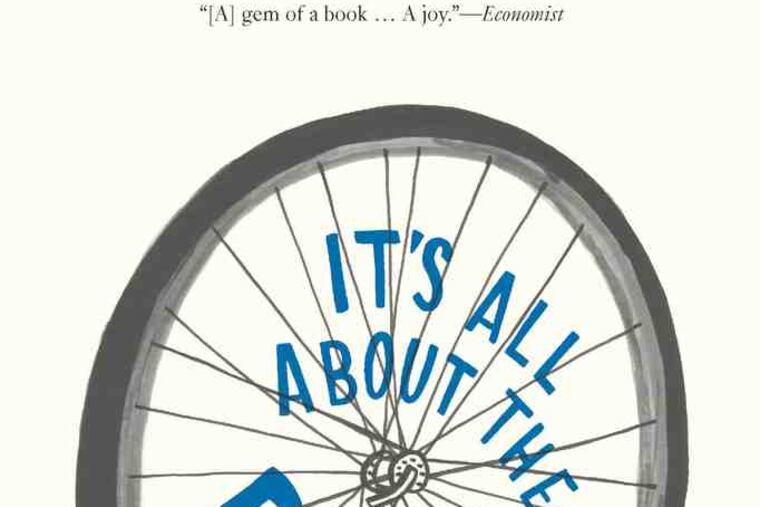
The Pursuit of Happiness on Two Wheels
Robert Penn
Bloomsbury. 204 pp. $20
nolead ends nolead begins
Reviewed by Steven Rea
Dream car. Dream house. Dream lover.
Just about everyone has an idealized, fantasy lust-object. Some thing, or romanticized notion of a human being, assembled from the greatest parts and attributes out there. Few of us, though, get to realize that dream.
Well, Robert Penn does. In It's All About the Bike: The Pursuit of Happiness on Two Wheels, the British author - a journalist who has traveled much of the world by bicycle (25,000 miles before he was out of his 20s) - chronicles his quest for the perfect machine. From Vicenza, Italy, to Portland, Ore., to Stoke-on-Trent in the United Kingdom to Marin County, Calif., Penn drops in on artisan frame builders and legendary wheel makers, folks who fabricate headsets and handlebars, drivetrains and brakes, saddles and tires, putting together his, yes, $5,000 bicycle.
But It's All About the Bike (a play off of Tour de France king Lance Armstrong's best-selling autobiography, It's Not About the Bike), is more than just a gearhead's hejira, a globetrotter's catalog of componentry for the cycling crowd. Penn looks back at the birth of the bike, the 1817 "Draisine" - two wooden wheels fixed to a bench-like plank that the rider straddled, running one's feet along the ground - and traces the evolution of this self-propelled contraption from velocipede to high-wheel bicycle to the "safety" bike, designed by John Kemp Starley and first produced in 1885, whose main principles are still in operation today.
With humor and insight, Penn examines the historical, social, and cultural significance of the bike. His chapters - "Diamond Soul," "Drop Bars, Not Bombs," All Geared Up," etc. - each represent one of the key components of a bike. But along with tracing developments in the design and craft of a bicycle's many parts, Penn takes us on a tour to meet the men and women behind the components.
There is Brian Rourke, the legendary frame builder, an exacting Brit whose idea of custom-sizing a person to his or her bike has more to do with taking a ride across rolling countryside than it does with biomechanics and motion capture. ("The very best artisan frame-builders have more in common with the craftsmen who make Patek Philippe watches, Monteleone guitars or Borelli shirts than with the mass manufacturers who churn out carbon and aluminium frames from factories in the Far East," Penn writes.)
There's Gravy, the mono-monikered Marin County mountain-bike guru and wheel builder who lives and works next to Repack, the famous off-road trail. There are visits to the workers at Brooks and Campagnolo and Continental, the English leather saddle maker, Italian drivetrain factory, and German tire manufacturer, respectively. Colorful characters and craftspeople full of pride for their products at every stop.
And Penn flashes back to some of his own adventures and mishaps, such as his weeklong slog uphill to the Khunjerab Pass, linking Pakistan and China, "one of the highest paved roads in the world," and to the dramatic downhill blowout he experienced in the Fergana Mountains of Kyrgyzstan. (Oh, such boasting - who hasn't blown a tire along that old stretch of pavement?)
Penn can get a little too bike-geeky at times, and zealots will question some of his choices (although his argument in favor of lightweight steel over carbon or titanium frames is, to this reader, bulletproof). But when the writer starts explaining why he's been riding for more than three decades, and what the experience of climbing atop a beautifully simple and energy-efficient vehicle and taking off does for him, Penn is hard to beat:
"Today, I ride to get to work, sometimes for work, to keep fit, to bathe in the air and sunshine, to go shopping, to escape . . . to savour the physical and emotional fellowship of riding with friends, to travel, to stay sane . . . for fun, for a moment of grace, occasionally to impress someone, to scare myself and hear my boy laugh. Sometimes I ride my bicycle just to ride my bicycle. It's a broad church of practical, physical and emotional reasons with one unifying thing - the bicycle."