'Sister Act' gets it together in Philly
How a Tony-nominated musical acquired the setting and sound of our city.
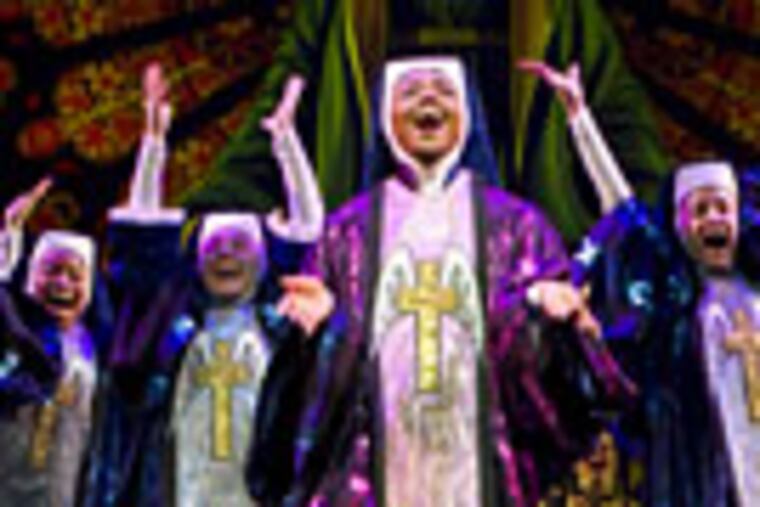
NEW YORK - Alan Menken's the guy who did it. The man who gave us the tunes from The Little Mermaid, Beauty and the Beast, Pocahontas, Aladdin, Little Shop of Horrors, and others - he did it. "Blame it on me," Menken says. "I love Philadelphia."
So when he took on the major project of composing the score for the new Broadway musical Sister Act - adapted from Whoopi Goldberg's two movies of the same name, and produced on stage in part by Goldberg - Menken began thinking "Philly sound."
He decided to take the nuns out of their original San Francisco setting in the 1992 film, and put them in Philadelphia - a city of fond memories for Menken, whose early work, The Apprenticeship of Duddy Kravitz, had a first run here.
The Philly sound, plus "the world of disco and all the great styles of the '70s, felt perfect, and they never fueled an original musical before. So it seemed there was a rich trove of fun we could have," Menken says in a phone conversation from his home outside New York.
That's the general opinion of Tony nominators, who this month made Sister Act one of four contenders for best musical of the season (winners will be announced June 12). Broadway critics also had a generally good time at Sister Act, which opened April 20 at the Broadway Theatre with Patina Miller as Deloris Van Cartier, a Philly club singer who sees her sugar daddy commit murder and is then hidden by Philadelphia police in a convent somewhere near Pat's and Geno's.
There, she fits in like - well, like a nightclub singer in a convent, until she takes over the choir and starts pulling in the crowds on Sunday mornings. Even the stern mother superior (Goldberg for a time in the London precursor to the Broadway version, and The Light in the Piazza's Victoria Clark on Broadway) is reluctantly converted to Deloris' side.
But one guy's been on her side for a long time - the Philadelphia officer in charge of Deloris' cloistered safety. Played by Chester Gregory, he's coincidentally known her ever since he was too shy to really approach her in high school (doesn't that fateful high school connection sound just like Philadelphia?) and now, all grown up, he still wishes "I Could Be That Guy," the cool song he sings.
In order to turn the tunes to a '70s Philadelphia style, Menken and lyricist Glenn Slater did a lot of listening to the music of the era, much of it from Menken's own record collection. The show's original production opened at Pasadena Playhouse in 2006, the beginning of an evolutionary journey that took it to Atlanta (2007), then the Palladium in London (2009), and finally last month to Broadway.
Between London and New York, the producers decided that Sister Act was not quite there yet - not for an American audience, in any case. That's when the show took a bigger leap into Philadelphia, with the hiring of playwright Douglas Carter Beane.
Beane, who wrote the hilarious The Little Dog Laughed, which ran on Broadway a few seasons back, and the book to the Broadway musical Xanadu, also wrote a play called Music From a Sparkling Planet, whose heroine, Tamara Tomorrow, is modeled loosely on Philly TV's Sally Starr.
He spent his teen years around Reading, sneaking into Philly by train on weekends in the mid '70s. He'd hit the clubs - the trendy Second Story at 12th and Walnut, the Black Banana at Third and Race, or West Philly's the Crypt. He saw Patti LaBelle and Teddy Pendergrass and soaked up Philly music.
"It was a remarkable time," he said over a cheesesteak in an East Village joint called 99 Miles to Philly, which serves them up the real way, wit or witout. "It was a little bubble of wonder, my entire misspent youth." When director Jerry Zaks called him about refining the musical's book, Beane recalls, "he said, 'They moved it to Philadelphia in the '70s.' I said, "That's weird - I spent a lot of time in Philadelphia in the '70s"
As it turned out, Beane had no time to get back to Philadelphia, though it's just a hop from his Manhattan home. But he signed on to doctor the script anyway - and proceeded to rewrite the show that husband-and-wife team Cheri and Bill Steinkellner had scripted, handing in his preliminary effort in a month.
He continued refining, and a month later the cast did a first read-through. A month later, in January, came the second reading. Rehearsals began a week later.
Both Beane and Menken say the intense deadline made the collaboration work, with Zaks and Goldberg in on the rewrites, lyric changes, and constant tweaks. Indeed, the funny script, playful lyrics, and Menken's music with its '70s Philly soul twist all mesh for a galloping evening.
"I remember saying, 'It's got to feel like Philadelphia,' " Beane says. The original script "would just say we're in Philadelphia - it didn't have that Philadelphia feel.
"The minute I heard the score I said, 'I know that music! I get it!' " Beane says. He decided to model the parish on St. Monica's at 17th and Ritner Streets, where he'd gone with Philadelphia friends a few times. (He was raised Methodist.) He jumped onto Google to confirm place names and ideas he had about the time, and Sister Act drops its Philly markers throughout - Wawa is in the script, and so are Larry Kane and others (including a fictional Inquirer critic's pullout quote about the nuns' choral performances).
At one point, Beane says, Zaks noted that a line about blocking off Porter Street for a papal visit didn't work because the name was tough to discern in the sentence. Beane offered three others, and now the street is Arch.
Though it was a quick job, he says, "in some ways, I did live with it forever because I was carrying the memories of the clubs, the music and the town."
Of the whirlwind that landed Sister Act on Broadway, Menken says, "We had many, many moments in the last six months where it was 'Oh, no! Oh, no! Oh, no!' and then 'Oh, yes! That's going to work!' That's the joy of collaboration."
'Sister Act'