Making it work
Alice Ripley is in town, reprising her Tony-winning role in "Next to Normal," a musical with a theme that's anything but normal: Mental illness.
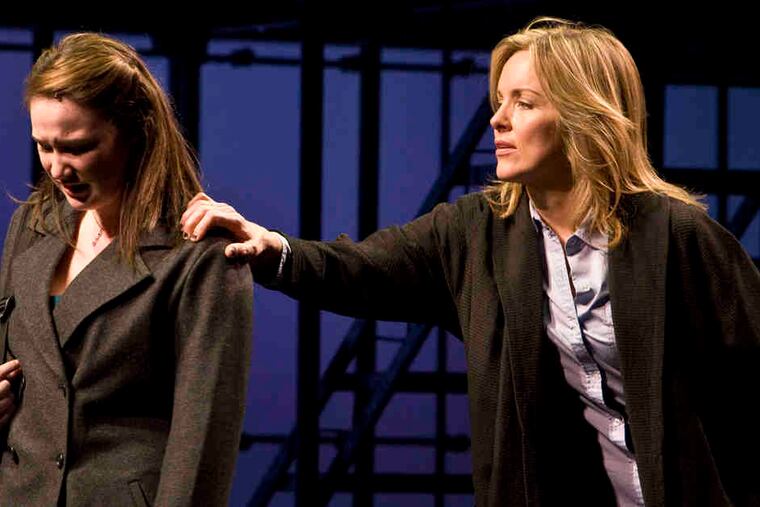
It took some time before Brian Yorkey figured out exactly what mental condition would plague his leading lady. Yet even before the librettist/lyricist had paired the symptoms with a diagnosis, he and composer Tom Kitt knew who they wanted to play the tricky role: Alice Ripley.
Years passed and incarnations of their rock musical Next to Normal (originally titled Feeling Electric) came and went. But Ripley was never available - until she was.
When the show began workshops at Second Stage Theatre in 2006, Ripley was finally free to play Diana Goodman, whose bipolar disorder wreaks havoc on her household. It - and Ripley - ultimately went to Broadway, and this week, she stars in the touring production at the Academy of Music.
"Literally from the first day she came in and started working on the material, we all sort of looked at each other and went, 'Oh well, there we go. There it is,' " Yorkey said in a phone interview. "Our suspicions all those years ago had been correct - she was the person to play Diana. She owned the part. It was hers, and she was, in a way, as much of a creator as we were."
Diana is by nature mercurial, but the actress who plays her must possess considerable physical and vocal endurance, as she rarely leaves the stage. Ripley has all that, as well as carefully considered thoughts about playing someone who is mentally ill.
Over the phone she explained, "I don't see Diana as having anything wrong with her. I have to see it that way in order to play her because she doesn't think there's anything wrong with her."
Refusing to label her character's behavior abnormal has paid off, with critics praising her performance as "other and dangerous" and "bold and raw." In 2009, she received the Tony Award for best actress in a musical; the show won the Pulitzer Prize for drama.
Ripley previously had been nominated, along with Emily Skinner, for a Tony in 1998 for their portrayal of conjoined twins in Side Show. While not a commercial success, the show amassed a cult following and helped to ignite Ripley's musical-theater career.
"It just so happens that I've ended up in some unusual shows with insights from unusual characters," she said. She was initially hesitant to audition for Side Show, but she soon discovered that it was written not as a freak show, but a love story. "I see the Goodman story as a love story, too. Self love, because that's what Next to Normal is about."
What it's also about is unresolved grief and miscommunication, denial and repression. And just as Ripley is challenged to run headlong into these themes eight times a week, Yorkey struggled, in a different sense, to write about them.
The musical began as a 10-minute scene by him and Kitt that was showcased at the 1998 BMI Lehman Engel Musical Theatre Workshop, inspired by a segment on electroshock therapy Yorkey had seen on television.
"When we started writing it, we were in our mid-20s and we were writing about everything. Growing older, and hearing story after story from people who really went through these things, you start to realize that answers aren't actually that easy," said Yorkey, who recently was a script doctor for Broadway's Catch Me If You Can and is now reuniting with Kitt to write a movie musical to be produced by Warner Bros.
Next to Normal went from being a comment on the failings of the medical establishment to treat mental illness to a probing, throbbing story about heartbreak in a household of four with Ripley's Diana at its center.
"She very quickly internalized Diana and expressed her to a degree that could be our guide," said Yorkey. The team would try out new material on Ripley, and the feeling was that if she could make it work, then it worked.
They were also careful to avoid stereotypes, something psychologist Nancy Elman - who knew Yorkey and was asked by the team to offer her professional opinion on the script - picked up on immediately.
"I think part of what's so appealing about this show is that it points out people's problems and how they get stuck, but there's empathy for each one of them," said Elman, a retired University of Pittsburgh professor who now has a private practice focusing mainly on couples therapy.
When Next to Normal received a regional-theater production by Washington's Arena Stage in 2008, Elman went to see it and observe audience reaction. She then helped Kitt and Yorkey rework some specific aspects of the plot, one being the ending, which she found too tidy and optimistic. It needed to be more ambivalent, she thought, and the company agreed.
The creative team made these sorts of tweaks to the script and the score all the way up to the musical's opening on Broadway in April 2009. Since the national tour began last November, Kitt, Yorkey, or director Michael Greif tries to check in with the production in each city.
"I try to hug her really hard every time I see her," said Yorkey of Ripley. "Certainly as authors we're asking a lot of people like Alice because they're really taking us to some very dark and difficult places. It's an amazing thing, and I can't imagine the toll it takes on her psyche, let alone her stamina."
In order to conserve energy for her hours on stage, Ripley says she doesn't socialize much, instead keeping company with a blank canvas or her guitar. On her album Daily Practice, Volume 1, released earlier this year, she sounds like she's singing for an audience of none, offering up a raw compilation of cover songs that have both grounded and inspired her since her teenage years in Ohio. (Harking back to early childhood, when she lived in West Chester, she says she's thinking of filming her next music video at the Liberty Bell, or perhaps on the street where she once rode her bike.)
For now, it's all about playing Diana, transfixing the audience and then transforming them.
Said Yorkey, "I think the real challenge that we have in common - Alice and I - is the challenge to not let things go by that are almost true, but to keep going until we get to the things that are actually true."