An agonizing fall and every single detail of it
The narrator of True Things About Me is on a downward spiral, and she's moving fast. Her harrowing story begins at her dreary job, where she sits at a window processing some kind of claims. She tells us each small thing she does with such hard-eyed accuracy that when she has sex with a man in the parking garage a few minutes after meeting him (and just a few pages into the book) it's shocking but it feels sort of - inevitable.
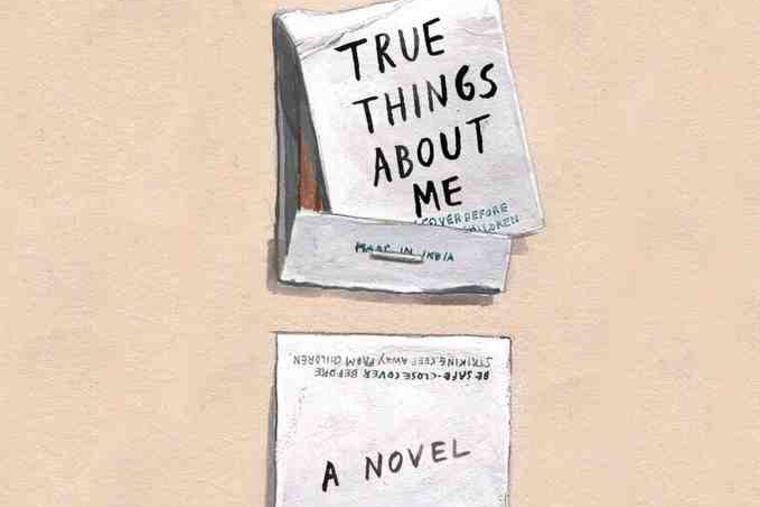
By Deborah Kay Davies
Faber and Faber. 224 pp. $14
nolead ends nolead begins
Reviewed by Katie Haegele
The narrator of
True Things About Me
is on a downward spiral, and she's moving fast.
Her harrowing story begins at her dreary job, where she sits at a window processing some kind of claims. She tells us each small thing she does with such hard-eyed accuracy that when she has sex with a man in the parking garage a few minutes after meeting him (and just a few pages into the book) it's shocking but it feels sort of - inevitable.
The novel is never about anything but the obsession that follows this encounter. We don't learn what kind of job the woman has or why the man had to go there, though we suspect it's a legal proceeding of some kind and he's on the wrong side of it.
We never even learn her name, or his. We just get pulled and bumped along behind our heroine as she plunges down a rabbit hole, and things with her new lover grow ever more twisted. Over the course of a slim 200 pages or so the guy steals from her, takes her car for several days at a time, abandons her in strange places, and comes and goes from her house as he pleases, sometimes returning with friends who use the house for a party. He hurts and humiliates, even tortures her, and the worse it gets, the more devoted she feels.
At this point you might be imagining the novel as a titillating-yet-cautionary, girls-be-careful kind of story, something like a made-for-TV movie. It's not. The sex isn't very sexy - it's more worrying than anything - and while the relationship the reader forms with the woman is one of intense identification, it isn't girlfriendy. We're right there with her, that's all, breathing the fusty air of her claustrophobic obsession, and she's really only relatable because her creator has such keen eye for detail. The typical reader hasn't gone through the pain that produced Sylvia Plath's Ariel poems, but everyone can feel the heat from the fire that forged them.
True Things moves on a swift current of short, hard sentences, which in turn are arranged into the brief chapters of a conceit-structure that could have been corny but is tidy and effective: the first-person "true things" of the title. "I talk to the animals," one chapter is called. "I feel empty sometimes" is another. She makes these bald statements about herself, chronicling her own undoing as though she were watching herself from the outside. In fact, that's sometimes precisely what she does:
. . . after messing about in front of the dreaded mirror for half an hour I was unhappy with my make-up. My eyebrows looked like two wrong words someone had tried to scribble over with a black felt-tip pen. One was higher than the other, which made me look like a joke chef in a cartoon. ... I washed it all off and started again. ... When I'd finished it looked as if I weren't wearing any. But not in a good way. My blank canvas was still blank.
At other points, she describes feeling disconnected from herself, even disembodied, floating like a balloon above her own head. Anyone who has experienced a profound trauma or dissociative episode will recognize these as not mere poetry but descriptions of almost clinical accuracy.
Many items on the list, though, are jokes, woeful understatements of the mess her life has become. "I provide bed and breakfast" is the droll title of the chapter about the day the man, who now terrifies her, refuses to leave her bed.
Happy to report: This book is funny. In its treatment of sexual obsession it is reminiscent of Rod Liddle's darkly comic short-story collection Too Beautiful for You, but it doesn't splash out with as much hilarity and showmanship. The mood here is bleaker, quieter, though it is buoyed by humor and an occasional nice, human moment. On a visit to her parents she walks into the garden with her father.
We sat on a garden bench and I ran my fingers through the swaying plant. I told my dad it felt like ropy, damp hair. Almost like a mermaid's. He had a feel. You're right, it does, he said. I could always tell my father things like that, when we were on our own.
In this way Davies, a British writer whose debut short-story collection won the 2009 Wales Book of the Year Award, situates the story in an interesting space between dreamily fantastic and wholly realistic.
Since her story is anchored with all the weight of real life - a job she could lose if she doesn't get it together, fretful aging parents, ordinary trips to the grocery store - the cinematically outrageous things she does with this man actually feel quite possible. And that might be the scariest idea of all.