Acupuncture's value criticized despite its widespread use
In May 2005, it seemed like an intriguing match. The University of Pennsylvania School of Medicine announced a partnership with the Tai Sophia Institute, a center for complementary and alternative medicine based in Laurel, Md.
In May 2005, it seemed like an intriguing match.
The University of Pennsylvania School of Medicine announced a partnership with the Tai Sophia Institute, a center for complementary and alternative medicine based in Laurel, Md.
The collaboration sought to combine Penn's expertise in traditional, evidence-based Western medicine with Tai Sophia's strengths in non-Western therapies such as acupuncture.
But resistance on the Penn campus was fierce. Neal Nathanson, a Penn epidemiologist who echoed the views of many, called the collaboration "a return to voodoo medicine" and said in a recent interview that it "put us in bed with an outfit that we didn't support in terms of the principles."
By the following year, the collaboration had died of nonrenewal. A Penn spokeswoman said the partnership "was superseded by Penn Medicine integrating complementary and alternative medicine into the medical school curriculum and patient care." And that includes acupuncture.
Nathanson does not dismiss all alternative medicine as worthless, and notes that Penn does research in acupuncture. He said he had a bigger problem with Tai Sophia programs in areas such as aromatherapy, which uses aromatic oils.
But the reception given Tai Sophia - the first school in the United States to offer an accredited program in acupuncture - is symbolic of acupuncture's place in American medicine: widely used but not fully accepted.
Many patients swear by it. Three million Americans used it in 2007, according to the federal National Health Interview Survey. Some physicians practice it, and others recommend it to their patients.
There are substantially more than 100 acupuncturists in the Philadelphia region, and its first accredited school, at the Won Institute of Graduate Studies in Glenside, will graduate its fourth class, with 12 students, on Thursday. Twice as many are expected to begin the new class this month, paying $51,000 for the full three years of training.
But critics such as Stephen Barrett, the retired Chapel Hill, N.C., psychiatrist who administers Quackwatch, a website dedicated to exposing fraudulent or useless therapies and drugs, continue to attack acupuncture - indeed, all complementary medicine - as essentially nonsense.
While some patients may seem to improve with acupuncture, Barrett argues, this is either an example of the placebo effect or something that may well have happened anyway.
Acceptance of acupuncture by the medical community is not purely an academic issue. There is big money involved. Medicare and Medicaid don't cover it, and most private insurance plans don't either. Some group plans under Independence Blue Cross, the region's largest health insurer, reimburse part of the cost in certain circumstances.
A 2007 survey by the National Institutes of Health (NIH) showed that Americans spent nearly $12 billion out of pocket on visits to alternative-medicine practitioners such as acupuncturists, chiropractors, and massage therapists.
Some people clearly are substituting alternative treatment - a broad and hard-to-define category - for mainstream therapies, but many others use both, often for very different reasons. Alternative practitioners often say that the medical profession does not understand what they do.
Acupuncturist Ed Cunningham cites a time he was treating a patient for back pain, placing the metal needles in locations first mapped out centuries ago. (The earliest written records of acupuncture date back to China around 200 B.C.)
"Then he started complaining about groin pain," Cunningham recalls. "I turned him over and realized he had what were almost certainly cancerous nodules. I told him, 'You need to go to a doctor tomorrow. Not next week, tomorrow.' "
Cunningham is clinical director at the Won Institute. And the incident reflects one of the school's basic philosophies: Treat where acupuncture can be effective, know where it can't, and work along with traditional Western medicine.
"I treat people with cancer, but I make it very clear I'm not treating them for cancer," says Cunningham, a former critical-care nurse. "I'm treating them for the effects of chemotherapy and radiation. It helps them tolerate more aggressive treatments."
At Won, the only Pennsylvania program among the 58 schools in the United States that are accredited by the Greenbelt, Md.-based Accreditation Commission for Acupuncture and Oriental Medicine, entering students must have college-level credits in biology, chemistry, and physics. The national licensure examination has a lengthy module on Western medicine.
Recent students have included a French history major, an artist, a carpenter, chiropractors, a veterinarian, and a nurse-anesthetist. Some Won graduates have migrated from more conventional professions because of personal experience.
Lester Rolf, 70, a veterinarian who took care of research animals at the University of Pennsylvania, credits acupuncture with relieving his asthma. When he retired from Penn in 2008, he entered Won, "where I watched people feeling better and doing better and reducing their medications." He is now preparing for the exam.
But while accreditation and state licensing may elevate the status of acupuncture, they don't get it over the last barrier of acceptance in the United States: Research that proves its effectiveness by Western, evidence-based standards.
In China, where acupuncture has been most widely practiced, "they don't have the same standards of research. They don't do good control studies," says Mary Ellen Scheckenbach, acupuncture chair at Won.
One strong supporter of acupuncture, psychiatrist James S. Gordon, says that part of the problem with acupuncture is that "people oversell it." For example, he does not recommend that patients go to an acupuncturist for diagnosis of an ailment unless all traditional avenues have failed.
Gordon, who heads the Center for Mind-Body Medicine in Washington, uses acupuncture for stress relief on virtually all his patients but says "there's no definitive research that shows that it's effective, except for pain issues and addiction recovery."
The NIH's National Center for Complementary and Alternative Medicine, which is supporting dozens of studies of acupuncture, puts it this way on its website: While research on the specific effects of acupuncture have been inconclusive, "the observation of substantial pain relief in effectiveness-design studies cannot be dismissed."
"It's hard to study," Gordon says, "but that doesn't mean we shouldn't try. Have the Chinese been lying to themselves for 4,000 years or is there something there?"
Jun Mao, a physician and acupuncturist at Penn, is one of dozens of researchers around the country who are trying.
Starting this fall, he will head a three-year, NIH-funded study intended to find out whether acupuncture can help breast-cancer survivors tolerate drugs that can cause severe joint pain. One-third of the 75 participants will get acupuncture, one-third will get "sham" acupuncture, in which needles are essentially put in the wrong places, and one-third will receive conventional care, including exercise and over-the-counter pain medication.
"Our goal is to manage their symptoms so they can stay on the drugs," Mao said.
Other recent research has used brain-imaging techniques and explored chemical changes in the body triggered by acupuncture. Studies have included the use of acupuncture to increase fertility for women undergoing in vitro fertilization.
Still, acupuncture is more difficult to study than, say, drugs, because its effectiveness may depend heavily on the individual practitioner's skill.
"It's the same problem with physical therapy or massage," says Lixing Lao, who heads the Traditional Chinese Medicine Research Program at the University of Maryland School of Medicine.
"Some critics will never be happy," says Lynnae Schwartz, a pediatric anesthesiologist at Children's Hospital of Philadelphia who regularly uses acupuncture. "I'm most concerned with building a relationship to the patient, and I'm bringing more than a needle."
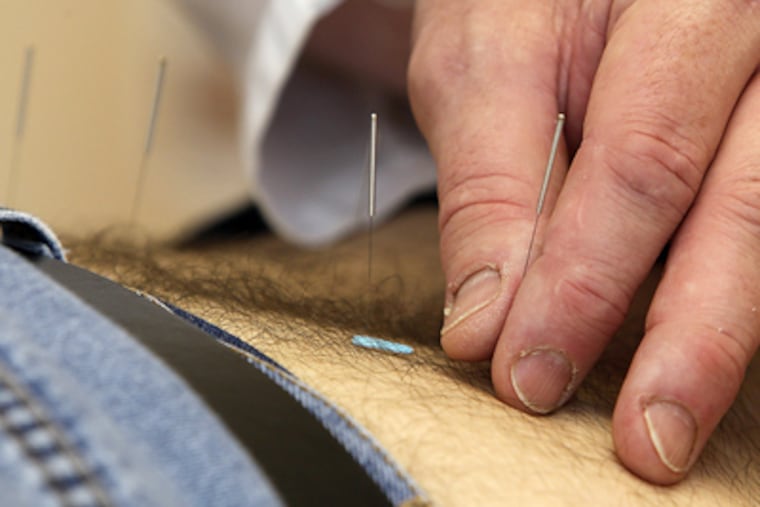
Ed Cunningham demonstrates acupuncture at
the Won Institute in Glenside: www.philly.com/
acupuncture EndText