A century of classical eminence
A little more than two weeks ago, Ralph Berkowitz was playing, alone and for his own pleasure, Schubert's Piano Sonata in A, D. 959.
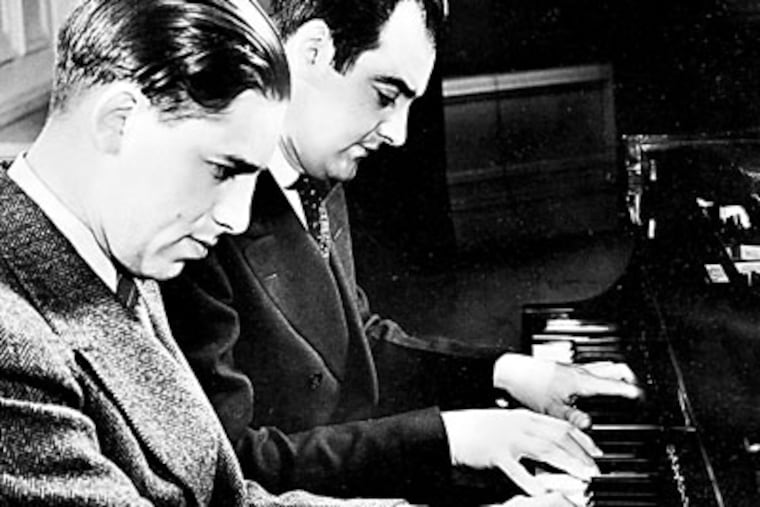
A little more than two weeks ago, Ralph Berkowitz was playing, alone and for his own pleasure, Schubert's Piano Sonata in A, D. 959.
But for decades, he made his mark as a deft collaborator to some of the 20th century's most notable musicians. He accompanied legendary cellist Gregor Piatigorsky for 30 years in concerts and recordings, and performed with tenor Jan Peerce, violinists Isaac Stern and Miriam Fried, and cellists Leonard Rose, Felix Salmond, and Raya Garbousova.
And when Eleanor Roosevelt was engaged to narrate Peter and the Wolf at Tanglewood - where Mr. Berkowitz was assistant to conductor Serge Koussevitzky and, between 1951 and 1962, was Tanglewood's dean - he became her coach, marking a piano score with colored pencil so Roosevelt would know when to come in.
After a busy career that ended with his last public performance in 2000, Mr. Berkowitz, 100, died Aug. 2 in Albuquerque, N.M.
In 1928 he became an early enrollee at a new Philadelphia conservatory when director Josef Hofmann accepted him as a student at the Curtis Institute of Music. With music theory already under his belt from what would become the Juilliard School, Mr. Berkowitz earned an accompanying degree from Curtis. After graduation in 1935, he taught at the school from 1937 until 1943. Later, he made a substantial gift to Curtis that named the Freda Pastor Berkowitz Studio in honor of his first wife, who was also an alumna, and established the Ralph Berkowitz Fellowship for pianists.
After Curtis, he became a central figure at Tanglewood, working with faculty members Leonard Bernstein, Aaron Copland, Darius Milhaud, and Paul Hindemith.
Though he did not have a first-tier solo piano career, Mr. Berkowitz had a reputation as a solid and polished musician.
When Piatigorsky canceled a Tanglewood concert, the cellist was replaced by a group of musicians in various Beethoven chamber works - with Mr. Berkowitz accompanying them all.
"In the end . . . it proved to be Mr. Berkowitz' evening," wrote a reviewer in the New York Times of the August 1955 concert. "By redeeming an awkward situation and by playing with consistently thoughtful musicianship, he deserved to make it so."
In 1946, Mr. Berkowitz traveled to New Mexico to perform in the June Music Festival; he returned every year, and in 1958 he moved there. From 1958-70, he was manager of the Albuquerque (later called the New Mexico) Symphony Orchestra, with which he frequently performed as soloist.
As a centenarian whose dates spanned classical music's most varied and rapidly evolving century, Mr. Berkowitz witnessed some pivotal musical events. He attended the first performance of Bartok's Concerto for Orchestra; the premiere of Gershwin's Concerto in F with Gershwin as soloist; Rachmaninoff's Rhapsody on a Theme of Paganini; and the U.S. premiere of Berg's Wozzeck (presented by the Philadelphia Grand Opera Company, led by Leopold Stokowski).
Born in New York in 1910 to Romanian parents, Mr. Berkowitz showed a strong polymathic streak throughout his life, lecturing on music, literature, and art. He was an active visual artist - he studied at the Barnes Foundation for three years - who worked in paint, pastels, and woodcuts. For a TV station in Albuquerque, he produced a show called The Arts. He was also an arranger and composer. A Telephone Call for singer and orchestra, based on the Dorothy Parker short story, was programmed on a concert in Brazil, though in an interview Mr. Berkowitz said he never heard the work performed.
After his divorce from Freda Pastor Berkowitz, he married Beth Hodgson Berkowitz. Two daughters and several grandchildren and great-grandchildren survive him. A memorial will be held on what would have been his 101st birthday, Sept. 5, at 10 a.m., in the recital hall of Robertson & Sons Violins in Albuquerque.