Deeper perspectives on Afghanistan, 'long war'
Four new books counter some prevailing conclusions.
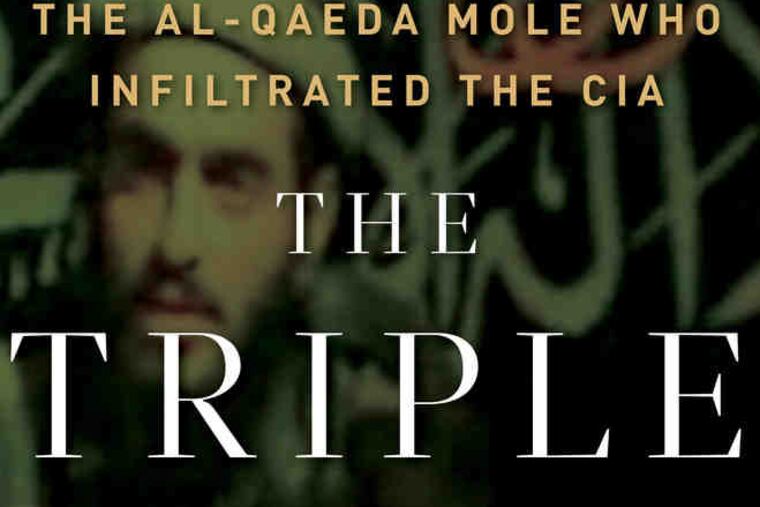
The Al-Qaeda Mole Who Infiltrated the CIA
By Joby Warrick
Doubleday. 244 pp. $26.95
nolead ends nolead begins Counterstrike
nolead ends nolead begins The Untold Story of America's Secret Campaign Against
Al Qaeda
nolead ends nolead begins By Eric Schmitt and Thom Shanker
Henry Holt. 320 pp. $26
nolead ends nolead begins Taliban
nolead ends nolead begins The Unknown Enemy
nolead ends nolead begins By James Fergusson
Da Capo Press.
416 pp. $27.50
nolead ends nolead begins The Wars of Afghanistan
nolead ends nolead begins Messianic Terrorism, Tribal Conflicts, and the Failures of Great Powers
nolead ends nolead begins By Peter Tomsen
PublicAffairs. 849 pp. $39.99
nolead ends nolead begins
Reviewed by Robert D. Crews
How much longer will the United States be at war? Many celebrated the killing of Osama bin Laden, a decade after the attacks of 9/11, thinking that it signaled a victorious conclusion.
For the Obama administration, however, this was not the end. The president had long since abandoned George W. Bush's "global war on terror" language. Yet his campaign against "violent extremism" has dramatically widened the geographic reach of U.S. firepower.
Months after dumping bin Laden's body in the Arabian Sea, U.S. forces have remained at war not only in Iraq, Afghanistan, and Pakistan, but also in Yemen, Somalia, and Libya, where NATO pledged to protect civilians and deny terrorists another base. Still, on July 9, Defense Secretary Leon Panetta proclaimed the United States was close to "strategically defeating al-Qaeda."
So is peace at hand? Officials have leaked reports that intelligence found at bin Laden's compound in Abbottabad, Pakistan, promises to turn the tide. But we would be wise to consider instead the evidence presented in a batch of new books on al-Qaeda and Afghanistan.
In Counterstrike, Eric Schmitt and Thom Shanker, reporters for the New York Times, warn that another catastrophic terrorist attack is inevitable, but their behind-the-scenes account of the evolution of U.S. counterterrorism strategy gives officials the highest marks. Cast as a spy thriller, it profiles analysts who pushed after 9/11 for the transformation of a dysfunctional bureaucracy that one source likened to "a drunken octopus trying to solve a Rubik's Cube."
Already under Bush, officials recognized that they could not kill and capture every foe. Deterrence, a Cold War strategy, could be adapted for this new struggle. Intelligence could be exploited, enemy propaganda countered, and terrorism prevented by establishing forward bases in "inhospitable, barely governed places" such as Djibouti in the Horn of Africa. The Obama administration enthusiastically adopted these approaches, bringing them to bear, together with an upsurge of lethal drone attacks, against alleged al-Qaeda and Taliban fighters in Pakistan's Federally Administered Tribal Areas.
Counterstrike is a glowing portrayal of the American intelligence community, though the authors concede that it suffered a setback in 2009, when an al-Qaeda bomber killed seven CIA operatives in Khost, Afghanistan. This tragedy is the subject of The Triple Agent, by Joby Warrick, a correspondent for the Washington Post. It tells the story of a Jordanian, Humam Khalil al-Balawi, and the American spies who thought that they had recruited the "golden source," an al-Qaeda insider.
In 2008, Balawi's online rants praising the killing of Americans in Iraq had brought him to the attention of the United States. Washington pressed the Jordanians to arrest him in early 2009. Yet, within a few months, he was in Pakistan, having agreed to change sides and be on the CIA payroll. After he met Ayman al-Zawahri, the CIA arranged to meet the informant who could lead them to al-Qaeda's then "No. 2" leader. They invited him to their base at Khost, where a birthday cake awaited him. Immediately after arriving on Dec. 30, this unlikely killer - the father of two young girls, and a pediatrician who had cared for refugees - detonated a bomb, killing himself and his handlers.
Warrick has pieced together a fast-paced and compelling narrative that reads like a Hollywood screenplay. He provides a rare look at the careers and personal lives of CIA officers, including the courageous women who played key roles. But he offers little more than speculation about the suicide bomber, who is depicted as a bizarre religious fanatic.
In contrast, in both Counterstrike and The Triple Agent the agent on the American side is noble, gifted with "near photographic memory" and "rugged good looks and muscle." In implausible narratives that manage to be triumphalist while cataloging colossal failures, Americans are tough and witty, and although they have collaborated closely for years with Libyan, Egyptian, Saudi, and Yemeni police, their hands are clean.
More important, it is not merely a literary device that the villains are flat, one-dimensional characters. The authors follow their sources in displaying very little curiosity about the ideas that animate their foes. Like Obama's incoherent slogan targeting "extremism" (who decides what counts as "extreme"?), the persistence of explanatory frameworks that reduce complex motives to fatalism, ignorance, and fanaticism says far more about "us" then it does about "them."
Jihadist ideologies are, in fact, about much more than religion, as the Oxford historian Faisal Devji has shown. That they intersect with those of civil society groups and nongovernmental organizations concerned with issues ranging from development and human rights to the environment means that the "countermessaging" hailed by Schmitt and Shanker and their Pentagon informants amounts to little more than propaganda.
While the PR and consulting firms profit, it is unlikely that expensive campaigns that publicize al-Qaeda's killing of civilians will win over public opinion when the Americans and their allies also continue to be responsible for civilian deaths in multiple Muslim countries. The inability to engage seriously with ideas critical of American global power continues to fuel what many in Washington fatalistically call "the long war."
Peter Tomsen, a former U.S. envoy to "the Afghan resistance" from 1989 to 1992, reminds us in his sweeping history that the CIA has a miserable record in understanding the politics of the region. The Wars of Afghanistan is rich with details about his interactions with key players during this critical period.
After the Soviet withdrawal, the United States continued to oppose compromise with the last Afghan communist ruler, Mohammad Najibullah, and to arm the mujahideen, including figures who are now fighting Americans. Drawing on these lessons, Tomsen persuasively calls for wresting policy-making away from the Pentagon and spy agencies, and advocates U.N. mediation of an Afghan peace process.
Should Obama ever commit to such an undertaking, James Fergusson's Taliban might present a useful challenge to conventional wisdom. A Scottish journalist who has written extensively about Afghanistan, Fergusson contends that the Taliban have been misunderstood and that "they are capable of learning from their mistakes and of changing their minds." He underplays divisions in Afghan society about the return of the Taliban and recycles worn cliches about the Pashtun people - probably the most stereotyped and demonized ethnic group in the Western media today. But Fergusson's critique of the West's failures in Afghanistan is devastating, and his insightful conversations with Afghans, including Taliban members and their supporters, are very much worth reading.
Hearing their voices and constructing policies that accommodate their aspirations are the only viable options left. Night raids, drone attacks, assassinations, and the arming of tribal militias have sown chaos and resentment, even if they have sometimes achieved their intended aims.
All of these books highlight the limits of our knowledge about these societies. Neither technology nor propaganda can substitute for dialogue that produces more subtle understanding - and an end to "the long war."