Well Being: Passion for jujitsu brings Philadelphia partners together
Brian Rago and Zak Maxwell are martial artists and business partners. Together they teach Brazilian jujitsu at Gracie Academy Philadelphia, the school they operate at the Optimal Gym in Queen Village.
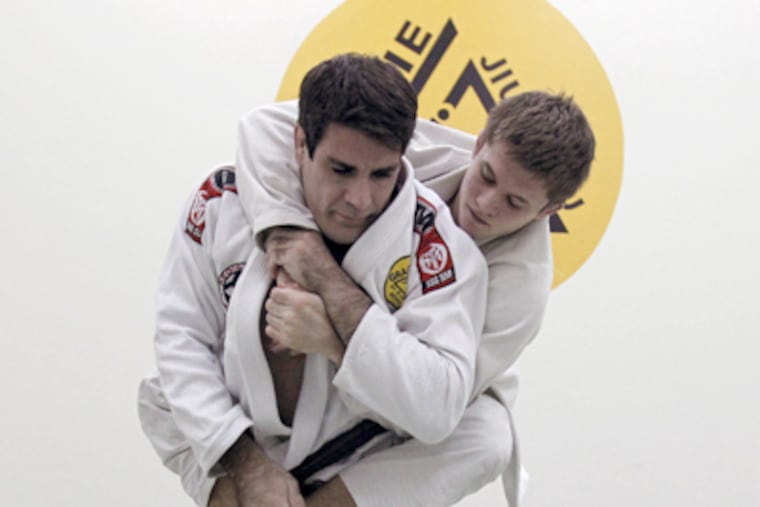
Brian Rago and Zak Maxwell are martial artists and business partners. Together they teach Brazilian jujitsu at Gracie Academy Philadelphia, the school they operate at the Optimal Gym in Queen Village.
Both have earned black belts in this physical and mental discipline, which combines the aggression of street-fighting and wrestling with the grace of ballet. Both are disciples of the style of jujitsu popularized by the legendary Gracie family of Brazil. And both have competed and succeeded in international competition.
Last month, Rago won five straight matches to capture the age-group title in the black belt division at the world masters championships in Rio de Janeiro, repeating what he achieved when he wore purple and brown belts.
"He's really good," Maxwell says of Rago, "and he definitely proved it."
For his part, Maxwell has won titles in five pan-American jujitsu contests at levels below black belt. Last spring, he qualified in Las Vegas for the World Professional Jujitsu Championship in Abu Dhabi, a feat in itself.
The two men differ in age (Rago is 39; Maxwell, 22), and personality (Rago is articulate and cerebral; Maxwell, laconic and intuitive), and they came to the sport in different ways.
Rago, who grew up in Chatsworth in the Pine Barrens of South Jersey, participated in a variety of conventional sports as a youth, but channeled most of his ambition into playing the guitar. At Temple University, he was a classical-guitar performance major, and he didn't begin learning Brazilian jujitsu until he was 33, unusually late for the acquisition of muscle memory.
After shoulder surgery, he was eager to re-form his body. "Do I go to the gym and do something tedious and boring," he asked himself, "or do I do something I always wanted to do?" That "something" was jujitsu.
Maxwell's grasp of jujitsu is virtually genetic. Both his father and mother are black belts, and Maxwell began "messing around" with the sport when he was 5. In his teens, he got serious about jujitsu under the tutelage of Regis (pronounced HAY-jiss) Lebre, a Royler Gracie protege who began coaching at the former Center City gym of Zak's parents.
"I was lazy," Maxwell admits. "He got me moving."
After college, Rago taught classical guitar for a few years at local private schools. Then, in his mid-20s, he launched Axiom Data Corp., which does market research and data analysis for pharmaceutical companies. The business flourished to such an extent that Rago today can afford to pursue his passion.
"I took to it because it's a very technical, intellectual discipline, not simply physical and athletic," Rago says. "I found it to be remarkably similar to playing classical guitar. You're using basic physics, leverage, and body mechanics to manipulate a foreign object. When playing the guitar, it's the instrument. In jujitsu, it's your opponent."
For Rago, jujitsu's appeal is threefold. It's a pleasant way to exercise; it builds confidence by imparting self-defense skills; and it fosters close contact and friendship with a diverse group of people bound by ties of respect and trust.
"It's simulated combat," Rago says, "but before and after we bow in respect. This is a reminder that in jujitsu we're not trying to hurt each other; we're trying to improve with each other."
Rago likens jujitsu to jazz; one begins by learning and practicing the basics. Then one improves and progresses by cooperating and collaborating with others - reacting and adapting to their riffs in jazz, reacting and adapting to their moves in jujitsu.
Rago speaks with the precision of a pedagogue, and jujitsu induces him to wax philosophical.
"We don't take what we want; we take what the opponent gives us," he says. "We take what is there; we don't insist on what is not."
Doing so causes too much stress, requires too much energy and strength.
"Being strong is nice, but you can't rely on it," Rago says. In jujitsu, the weaker, slower, smaller, and older often prevail over the stronger, faster, bigger, and younger by dint of superior knowledge and "mat wisdom."
Above all, the master of jujitsu is efficient, using strong body parts (leg, back, core, etc.), ideally in combination, against an opponent's weak body parts (wrist, elbow, shoulder, etc.), ideally isolated.
What makes Rago's recent victories so impressive is that he vanquished opponents who had achieved black belt status long before he first donned a gi, the kimonolike jacket and pants worn by practitioners of the sport.
For Maxwell, jujitsu entices for the same reason golf seduces. "You can never really master it," he says. The essential thrill is the pursuit of perfection through successive approximation. Becoming a black belt inspires more humility than pride. It merely certifies, Rago and Maxwell say, that you've reached a level where you know how much you don't know.