Seeking answers from some weird science
Water Bears in Space. This PuppeTyranny production, written and directed by Candra Kennedy (writer of the 2009 Fringe Fest hit Rails), may not be the strangest Fringe show I've ever seen, but it at least makes the top three. WBIS is based loosely (very loosely) on the 2008 TARDIS experiment, which asked, quite reasonably, "Why should we send dry aquatic invertebrates into space?"
Water Bears in Space.
This PuppeTyranny production, written and directed by Candra Kennedy (writer of the 2009 Fringe Fest hit
Rails
), may not be the strangest Fringe show I've ever seen, but it at least makes the top three.
WBIS
is based loosely (very loosely) on the 2008 TARDIS experiment, which asked, quite reasonably, "Why should we send dry aquatic invertebrates into space?"
Kennedy takes that question a few steps further, asking, "What if a trio of tardigrade - or water bear, or moss piglet - siblings set out on a quest to find their lost pet amoeba, and as part of a mad scientist's revenge plot, they ended up on a space shuttle with a more carnivorous variety of tardigrade, who also happens to have anger issues and some gender confusion?" What if, indeed.
If you've let your subscription to Scientific American lapse, tardigrades are microscopic organisms that live on moss, and can survive extreme desiccation and fluctuations in temperature. They were guests on the shuttle Endeavor's final flight and returned unharmed, but what really happened out there, you know?
Assisted by the four-piece live band Upholstery, a no-holds-barred, Bette Davis-inspired performance by Kate Black-Regan as unhinged, unthumbed Dr. Felicia Hyde, and a team of seriously committed puppeteers - who wiggle those eight-legged, dryer-vent-hose-looking critters so charmingly that we forget they're probably made out of dryer vent hose - we learn the whole, horrible truth and, ultimately, a bit about ourselves. I swear.
Could the show lose about 15 minutes and survive? Sure. But then they wouldn't give out Moss Piglet Rum Punch at intermission, and you might also lose the bacteria chorus and human-size thumb dance. Some risks are just too great, even in the name of science, and especially in the name of weird science.
- Wendy Rosenfield
Live Arts Festival / Philly Fringe
Check our "Philly Stage" blog at www.philly.com/phillystage
for up-to-date reviews of
Live Arts and Fringe performances. For stories and other information about the 15th annual festival, go to www.philly.com/fringe.
The festival continues through Sept. 17
throughout Philadelphia.
Tickets: $10-$55;
some events are free. Information: 215-413-1318
or www.livearts-fringe.org. EndText
of Hope, 1125 S. Broad St.
Teach Your Children. The play achieves a rare, albeit minor, feat in theater: It presents a complex moral issue without moralizing.
Tom Tirney based his play on the case of 44-year-old Robert Hawkins, a popular Council Rock High School South teacher sentenced to prison for an affair with a 17-year-old female student (James Jackson and Melissa Connell play the lovers and seven other roles).
Tirney intended to examine texting and technology's effects on communication (he failed), and the first scenes blather in trite phrases and academic jargon. While computerized chalkboard animation invigorates the set, a constant stream of text messages clutters an otherwise straightforward, naturally unfolding narrative that frankly depicts rampant teen promiscuity and drug and alcohol use without blaming it.
Kaci Fannin's deft direction and the nuanced performances create an emotional landscape of subtle contours, discouraging quick judgments and revealing the issue's complexity. When student pursues teacher and neither suffers, whom do we blame or punish? Other teachers knew - were they duty-bound to stop the affair? The play's minor tragedy indicts parents who provided financial support, but eagerly pushed their daughter on an older man willing to help her navigate life's tougher questions.
That the play - and the real case - ends in a prosecutor's office settles nothing. Teach Your Children may force us along, but it forces us to think.
- Jim Rutter
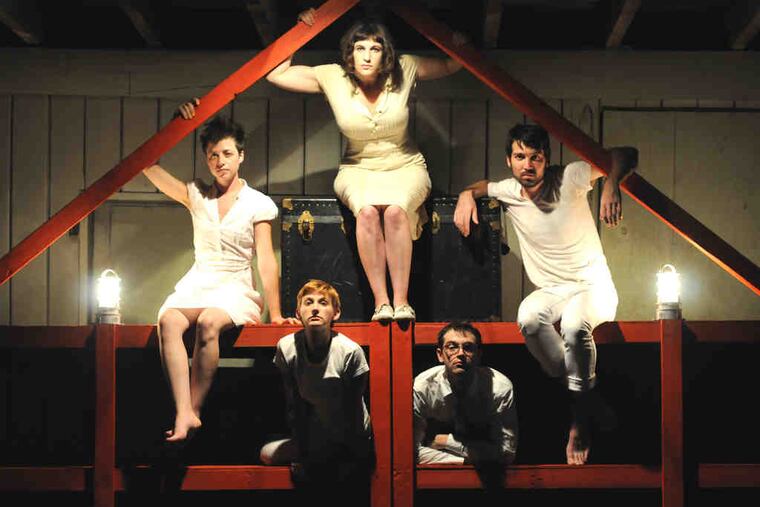
Overseers. Applied Mechanics' newest theatrical production-as-installation supports its mission statement, which also happens to be the definition of its parallel branch in the physical sciences: "Applied mechanics examines the response of bodies or systems of bodies to external forces." The ensemble's performers, stationed on platforms, stairs, in a trunk, inhabit a dystopian future in which those external forces stage a battle royal for humanity's health and well-being. Think Margaret Atwood meets The Prisoner (though the show's text draws on writers ranging from Emily Dickinson to Sun Tzu to Don DeLillo), and you're headed in the right direction.
While the actors - as a doctor, priest, bureaucratic functionary, revolutionary, and artist (all excellent, all co-creators of the piece, and all willing to have some fun while delivering their message) - respond to the growing threat of a disease infiltrating their "Sector," the audience must also respond.
Sometimes, you're invited to eat cake and drink gin, you move to another station as the action shifts, or occasionally, you simply need to get out of the way fast enough to avoid being stepped on by 2-foot-high stilts supporting Kristen Bailey's Pater B.
You choose your own adventure, with deft guidance by director Rebecca Wright, who brings up the volume of a discussion in one corner while softening another. Some clues slip past, but there's enough repetition and overlap to avoid frustration and thread together a coherent narrative.
Maria Shaplin's design contributes mightily to Overseers' unified otherworldliness: Cast members wear cultish, cream-colored, raw-linen jumpers; Mary Tuomanen's scientist sports elongated fingers and bustles with the no-nonsense, head-down demeanor of a woodland creature, analyzing slides from atop a wooden perch. There's a bit of style over substance here, but that style and the creative means by which it's delivered make this a Fringe pick well worth viewing and, of course, exploring.
- Wendy Rosenfield