Shivalingappa dances 4 solos
Namasya. The moment Shantala Shivalingappa appeared at the Brooklyn Academy of Music in Tanztheater Wuppertal's Bamboo Blues in 2008, the audience inhaled collectively, as if a floral scent had suddenly wafted onto the stage. It had.
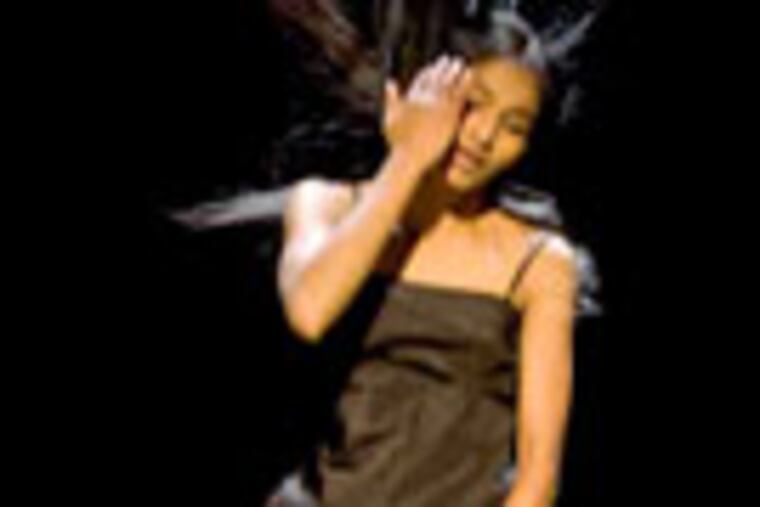
Namasya. The moment Shantala Shivalingappa appeared at the Brooklyn Academy of Music in Tanztheater Wuppertal's Bamboo Blues in 2008, the audience inhaled collectively, as if a floral scent had suddenly wafted onto the stage. It had.
It wasn't the first time Shivalingappa danced with Pina Bausch's company, but it was the first whiff we had. She appeared shorter, more adorably childlike, than the older, wiser Wupertallers. Sunday at the Arts Bank, she danced four solos looking anything but childlike. The evening, "Namasya," was an homage to teachers and mentors.
Bausch choreographed the second piece, Solo, for Shivalingappa. Her elegant legs, hidden under a bronzed ball gown, made wide-legged squats, spreading the skirt as she turned her thoroughbred profile to the audience, polished arms hovering in a straight line over her thighs.
Butoh master/Sankai Juku founder Ushio Amagatsu choreographed the first solo, Ibuki. In white pants and belly-baring vest, Shivalingappa splayed her curling fingers, resting her up-angled arms elbow over elbow. She began and ended on her side, propped up on one elbow as if floating lazily downstream on a raft.
In the middle of her own dance, Shift, she stalked about as if seeking another starting point. In Smarana by Savitry Nair, she sat, back to us, those shoulders carved like stone by Nicolas Boudier's lighting. Up and dancing, she crouched, turning in a tight circle to a thrumming sitar. All four dances had elements of the Kuchipundi form for which she is famous but were spare and modern.
- Merilyn Jackson
Live Arts Festival / Philly Fringe
Check our "Philly Stage" blog at www.philly.com/phillystage
for up-to-date reviews of
Live Arts and Fringe performances. For stories and other information about the 15th annual festival, go to www.philly.com/fringe.
The festival continues through Saturday throughout Philadelphia. Tickets: $10-$55; some events are free. Information: 215-413-1318
or www.livearts-fringe.org. EndText
The Wedding Consultant. This is the second Fringe appearance for Eric Singel's comic solo show, which visits same-sex marriage and the notion that "one wedding is just like another." Since its premiere in 2007, the states recognizing gay marriage have increased from one to six, and no doubt the number of wedding planners surged accordingly.
But the production, directed by Jose Aviles, is less about Singel's drag character Iris Holcombe, a party planner with innumerable prejudices, than about the moment when a tray of assorted clashing personalities gets served up at the ceremony. Party-boy groom Lance, classy groom Leslie, nice-guy best man Mike, Leslie's lesbian mom Rhonda, and Lance's mom Bobbi Sue (who thinks Leslie must be a real catch) offer up slices of their lives, and, as at any such event, some time is better spent than others. (Watching Lance pretend to be wasted is about as interesting as watching anyone pretend to be wasted.) But Mike, third-generation cop, first-generation gay cop, anchors things with surprising depth.
The others? Well, they're colorful, and Singel adds a maxim of his own: Be careful what you wish for. You might get it.
- Wendy Rosenfield
Canyon. The setup: John Jasperse creates works for top companies all over, but not in Philadelphia. Canyon would get its world premiere here, then move to the Brooklyn Academy of Music.
At Friday's opening, the Wilma was all open stage - no curtains or backdrop - with white flooring covering part of the blackness. Strips of neon-yellow tape were strewn on stage, walls, in the audience, looking like patterns on a computer chip. Before the show started, a large white box rolled around the stage, our introduction to Jasperse's exploration of disorientation and sensory overload.
Set to a modern, at times atonal, score by Rowe Hahn, Canyon seemed promising as six excellent dancers, including Jasperse, began running and leaping across the space. At one point they reacted to each other's movements as if connected by a string. A man lay on the ground, and the box rolled over him. But despite high-caliber dancing, it was difficult to discern much meaning. At 70 minutes, the piece dragged.
- Ellen Dunkel