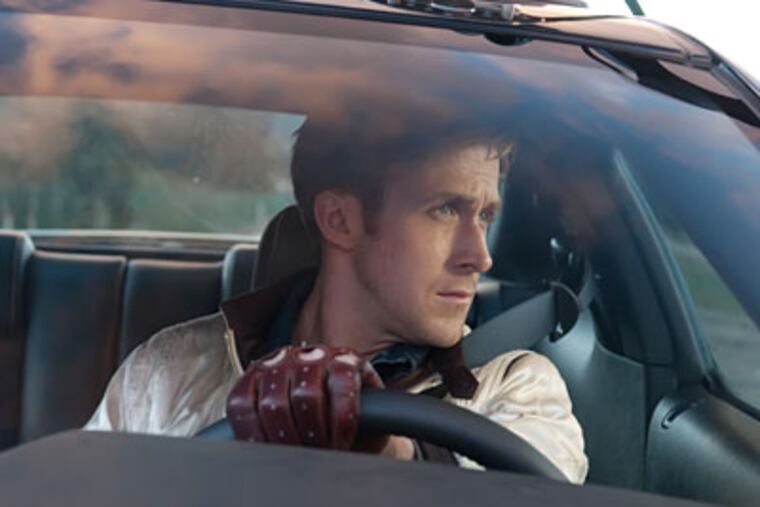
TORONTO - Albert Brooks became a father at 51 and a villain at 64.
He highly recommends both.
The Daily News spoke with the veteran multi-hyphenate (comedian/writer/director/actor) at the Toronto International Film Festival, where he jovially talked about his new movie, Danish director Nicolas Winding Refn's "Drive," in which Brooks plays a gangster who's 10 percent empathy and 90 percent ruthlessness.
It's a big change of pace for the longtime funnyman, who became famous as a stand-up comic, but has a long list of movie credits, including "Taxi Driver," "Broadcast News" and "Finding Nemo," plus his own written-and-directed movies such as "Modern Romance," "Lost In America" and "Defending Your Life."
Brooks knows what it takes to get a movie made and he was very impressed with Winding Refn.
"I love this guy," he said. "He does many, many, many takes, which some actors like, some don't. I do. He is very actor-friendly. And most importantly, he's got a style. If you're going to work for a director, you're going to want that director to have their act together, because one way or another, the ship goes down with the director. You can do great performances in movies that don't work but it doesn't do anything. You want the movie to work. He pulled out a real movie here.
"After I'd met him I watched his 'Pusher' series. He used these real drug dealers in Denmark . . . and by the third film they got so big they became actors."
Brooks acknowledged that would be an interesting way to fight criminals - to "make them all stars."
In Brooks' case, Winding Refn took a star and turned him into a criminal.
"The lure of the bad guy for me was to be able to play something unexpected and different," he said. "I'm an adult. I have a temper. I understand anger. But I don't write roles like that for myself. It's never occurred to me to kill Julie Haggerty - even though I wanted to. I knew I was capable of [being a bad guy], but someone had to put me in a movie to prove it."
Prove it he did. Brooks has been winning raves in Toronto for his performance as Bernie Rose.
Bernie is a nasty SOB, but he does have feelings, as when he offs a "Drive" character in a bloody but painless - almost sensitive - way.
"I liked the guy [I killed]," Brooks explained, "but he's going to be dead either way. My attitude was 'I can do it right now and it'll be a lot easier or go ahead, go to lunch and wait for the bullet to come crashing through the window.' It's compassion."
Brooks also touched upon a variety of other topics.
On star Ryan Gosling: "Everyone's there to service him. He and Nicholas, it's their movie. I loved him in 'Half Nelson,' when I didn't even know who he was, and last year, in 'Blue Valentine.' And I said to him, 'You'll be a superstar in spite of yourself.'
"But I admire him for that. He's doing what he wants to do. And any success he has it's going to be on his terms. But that's the only way you want success. You don't want to work for the devil."
On the inspiration he drew from co-bad guy Ron Perlman: "I got this great vibe hanging around with him of George and Lenny in 'Of Mice and Men' and that's what I was playing in my mind. It was a very good relationship to play for me."
On acting vs. directing vs. writing vs. stand-up: "It's a totally separate business. When I'm being directed I like being directed. I don't pretend to direct. I like them to have the overtime problems. I'll go back and sit and wait to be told what to do. I become a cow. If someone asks an opinion I'll give an opinion, but I have no desire to secretly direct unless I'm really directing. I can separate the jobs really well.
"Unlike Steven Spielberg, I never wanted as a kid to take a camera and want to be a director. But as soon as I started writing screenplays, I remember trying to find somebody to direct the first movie I wrote and they were established and a lovely person - and I kept saying, 'No, no, no, you can't do that.' So I became a director to service the writing. But I wanted to be an actor before I wanted to be anything. I went to Carnegie Mellon, I did summer stock for a number of years, I was serious about acting. It's just that the only jobs I could get as a young person were in comedy, because I could get on those national television shows doing comedy and I couldn't get parts in movies at 19 - so that's how I got into stand-up."
On making it in comedy solely as a stand-up today: "Most of the stand-ups today that I know, I know them because they're in movies or a television series. I'm sure there are names that sell out Tickle Me in Cincinnati, that don't do anything else. I'm sure there are prominent comedy club draws. But it seems to me that as they enter the mainstream, they're entering it as something else. In the heyday of Johnny Carson, you could enter just as that, because there were variety shows to work on and you could open in Vegas for Helen Reddy and make a great living."
On becoming a father late in life: "It's terrific. You get past the selfish years and you're able to devote your brain and your energy to it. If I became a father when I was still trying to baby my career, I would have never been home. I would have always been trying to keep the balls in the air. But if you do it late, that baby isn't crying as much.
"Plus, I forget how old I am. I'm playing Paul Rudd's father in Judd Apatow's next movie and I said to Judd, 'No one's going to believe that. Should I wear a gray wig?' And Judd said, 'No people will believe it.'
" 'No they won't,' I kept saying. 'No one's going to believe it.'
"And he said, 'Don't worry about it.'
" 'Should I limp?'
" 'No, it's OK.' "
On screenwriting: "I don't have a drawer of unproduced scripts but I do have a s-------- of ideas. Generally if I write a whole script, I'm going to try and get the money."
On having his tweets appear in the Philadelphia Daily News: "Tell your boss it's the best free job I've ever had.
"This is the new America."