Penn Museum offering a hands-on 'Imagine Africa' exhibition
Walk through one door at the Penn Museum this weekend and you'll feel as if you've strolled into a before-and-after advertisement.
Walk through one door at the Penn Museum this weekend and you'll feel as if you've strolled into a before-and-after advertisement.
Near the door is the museum's African exhibit - a cluster of tall glass cases filled when W. Wilson Goode was Philadelphia's mayor. About 350 artifacts are on display - a driblet of the museum's stash of 42,000 Egyptian objects and 20,000 objects from elsewhere in Africa.
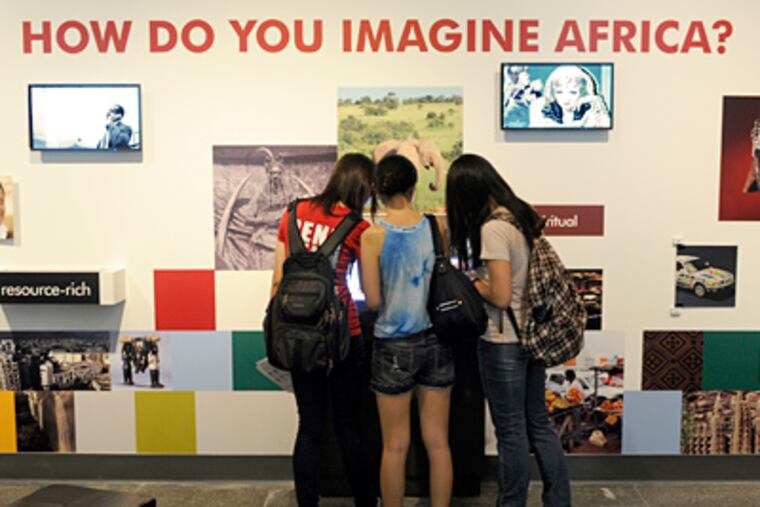
On the other side of the wall is the new "Imagine Africa" exhibit, stuffed into a corridor. It's colorful, loud, and hands-on.
Museum staffers hope it will become the first step in redesigning the African exhibit so that it answers visitors' questions about Africa and draws more residents, especially from neighboring West Philadelphia. Beginning this weekend, visitors are invited to leave notes, take computer surveys, and write on white boards exactly what they'd like to see in a redesigned African gallery. "Imagine Africa" is a yearlong community-engagement project that opens with a celebration.
The opening events Sunday afternoon include storytelling, crafts, a gallery tour, a lecture, and performances from the African Rhythms dancers and the singers and percussionists of the Women's Sekere Ensemble. The museum cafeteria will offer themed specialties, from Moroccan-spiced lentil soup to black-eyed pea fritters, during the opening.
A jukebox will offer African music from Hugh Masekela, who had a Billboard hit with "Grazing in the Grass"; Ladysmith Black Mambazo, a group that collaborated with Paul Simon on his Graceland album, and dozens of other contemporary artists.
There are eight "Imagine Africa" exhibits, scheduled to be open until Sept. 16 next year. A fashion display, which is designed to engage teens, traces the history of adornment in Africa from scarification to the beaded aprons worn by status-conscious wives of chieftains. A healing exhibit will focus on Penn's current medical projects in Botswana, including telemedicine.
One goal of the project at the University of Pennsylvania Museum of Archaeology and Anthropology is to increase the number of African American visitors to the facility in West Philadelphia, where 85 percent of residents are African American.
"We know we have a building that looks like a fortress," says Kate Quinn, director of exhibitions. "People who go by probably don't even realize they can come in. We want to say, 'This is your museum.' "
The museum formed an advisory panel to connect with West Philadelphia churches, schools, community centers, and business groups, said Jean Byrne, director of community engagement.
"We realized we couldn't just open the doors and expect everyone to come," Quinn says. "The whole idea behind this is to try to connect with the community, especially West Philadelphia, to find out what they would like to know about Africa. If we're getting a sense from the public that they really like this topic or that, we can go into it."
The museum has one of the largest collections of African objects in the United States, and the university has experts able to discuss most Afro-centric topics. The collection includes 980 objects from Morocco alone.
There are so many possibilities that museum staff want to be certain they choose those that will interest visitors. "You go into our storage and you say, 'Why isn't this on display - and this and this?' " Quinn says. "If we get direction on what people want to see, we can do so much more."
"Imagine Africa" events will be held throughout the year. The opening celebration will require regular admission tickets, but the museum and the "Imagine Africa" exhibit will be free on Oct. 26, March 28, and May 23 from 5:30 to 7:30 p.m. Local artists will entertain on those community nights. Visitors may also pay what they wish if they visit "Imagine Africa" before or after 6 p.m. lectures on Oct. 20, Nov. 30, Feb. 28, and April 18. For more information on the yearlong schedule, go to www.pennmuseum.
This year, a special "Imagine Africa" membership is available for less than the standard $95 household membership. "Imagine" memberships do not include free tickets to the "Maya 2012: Lords of Time" exhibition in May. "Imagine Africa" memberships are $45 for an adult plus all children under 18 in the household or $55 for two adults and all children under 18.
'Imagine Africa'
University of Pennsylvania Museum of Archaeology and Anthropology, 3260 South St. Open 10 a.m.-5 p.m. on Tuesday, Thursday-Sunday; 10 a.m.-8 p.m. Wednesday.
Opening celebration Sunday, 1-4 p.m.
1 p.m. Women's Sekere Ensemble performs (and again at 3 p.m.)
1:30 p.m. Pot-building demonstration; lecture; gallery tour
2 p.m. Storytelling
3:30 p.m. African Rhythms dance performance
Crafts all afternoon.
Exhibit is scheduled to close Sept. 16, 2012. Admission: $10, $7 for ages 65 and older, $6 for children ages 6-17 and full-time students with ID.
Public transportation: SEPTA's University City Station; Market-Frankford Subway Line at 34th Street Station; trolley routes 11, 13, 34, and 36; bus routes 12, 21, 30, 40, and 42.
Information: 215-898-4000, www.penn.museumEndText