Galleries: Life-size images and forms of everyday moments
Artworks that reproduce people and things at real-life scale have always found an appreciative audience. But the perfect copy finally may have lost its luster for artists, judging from the efforts of the 10 who make up the Print Center's exhibition "To Scale." Not only do few of these pieces aim for fool-the-eye precision, but also none shocks a vi
Artworks that reproduce people and things at real-life scale have always found an appreciative audience.
But the perfect copy finally may have lost its luster for artists, judging from the efforts of the 10 who make up the Print Center's exhibition "To Scale." Not only do few of these pieces aim for fool-the-eye precision, but also none shocks a viewer in the way that Duane Hanson's life-size facsimiles of everyday Americans did in their day, or boasts the iconic graphic power of Andy Warhol's Brillo box. These life-size images and forms generally seem born of a more personal quotidian moment or thought and an affection for things that usually go unnoticed.
Joseph Lupo's screenprints of his fastidiously drawn copies of credit-card-machine receipts and Gary Kachadourian's huge xerographic prints made from scale drawings come the closest to facsimiles in this exhibition, allowing viewers a glimpse of the artists' everyday surroundings and travels. The views of a begonia in Roy McMakin's photographs suggest human physical and emotional states through the plant's "postures." Talia Greene's prints of ants on inch-wide strips of fabric are sneaky and wonderful, and a reminder that "to scale" can be tiny and still be extremely effective.
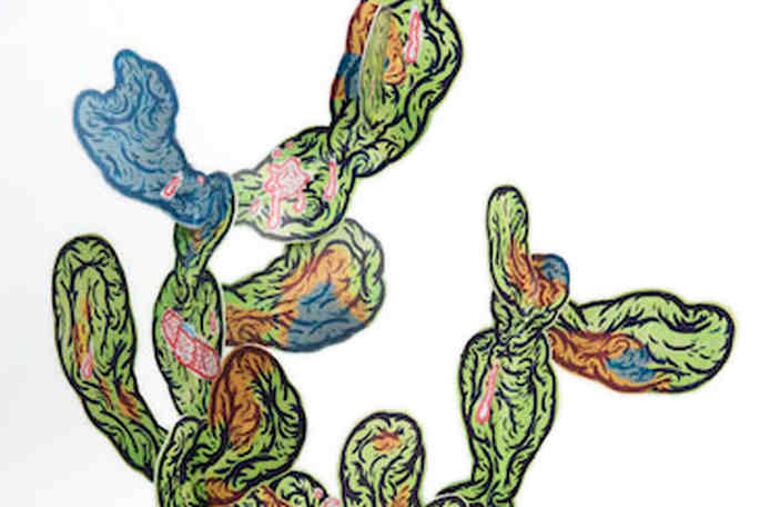
The show's sculptures veer between a Pee-wee's Playhouse aesthetic and conceptual and process art. Common houseplants with recognizable forms - the cactus, the jade plant, the half-dead plant - are transformed into their cartoon avatars in Taylor McKimen's charming ink-jet prints mounted on corresponding cut-wood shapes. Jenn Figg's Deadfall is a remarkable forest scene constructed from cardboard covered with vinyl and printed with photographic images of tree trunks, leaves, and mushrooms. At the cooler end of the spectrum are Nicola Kinch's suspended fiberglass ladder to nowhere and Shelley Spector's poetic oil-can evocations constructed of layers of paper rubbed with wax and oil.
Kay Healy, the only artist to work directly on the wall, asks friends to recall objects from childhood, and she makes screenprints of them loosely based on images she finds on the Internet. Wheatpasted to the gallery's walls, her prints of vintage refrigerators, radios, and lamps are reminiscent of those children's books whose illustrations featured removable adhesive images that allowed children to move objects and people according to whim. (Healy also sells her prints individually, so that grown-ups can do their own mix-and-matching.)
Caitlin Perkins' Recording Barometer, a sculpture made to resemble a real barometer, and the scale charts she lithographs and makes monoprints on, are the most unusual interpretation of this show's theme. During the exhibition's opening, Perkins invited guests to make their own monoprints, recording their impressions of the weather that night, using a stylus to write. The scratchy results, also on display, suggest the communications of ghosts at a séance.
Buffed & baffling
Those who have seen Nick Paparone's previous installations may be surprised by the polish of his first one-person show with Fleisher/Ollman Gallery. This is the same artist, after all, whose first show at Vox Populi three years ago featured a shack-size structure that was covered with comic books, had no entrance, and sprouted sticks from its top. He still likes to baffle.
Every aspect of this latest iteration of his project, "Accents for the Self-Made Man," is so highly designed that it's a bit like walking into a showroom, except it's not immediately clear what this showroom is pitching. (Paparone, who worked in advertising before getting his M.F.A., makes liberal use in this installation of the signifiers associated with that business.)
Large "paintings," which are in fact photographs of collages of Paparone's own painting and found photographic images printed on vinyl, hang on the gallery's walls, each accompanied by an Oriental-style rug and a lamp with a carved-pineapple base. The patterns on each rug pick up elements of its accompanying "painting," as do the colors of the lamps' shades. Standing in the midst of these grandiose displays, a viewer might (or might not) gather that they represent lifestyle choices for various tastes and that the tastes are all sadly similar. That redundancy is echoed by a video of a car accident shown over and over on a wall-mounted monitor. In sum, it's a vision of marketing collateral run amok.
In an alcove, Paparone has set up a mini-auditorium for the PowerPoint presentations he'll give Saturday (at 1 p.m.) and Oct. 10 (at 3 p.m.). For now, the rows of empty chairs facing an empty screen and sheathed in white fabric covers printed with "Fumer Tue" ("Smoking Kills") make their own somber point.
Dan Murphy, who is also having his first show here, has used the smaller gallery to dazzling effect. A self-taught Philadelphia artist who copublishes the free magazine Megawords, Murphy is showing his collages of found paper, photocopies, and magazine pages neatly held together with packing tape; a "shrine" composed of found materials; cut-vinyl emblems of the Philadelphia street scene; and a wall painting. All display Murphy's evident love of cataloging and preserving, and his original eye for color and design.