Sweeping effort to convey the epic tale of . . .
About 60 museums and venues will hold exhibitions of the 1945- 1980 art scene in L.A.
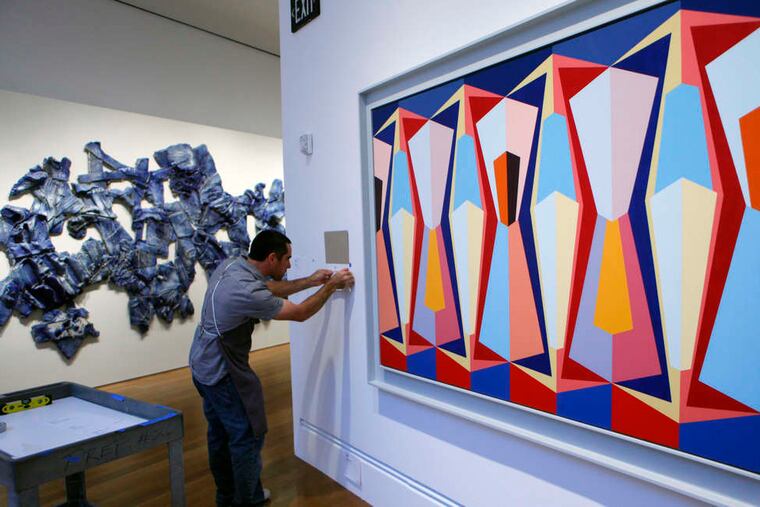
LOS ANGELES - It seems worthy of an old-fashioned Hollywood epic, with a cast of thousands and a plot that spans 35 years: "The Greatest Story Ever Told About Southern California Art."
Over the next six months, more than 60 museums and venues from Santa Barbara to San Diego will hold exhibitions of postwar Southern California art in an effort called "Pacific Standard Time: Art in L.A. 1945-1980." Organizers believe it's the biggest museum collaboration ever.
Each show tackles a different theme - the first wave of Chicano artists, the trailblazing feminists behind the Woman's Building, pioneers of the so-called light-and-space movement. But they share a common goal: to promote Southern California as an international art capital and cultural tourism destination by telling the sweeping story of the origins of the region's dynamic art scene.
"With something like this, you're not going to be able to forget about L.A. again," said Kellie Jones, a Columbia University professor who organized a survey of L.A.-made African American art for the Hammer Museum as part of "PST." "It's going to affect not just the way this country sees art in L.A., but the way the world sees it."
Since the rise of abstract expressionism in the 1950s, New York has dominated textbook accounts of contemporary art. "Pacific Standard Time" hopes to establish Los Angeles as an equal player in the post-World War II art world by spotlighting its unique contributions, including David Hockney's dazzling swimming pool paintings, Ed Ruscha's deadpan prints, and Charles and Ray Eames' lifestyle-defining furniture.
But the goals go beyond that. Joan Weinstein, associate director of the Getty Foundation, which financed the $10 million effort, says that along with spurring new scholarship, the project's two main goals are "raising the profile of Los Angeles as a visual-arts destination, nationally and internationally" and working "to attract new audiences to new museums."
Toward that end, the Getty is paying for a regionwide advertising campaign, designed by L.A. agency TBWA / Chiat / Day (price tag undisclosed).
Print ads and a new phone app will augment 900 street-pole banners, bus wraparound ads, and online video promotions. One video spot, designed to explicitly link the postwar art scene with today's L.A. and to lure a younger audience, shows artist Ruscha with Anthony Kiedis of the Red Hot Chili Peppers discussing art while driving the city streets. News conferences have been held in New York, London, Paris, Tokyo, and Berlin.
"Come October, if you're interested in art and in the swirl, I think you will know about it," said Lindsay Pollock, editor of the New York-based magazine Art in America, who has devoted part of the October issue to the event. "I think it will be a major part of the conversation."
Still, luring tourists bound for Disneyland and Rodeo Drive to Ed Kienholz's grim assemblages or even David Hockney's sunny "splash" paintings is a challenge.
"The worthiness of the exhibitions will, I think, be to a large degree applauded," said Paul Schimmel, chief curator of the Museum of Contemporary Art in Los Angeles, which is part of "PST." "Whether the advertising and the awareness that comes from bringing all these shows together at the same time can create the kind of unprecedented audience people hope for, this is the big unknown."
One reason nobody is making clear predictions about attendance is that the project has few precedents. The 1984 Olympic Arts Festival focused more on the performing arts and lacked a scholarly dimension.
"Pacific Standard Time" began in 2001 with the Getty Research Institute, which launched an oral-history project to preserve the recollections of the era's artists, gallery owners, and other key players while they were still around.
About a year later, the Getty Foundation, the philanthropic arm of the J. Paul Getty Trust, began awarding grants, eventually totaling $2.7 million, to help local museums catalog their art archives and make them more accessible.
As the research began yielding new findings, the idea of mounting public exhibitions seemed a natural next step, said Andrew Perchuk, deputy director of the research institute.
Within months, plans were afoot for dozens of museums to join in one mega-event.
The Getty Foundation ultimately dispensed nearly $7 million in additional grants to cover research, exhibition planning, and a performance-art festival that will take place in January. The content was left up to each arts venue.
"It was really not a top-down, it was more of a bottom-up project," Perchuk said.
So the shows are wildly diverse. The Los Angeles County Museum of Art will have a sweeping survey exploring how California marketed the fantasy of midcentury design, with things as varied as original Barbie fashions and the Eames' living room reinstalled in the museum.
The gallery of the Otis College of Art and Design charts the history of the Woman's Building, from its founding in 1973 to its closing in 1991, a center of creative activity and one of the most important chapters in feminist art.
One of the Los Angeles Museum of Contemporary Art's shows, curated by Schimmel, focuses on art made during the politically turbulent 1970s.
The museum at Pomona College is bringing Judy Chicago to town to revisit her early fireworks-based performance art, and to "blow up" the campus football field.
Chicago, who has work in several "Pacific Standard Time" shows, said she has never seen a museum collaboration on this scale.
"I don't think this level of collaboration could have happened in the East, where there is so much competition between museums," she said. "There's a spirit of innovation and self-invention that continues in California."
The Getty also encouraged Los Angeles commercial galleries to stage thematically related shows this fall, and more than 70 are participating. The official V.I.P. program for "Pacific Standard Time," packed with museum receptions, artists' studio tours, and private collector visits, is designed to draw the European and East Coast art elite.
Still, for some cultural leaders, the promise of "Pacific Standard Time" is reaching more - and more diverse - audiences close to home.
"Sometimes, I really feel that more people know about us in Berlin than they do in Westwood," said Ann Philbin, director of the Hammer Museum. "Strangely enough, it can take something like this to make people around the corner come to visit us."