Gaby Moreno brings distinct voice to World Cafe Live
Certain voices emanate from a performer carrying such a naturally beguiling, tunefully confident range of emotion that it's as if the vocalist had no choice: singing is inevitable.
Certain voices emanate from a performer carrying such a naturally beguiling, tunefully confident range of emotion that it's as if the vocalist had no choice: singing is inevitable.
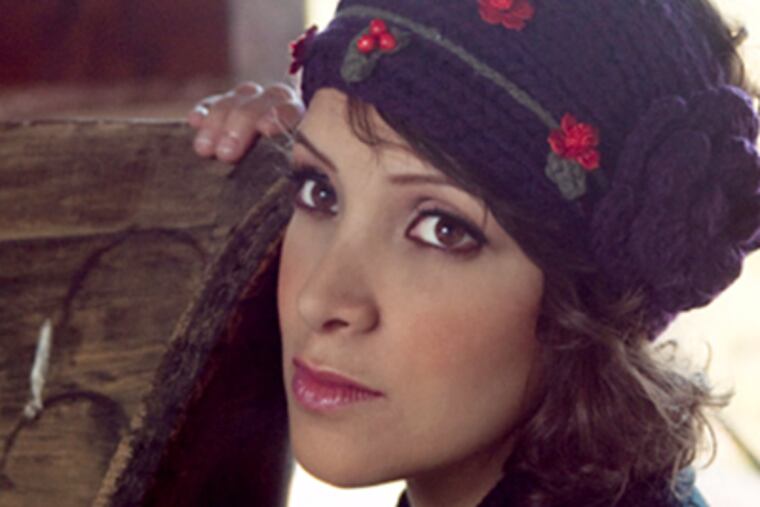
Guatemalan-born, Los Angleles-based singer/songwriter/guitarist Gaby Moreno, who perked up ears at the World Cafe Live on Thursday, has such a voice.
"Destined to be heard" might be another applicable cliche - except, given the music industry's foibles, there's never a guarantee that an independent woman following her muse necessarily will be. Especially one like Maria Gabriela Moreno, 29, who writes and sings in her native Spanish as well as the English she first heard in Guatemala City on records by Robert Johnson, Louis Armstrong, and Nina Simone. (Her original synthesis of influences also includes supreme French chanteuse Edith Piaf, sultry boleros, and other traditional Latin styles.)
Upstairs at the WCL on Thursday - a night crowded with local engagements of other touring female artists sporting distinct voices (Gillian Welch, former Damien Rice collaborator Lisa Hannigan) - Moreno launched a solo set (opening for L.A. acoustic duo the Milk Carton Kids) with her dynamic "Little Sorrow."
The petite Guatemalteca-Americana effected an immediately arresting presence on this and comparably bluesy numbers, rising on the balls of her feet to emphatically down-strum her guitar while vocally emoting in just-right melismatic embellishments of syllable-stretching soul. "Sing Me Life," off her second album, Illustrated Songs (released in April), was a highlight, as Moreno fully invested herself in its "Sing the up/ Sing the down/ . . . That's what I'm gonna do/ And you should, too" assertions, aided by some Motown-esque flourishes and earthy growls.
Other tunes, such as the delicate cabaret-jazz closer "Daydream by Design," allowed Moreno to showcase her subtler side, skillfully conveying a sense of fragility with her high vibrato coo. And, of course, there were the Spanish songs, including a luminous combo-cover of the vintage Cuban standards "Amapola" (1924) and the oft-interpreted (Nat King Cole, Doris Day et al.) "Quizás, Quizás, Quizás" (1947). Moreno's own bilingual, bossa nova-like "No Regrets" - which, she explained, she started to write in Spanish, finished in English - further revealed her cultural fluidity and artistic maturity and, clearly, marked her as someone likely to be heard from again.