A treasure indeed in Chadds Ford
N.C. Wyeth's hundred-year-old "Treasure Island" illustrations.
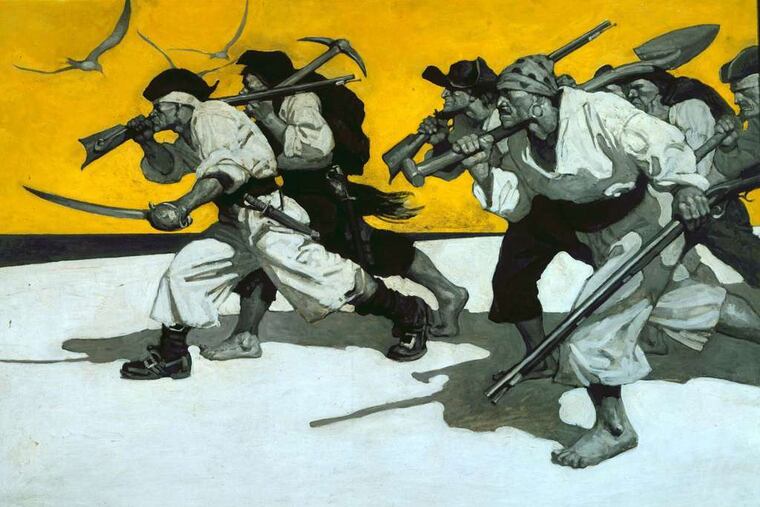
N.C. Wyeth was 29, living in Chadds Ford with his wife and two baby girls, when he got his first big break as an illustrator in 1911. Determined to make a success of the opportunity, he wrote to a close friend, "Have just accepted a commission from Scribner's to handle 'an elaborate edition' of
Treasure Island
! The gods have smiled upon me!!"
Indeed they had.
Wyeth had disclosed three years earlier in a letter home that successful painting used to be "more or less the result of enthusiasm and SPONTANEITY and not as much . . . hard work." But he evolved, and by the time of the Scribner's commission, it was his strong work habits that enabled him to swiftly produce the 16 exceptionally high-quality Treasure Island oils he delivered within a few months, meeting Scribner's deadline.
The 16 are shown together for the first time since they left the artist's studio in the exhibition "N.C. Wyeth's Treasure Island: Classic Illustrations for a Classic Tale" at the Brandywine River Museum in Chadds Ford.
Two of the most striking subjects, "Preparing for the Mutiny" and the book's "Endpapers," are also regular large postcard images sold in the museum shop. Perhaps you have bought and circulated some. Perhaps you know all 16 from the original edition; there is now a reissue for the Wyeth illustrations' centennial observance.
We never seem to tire of pirate lore. Whether it's today's Somali pirates, the outlaws of the Barbary Coast in the early days of the United States, or the never-never-land piratescape occupied by Johnny Depp's Jack Sparrow, there's always interest, and it's rewarded at the Brandywine.
N.C. Wyeth's dramatic interpretations of Robert Louis Stevenson's Treasure Island resonate with genuineness and rich color, bringing to vivid life the adventure, the land- and seascapes, and most of all the characters - so vivid, such living, breathing human beings.
The exhibition goes further, examining some of the scores of applications Wyeth's art inspired - in theater, in illustration, on film and, literally, in an application, a recently released iPad app.
Timber!
Alison Stigora has for several years been showing large, site-specific installations made of branches. She gathers them from fallen trees and methodically partially burns them, then shapes their charred remains into voluminous black torrents of branches.
Just now in the spacious Skybox at Fishtown's 2424 Studios she's showing a juggernaut of solidly stacked branches that has to be the biggest one yet. A dramatic sight, it's made from more than 10,000 charred tree limbs gathered from fallen wood at two nature preserves and two private estates, and charred over the course of 184 hours. The project, months in the making, was supported by several nature conservancies.
In the vast indoor space in this former industrial building, Stigora has arranged a sprawling two-story sweep of timber, an installation reminiscent of the pileup of debris at a river's edge after a serious flood - a natural occurrence, monumentalized.
While Stigora's earlier pieces had such titles as Sea, Whirlwind, and Torrent, the Berwyn artist is calling this one Crossing Jordan, which seems a tad pretentious. The dead debris is all there, without any sense of rebirth evident as yet.
Fellow feeling
In recent years, Gratz Gallery's contribution to the display of early-20th-century Pennsylvania painting, most notably the so-called Pennsylvania impressionists, has become increasingly conspicuous. Just now, for example, Gratz is showing 42 large and small works by some of those artists in "Pennsylvania Painters & the New Hope Circle."
A lively display, it is a comradely gesture to the nearby James A. Michener Art Museum's current mammoth show "The Painterly Voice: Bucks County's Fertile Ground," which features 200 works by about 50 artists. Gratz's modest event is a cheery reminder to passersby of the major display a few blocks away.
Works by Harry Leith-Ross, Edward Redfield, George Sotter, John Folinsbee, Rae Sloan Bredin, and Fern Coppedge are of course here on Main Street, as is Henry Snell, an artist Gratz Gallery lately has helped rediscover. And if a Harer frame is no surprise in itself, Frederick Harer's rare 1920s oil painting of washerwomen, in one of his own frames, certainly is a New Hope conversation piece.