The CSI is you
The Franklin Institute hosts an interactive exhibit based on the TV show.
Mark Walton's been dead for three years and no trace of his body has been found. He was seen helping out his ex-wife, loading some plants into a truck, but then he seemed to have vanished. Then, one clear day, a hiker looks down in the desert and finds what is apparently a human skeleton with what is unmistakably a bullet hole in the head.
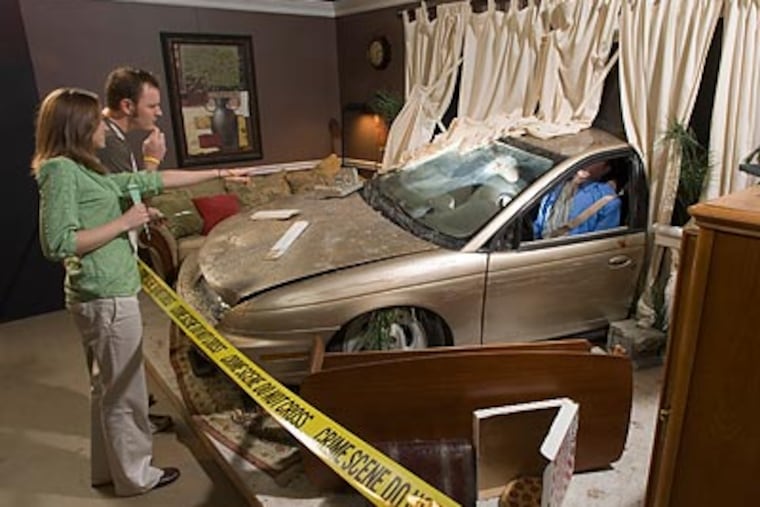
Visitors to the Franklin Institute, where most of the exhibits tend to be a little less violent, are getting a chance this fall to see if they can solve cases like this in "CSI: The Experience," a visiting interactive showcase based on the popular TV series CSI: Crime Scene Investigation.
When the visitor - now dubbed a novice Crime Scene Investigator - enters the experience on the third floor near the permanent Sports Challenge exhibit, he or she watches a short prep session on film with the TV show's creators and stars. The visitor then gets the inevitable clipboard to collate his or her evidence in the crime.
There are three separate crime scenes from which to choose: "A House Collided," where a car has run through the living room window of a home; "Who Got Served!", in which the body of a Las Vegas waitress is found in an alley behind a motel; and "No Bones About It!", the case of the late Mark Walton.
As with all episodes of the TV show, there are hidden clues and hypotheses to test. In "No Bones About It!", for instance, there is a long hair on the clothing scrap left near the body - one clearly not from the victim. That hair and other evidence collected at the crime scene is forwarded to the downtown lab for a thorough going-over.
The visitor gets to compare that hair to other kinds of hairs under a microscope. There are similar investigations of the size of the bullet hole in the skull and, even more improbably, a seed found on the victim's shirt. All of it leads somewhere, sometimes via circuitous routes, but a careful "CSI" experience, from the labs and the autopsies and microscopes, leads to what later seems a logical conclusion.
There is also a room designed as the "Franklin Bureau of Investigation" crime lab, where institute employees give impromptu talks on fingerprints, footprints, and other kinds of clues to solving crimes.
Steven Snyder, the institute's vice president for exhibit and program development, said the TV show CSI did not create the interest in forensics, but merely reflects a growing fascination with the topic by the layman. Though there was a similar exhibit at the museum about 20 years ago called "Who Done It?", Snyder thought it was time to bring a forensics show back to town.
"The best popular culture taps into something already there," Snyder said. "We noticed that, particularly with the new advances in investigation, and the public's interest in solving crimes, we were ready to have an exhibit, particularly an interactive one like this, that has great science and great stories."
In order to defray costs, the institute has partnered with other science museums as well as sponsors such as Peco and CBS, CSI's network, to have the exhibit tour here and to several other museums. CSI: New York star Sela Ward went to the institute for the exhibit's launch last month.
Snyder said he is hoping "CSI" is the kind of special exhibit visitors will come to more than once, particularly since there are three crimes to solve.
"We're going to keep an eye on that," Snyder said. "But the institute is about having a variety of kinds of experiences, and we are committed to doing special exhibits like this on many different topics."
CSI: The Experience
Through Jan. 2 at the Franklin Institute, 222 N. 20th St.
Admission: $25.50, $18 for children for general museum access.
Hours: 9:30 a.m.-5 p.m. Sunday-Thursday and 9:30 a.m.-8:30 p.m. Friday-Saturday.
Information: 877-834-8497 or www.fi.edu
EndText