Jazzman's life is upbeat now
Guitarist Pat Martino has a new CD out and a book telling of his struggle back from a near-fatal brain aneurysm that robbed him of the ability to play.
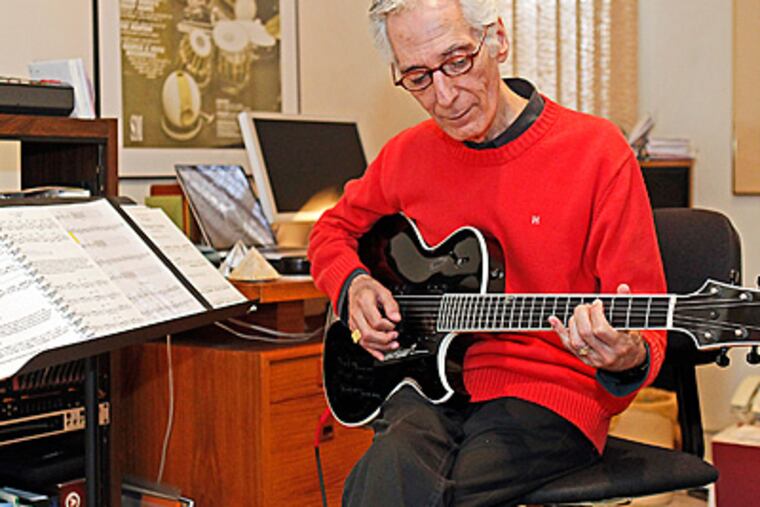
The South Philly rowhouse where Pat Martino resides has changed drastically from the home he returned to after undergoing neurosurgery in 1980.
His parents, who lived there at the time, have passed away, as have most traces of their personalities and decor. In their place are Asian-inspired artworks (and a number of pig figurines) reflecting the taste of Martino's Japanese-born wife, Ayako, and the occasional concert poster advertising significant dates in the legendary guitarist's own career.
Despite the changes he's wrought over the last 30 years, Martino can still see the home that once existed. "Even though it's been completely gutted and remodeled," he says with a hint of a smile, "this house is laden with memories."
While it's not uncommon for someone to grow a bit nostalgic in his parents' house, it is remarkable that Martino can recall his associations with the place at all - or that he's survived to remain there, three decades after suffering a life-threatening brain aneurysm.
The aneurysm was brought on by arteriovenous malformation (AVM), a condition he'd suffered from since birth - and that had been misdiagnosed and mistreated. Surgery at Pennsylvania Hospital saved his life but left him with amnesia, unable to recognize his parents and friends or to play the guitar that had made him famous.
Martino, 67, recounts that story in his new autobiography, Here and Now, published in October by Backbeat Books. The book traces the guitarist's life from his South Philadelphia upbringing as Patrick Azzara and his early musical efforts with his friend Bobby Rydell on drums, through his apprenticeship with jazz greats like Charles Earland, Jack McDuff, and Don Patterson, to his own pioneering recordings and innovative approach to the instrument. It then traces his illness, recovery, and comeback.
Journalist Bill Milkowski, a longtime contributor to JazzTimes and Absolute Sound magazines, collaborated on the book with Martino.
"There were some moments where Pat wouldn't remember specific things," Milkowski says, "but I didn't find that he had whole blocks of time missing. From the time he woke up from his surgery, bits of memory began coming back in waves, sometimes triggered by a word, a picture, a taste, a smell. But more than just going through a chronology of his life, following the narrative arc of his amazing story, he always connected the dots of how the events in his life related to a bigger picture."
Martino has a way of answering even the most direct question by means of circuitous philosophizing, making a conversation seem something like sitting at the feet of a Zen guru. While much of his memory has returned, he treats the past and the future as abstract concepts, focused wholly, as the title of his book suggests, on the here and now.
According to pianist Jim Ridl, who played with Martino frequently for more than a decade starting in 1992, communicating with him musically is something very different. "When you have a verbal conversation with Pat," Ridl recalls, "it can float to a lot of different places and you're not always sure where it's going to land. But when it comes to playing, he's kind of old school: You're here, you brought your goods, you better play."
That approach to performing reflects Martino's tutelage under his elders beginning at a very early age, hitting the road as a teenager, and playing in such famed, now-defunct Philly clubs as Pep's and the Showboat. He mourns the loss of such establishments and its effect on younger generations of jazz musicians, trained in colleges rather than clubs. His annual Thanksgiving weekend shows at Chris' Jazz Cafe try to recapture some of that spirit.
"It's such a special event yearly to be invited over to Chris' and for two nights just have a ball," he says. "It's a place that's realistic and true, as opposed to just another club that will last another six months before it folds."
Martino's new CD, Undeniable, recorded live at the D.C. club Blues Alley and released in October by HighNote, is another link to his past, a return to the organ-group style that was so important to his early career.
"There's something in that instrumentation that remains within it alone," he says. "It's like a specific flavor of ice cream or a specific color; it cannot be achieved in any other way."
Organist Pat Bianchi, who will be accompanying Martino at Chris', feels the weight of that history. "Pat's a master musician himself," says Bianchi, "but he worked regularly with Jimmy Smith, Don Patterson, and Jack McDuff - these are the legends of the Hammond organ. So it's a little daunting."
The experience of telling his story, Martino says, was akin to "looking at a catalog of photographs, like a family does on an evening where they're pondering over the past. You turn the page and you see a reminder of a beautiful moment, and you giggle and embrace the remembrance of those blessings. That also could apply to a crisis, a moment of impact that caused you to make a decision. You respect how it taught you to redefine the good and the bad in a way that you never thought that you would."
For all the pain it caused him, Martino now considers his aneurysm "the greatest thing that ever happened to me," turning him from a career-driven life to a more philosophically centered one. His transformation is captured by the Joni Mitchell song "Both Sides Now," which he performs frequently (and beautifully). He also illustrates the change through his altered attitude toward two classic John Coltrane albums.
"In earlier years when I saw an album titled Giant Steps, it meant to me the ability to play through more changes with a quicker pace. A Love Supreme meant a true devotion to the mastery of music as a form of art. As my perspectives and my intuition began to amplify, Giant Steps took on biblical proportions and A Love Supreme became something much more spiritual than entertaining. Music became a stepping-stone to another level of consciousness."
What hasn't changed on either side of that divide is Martino's six-string genius. Milkowski, who refers to Martino as "one of the major cats in the lineage of jazz guitar," says, "Now that he's made it all the way back and is on top of his game once again, he continues to burn with rare intensity, focus, and inspiration. There was definitely a difference in Pat's playing shortly after the surgery. He was struggling then. The amazing flow and audacious ideas weren't there. I've heard him make incremental developments over the years and within the past five years or so, he's been playing like the Pat of old, both in terms of technique and soul."
As for the artist himself, he is characteristically not interested in speculating about that future. "What's on my mind is a greater focus with more intimate accuracy on each and every moment so that I can truly focus on what life is really all about. The mind has a way of thinking about things that have nothing to do with the moment, but if I can love my life in that moment, I'm in the right place at the right time."
Pat Martino performs "Both Sides Now" and explains why it's such a meaningful song to him at www.philly.com/martinoEndText