Dance flash: Ronen Koresh's 20-year leap
IT HASN'T FELT like 20 years for Ronen Koresh, founder of Philly's Koresh Dance Company. "You never think in terms of time. You think in terms of how to make things happen. It doesn't feel like 20 years because you're so involved in what you do," Koresh said recently from a tour stop in Cincinnati. "It's a lot of fun and a lot of struggles."
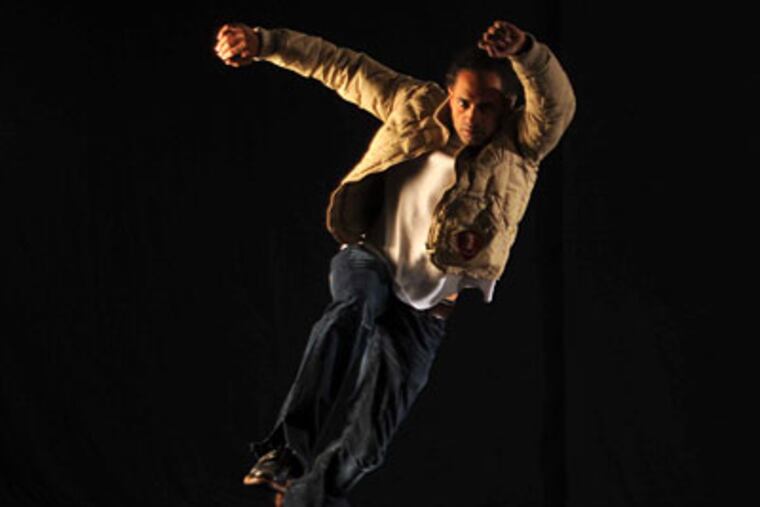
IT HASN'T FELT like 20 years for Ronen Koresh, founder of Philly's Koresh Dance Company.
"You never think in terms of time. You think in terms of how to make things happen. It doesn't feel like 20 years because you're so involved in what you do," Koresh said recently from a tour stop in Cincinnati. "It's a lot of fun and a lot of struggles."
To celebrate two decades of energetic, powerful and technically adept dance in our city, Koresh Dance Company will perform an anniversary show at the Suzanne Roberts Theatre, a compilation of pieces that Koresh believes show his evolution as a dancer, choreographer and man.
"When you're young, you consider the outside, the more external. We want to look beautiful and fit. That was the primary: sexy and hot," Koresh said. "When you get older, you're not as pretty . . . so you start going into the internal. You might be beautiful and physically fit [still], but what do you have to say?"
As Koresh matured, he also stopped being afraid. When he was younger, he craved the audience's love - which stifled his creativity and sense of self-expression. Now Koresh has another philosophy: "If my audience doesn't like what I'm doing now, I'll create new [audiences]."
Born in a small town outside Tel Aviv, Israel, Koresh moved to the U.S. in 1983. He was lured away from his initial New York City environs by a spot in a local company. He put down roots here, becoming a professor at the University of the Arts.
"I fell in love with Philadelphia because of the potential I saw," Koresh said. "I knew I wanted to start something, and I needed a place where I could start a school or a company without struggling all the time." But when his students asked where they could audition after graduation, Koresh was at a loss. There were few companies in Philadelphia he could refer them to.
"Someone needed to take initiative to support some artists and some dancers. I wanted to create a place for people to work and dance," Koresh said. He founded the Koresh Dance Company in 1991.
"It was an especially bold decision to have made 20 years ago because the scene was so much smaller. It's always bold to come to a city that's on the frontier of dance and that isn't a known dance city," said Lois Welk, director of Dance U.S.A. Philadelphia, a dance advocacy group.
She described Koresh's company as important to the ecology of the Philadelphia dance scene. "They're part of the reason why Philadelphia has become a strong reputation for dance right now. Part of it is because of the courage and strength of vision to select a city and come here and make it happen. It takes leadership to do that."
Koresh now employs 30 people, including 10 dancers, designers and administrators (including his brothers, Alon, who runs the business side of the company, and Nir, who runs the school). They also tour extensively, creating a larger imprint throughout the country. As of last week, Koresh said he hadn't been home for more than five days in a row because of his company's schedule. "They're ambassadors for Philadelphia wherever they go," Welk said.
But that's not enough. It's never really enough. He laments that there is no Philadelphia theater dedicated solely to dance, and that the city's companies - he estimated 40 or 50, while Welk put the number at 140 - are nomads. "It's not like, 'Oh, we've reached the promised land,' We're still knocking on doors every day to be able to survive, but it's better than it was," said Koresh.
He's done his part by hosting bimonthly Artist Showcases at the Koresh School of Dance, giving young choreographers and dancers a place to perform, marketing, technical support and rehearsal space for free. The next showcase takes place Jan. 21-22.
Though Koresh and the city he loves have changed, there are elements of his work that have stayed the same. "My work is still very physical and athletic but it deals with more important issues . . . not important, but more organic and truthful, deeper issues. [Expressing those ideas is] pretty much the reason I became an artist," Koresh said.
But he welcomes his own maturation. "When you're young, you're not as worldly, so what you have to say is limited," he said. "The primary evolution is that I got older, and hopefully smarter."