Valetta's self-portrait multiplied
To speculate on the psychological implications of painter Valetta's 20-year obsession with her self-portrait series (both single subjects and multipanel storytelling scenes, some including 54 or even 88 small images arranged gridlike within one frame) is
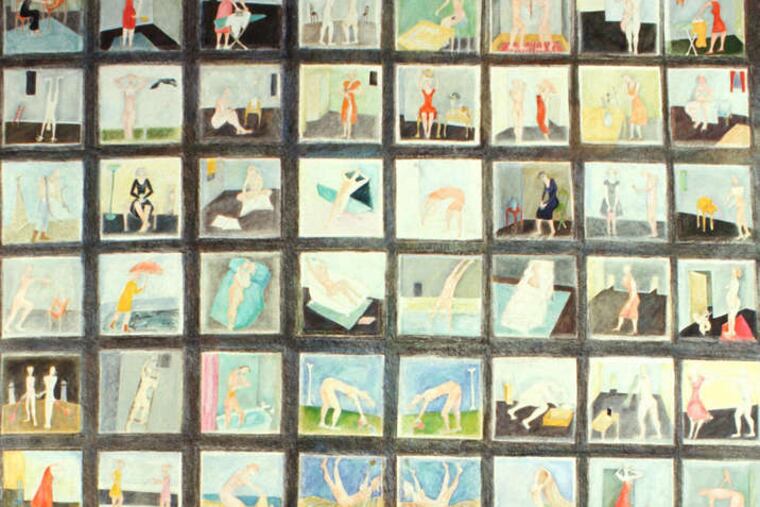
To speculate on the psychological implications of painter Valetta's 20-year obsession with her self-portrait series (both single subjects and multipanel storytelling scenes, some including 54 or even 88 small images arranged gridlike within one frame) is to ponder on her personal identity. But in the current 20-year retrospective now on display at Widener, another key consideration trumps that one. For naturally we wonder where the highly unusual output of this Brooklyn-born Westtown resident - who has little to say about her own work - fits into today's art scene. And here's my theory.
Valetta's art, perhaps surprisingly, has something in common with certain traits of the late-19th-century Golden Age of American illustration, when subject matter was king in the work of Edwin Austin Abbey and Howard Pyle, and neither made any distinction between his easel paintings and his illustrations. Criteria for judging art were very different then, and some of it apparently brushed off on Valetta, who breezed through an abstraction-friendly postmodern period, holding onto subject matter all the way.
Of course her work does possess noteworthy abstract qualities such as color, structure, and relationships reflecting present-day usage. And certainly the Pyle/Abbey comparison shouldn't be carried too far. These informal self-portrait sagas, in which some of the self-portraiture seems almost incidental, are also closer to an antic image than to any likeness painted "head on" at a mirror.
For Valetta, an ardent feminist, mixes the surreal with the representational, choosing a quasi-naturalistic setting for her casually drawn figures to move about in. An occasional figure floats against these flat or not-so-flat backgrounds, and there's a folklike naivete about these scenes in pastel. Besides, Valetta favors picture-making that's progressive. That means quite a few of these pictures go forward from one still image to the next as if this were moving-picture footage in which her drawing series provides the visual ideas for paintings. For her, the process is chiefly what matters unit by unit, not merely at the finish she saves for a final episode. And that's a respectably up-to-date idea.
Also on view at the gallery is a show "Handmade Wonders: African Vessels From the David and Karina Rilling Collection."
At home in India
The photographer Charlee Brodsky seems like an internationally shaped individual whose education and artistic ideas in her installation "A Light Within" at St. Joseph's University are the products of both East and West. In fact, her aim of capturing fragments of daily life in India, featured here, was realized in a carefully planned single 11-day trip. At the time, Brodsky avoided tourist routes by journeying to Kolkata (formerly Calcutta) with a nonprofit group that provides health services to disadvantaged women and children.
Brodsky, who teaches photography at Carnegie Mellon, thus presents a large, diverse show highlighting mainly those vivid quotidien photos with their accent on beauty of surroundings and the welcoming attitudes of those she met. But she includes a series on the usage of Buddhist hand gestures called mudra, and another on the Indian affection for the lotus flower, which denotes wisdom.
To this is added still another dimension - writings done at her request by Neema Bipin Avashia and Zilka Joseph, who live in the United States but have strong ties to India, that address each episode or walk-through she portrayed. These commentators' helpful storytelling and poetry are displayed alongside each color photo - reason enough not to rush through a fascinating show that does honor to a land that is home to more than a billion people.
Moving on
Karl J. Kuerner is a votary of Andrew Wyeth, his family's longtime neighbor in Chadds Ford. The 56 paintings in Kuerner's solo show, "Places to Go, Things to See," at West Chester University's E.O. Bull Center for the Arts, span many themes. Done in acrylic in a style that's neat and exact, they show a need to escape the hothouse atmosphere of his Wyeth-country surroundings. But possibly he has begun to revisit his own familiar approach in, for example, his expansive, livelier depiction of World War I aerial combat over Europe, and his meditative portrait of a Civil War vet. In these, Kuerner may be moving on.