Zuzu's wings: How her "Wonderful Life" tour took off
Karolyn Grimes was living near Kansas City, Mo., in December 1979 when the 39-year-old working mother of seven saw familiar faces on the family TV.
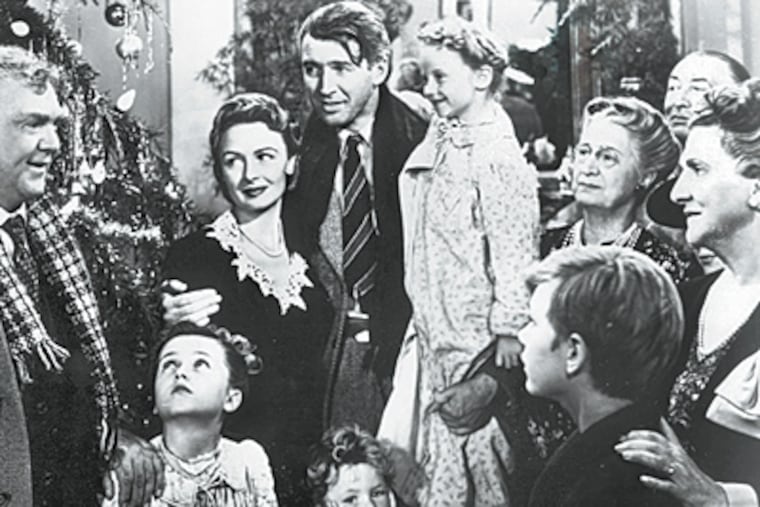
Karolyn Grimes was living near Kansas City, Mo., in December 1979 when the 39-year-old working mother of seven saw familiar faces on the family TV.
"I didn't watch old movies on TV," said Grimes, now 71 and living near Seattle. She said something tugged at her as she saw snatches of snow-clogged streets in small-town America and people she thought she knew on the screen.
"Then it hit me," Grimes said. "I was in that movie. I was Zuzu."
The film was the holiday classic It's A Wonderful Life, which debuted at the Globe Theatre in New York on Dec. 20, 1946. It airs here Saturday and on Christmas Eve.
Although Grimes had never seen the movie before 1979, her kids and everyone else seemed to be familiar with the sentimental chestnut from filmmaker Frank Capra. When the copyright lapsed in 1974, television stations worldwide began looping the movie into their schedules. It was free programming, a cash gusher with no royalties paid to its creators, and the widespread exposure informed the imagination of generations of families huddled around TVs for the holidays.
"Nobody recognized me as a 6-year-old, I guess," said Grimes, noting that she used her married name when she saw the TV film. "And I never saw movies I was in because my mom told me that would be prideful, being stuck on yourself. My mom didn't want me to be that way."
Watching it for the first time 33 years after her role in the film, Grimes said she was swept away by the story she had never heard before.
It was about Clarence the angel, played by Henry Travers, coming down from heaven on Christmas Eve to save financially ruined George Bailey. Bailey, of course, is played by Jimmy Stewart, who considers killing himself so that his life insurance would support his wife, Mary, played by Donna Reed, and their four children - 6-year-old Zuzu; her big sister, Janie, played by Carol Coombs; big brother Larry Simms as Pete; and baby Jimmy Hawkins as Tommy.
"Oh, it was fresh and dark, about as relevant today as it was when it was made," Grimes said. "Think of all the people out of work, losing their homes, hungry kids worried about their parents. What's so different about today and 60 years ago?"
Whatever its social relevance, the film remains popular. Several events are planned for its 65th anniversary; Grimes said she would be in Los Angeles for IAWL Day on Saturday.
Tom LaBonge, a city councilman and film enthusiast sponsoring the event, said in a telephone interview: "Look, we've got Occupy Wall Street demonstrators right here in front of City Hall. We need more George Baileys in our world."
NBC at Christmas will offer viewers a jazzed-up IAWL colorized version of the black-and-white original for the showings Saturday and Dec. 24. Paramount Studios has released Blu-ray color and black-and-white copies in time for the holidays.
And in Seneca Falls, N.Y., the small town that Capra used as a template for Bedford Falls in the film, the town has plans for its 10th annual IAWL festival Friday through Dec. 11, with Grimes and Coombs scheduled to share stories about the movie.
"Actually, we didn't think it was a big deal doing films back then," said Grimes, whose childhood nickname was Kay, not Zuzu. "It was just a job. All the kids in my neighborhood went over to the studios, Jimmy and Larry, and Carol and me. We walked over or were taken over by our moms, trying for crowd scenes or other work to make a little money."
"None of us thought we'd get rich or be famous," she said. Grimes now has a website that tracks her appearances: http://www.zuzu.net/.
The money she earned for the role was important to her family: Her father worked as a grocery store manager for Safeway, and her mother was succumbing to early onset of Alzheimer's disease. In all, Grimes as a child appeared in 16 movies, and she remembers being paid $75 a week over the 12-week shoot of IAWL. It was a big deal for her parents, she said, who had fled the Great Depression in Missouri for new lives in Los Angeles.
Before her film career ended, Grimes appeared in other gems such as The Bishop's Wife, starring Cary Grant, David Niven, and Loretta Young; John Ford's Rio Grande, with John Wayne and Maureen O'Hara; and "a bunch of stinkers no one cares about today," she said with a laugh.
Francis Caraccilo, a preservationist in Seneca Falls and an organizer of the annual IAWL celebration who regularly hosts Grimes, believes that Capra's film addresses important issues.
"For a lot of historians and people who just watch the film closely, the movie's relevance includes the fact that it addresses anti-immigrant sentiments and religious bigotry," Caraccilo said, pointing to the scene where the evil banker Potter complains that George Bailey is helping "garlic eaters" buy homes.
"Italian Americans appear throughout the film," said Caraccilo, an Italian American. "When Capra came through this town, it was clear that anti-immigrant and not-too-subtle hostility toward Catholics was part of the American social landscape in 1946."
"There's a generous heart in this movie," he said. "Think about that for a moment in 2011."