New Recordings
Pop Seventeen years ago, Mary J. Blige let loose with the harrowing My Life. Filled with raw emotions evoked by an abusive relationship and addictions of all kinds - to say nothing of her personal and professional move from pavement to penthouse - My Life set a high bar for all rap/R&B belters. Even Blige couldn't often match My Life's nervously fatalistic yet hopeful soul.
Pop
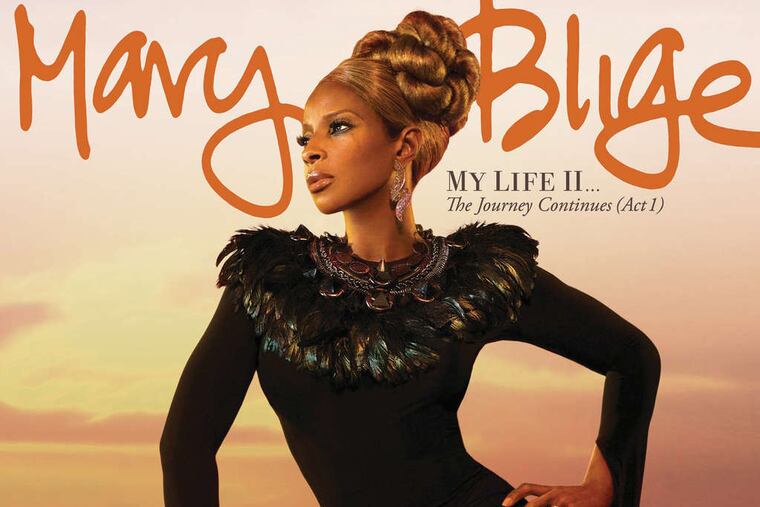
My Life II: The Journey Continues (Act 1)
(Geffen ***)
nolead ends Seventeen years ago, Mary J. Blige let loose with the harrowing My Life. Filled with raw emotions evoked by an abusive relationship and addictions of all kinds - to say nothing of her personal and professional move from pavement to penthouse - My Life set a high bar for all rap/R&B belters. Even Blige couldn't often match My Life's nervously fatalistic yet hopeful soul.
Blige's life and sound have famously moved past My Life's messiest business. This second volume's first act (more continuation here than the Final Destination film series) is a sequel, a star-stuffed (Drake, Nas, Beyoncé) slice of slick soul, rapid-fire hip-hop, and sappy but solid ballads. Of course, it contains MJB's patented brand of angst anthem on "The Living Proof," in which Blige starts out beaten down, only to rise like a self-affirming Technicolor phoenix. There are Gamble & Huff and Wu Tang Clan samples to croon atop, covers to be tackled (Rufus/Chaka Khan's "Ain't Nobody"), and battles to be won over her costars. Tracks such as "Empty Prayers" and "25/8" show Blige at her breast-beating best, giving the agonies of 1994 a good run for their money.
- A.D. Amorosi
nolead begins Candi Staton
nolead ends nolead begins Who's Hurting Now?
nolead ends nolead begins (Forced Exposure ***)
nolead ends Alabama-born R&B belter Candi Staton earned her "First Lady of Southern Soul" sobriquet in the early 1970s, recording for Rick Hall's Fame Studios, and she scored one big pop hit with "Young Hearts Run Free" in 1976. After decades singing gospel, she made a pop comeback with 2006's His Hands, recorded for Britain's Honest Jon's label. Who's Hurting Now?, a follow-up produced by Lambchop's Mark Nevers, includes songwriting contributions from '60s song scribe Dan Penn, alt-country singer Mary Gauthier, and indie changeling Bonnie Prince Billy, a.k.a. Will Oldham, who also wrote the title track of His Hands. The uniformly strong set of raspy-voiced soul was issued in the United Kingdom in 2009, but unavailable in the United States until this month. Standout cuts include Staton's quietly searing reading of Gauthier's "Mercy Now" and the rough-cut "Lonely Don't" - cowritten by Vancouver, Wash., bus driver Connie Knapp - which concludes that one is better off with one's own company than that of a drunken, good-for-nothing man.
- Dan DeLuca
nolead begins Jethro Tull
nolead ends nolead begins Aqualung: 40th Anniversary Collector's and Special Editions
nolead ends nolead begins (various packages; EMI ***1/2 )
nolead ends Forty years old now - thus, these anniversary packages - Jethro Tull's Aqualung is justly famous and justly notorious. It's famous for its ambition, its treetop playing, and for being one of the few early-'70s concept albums (Ian Anderson denies it; he would) that (a) really did have a coherent, worthwhile concept, and (b) said profound things about it via pop music.
For many, though, it also marks the moment prog vaulted the whale shark. The title track, with its angular chording, sneering vocals, and too-clever breaks (from full-on smash to sensitive strummed guitar, back to breakneck jamming), is now rendered a permanent joke via radio overplay, Exhibit A in prog's self-immolation. Aqualung might be the one time pop touched the face of God - but snot is running down its nose. The sour smell of excess does not, however, overwhelm a headlong, flamboyant collection by a group of musicians ready to try anything. This package is worth having just for that.
(I mean, it's frightening what's on offer. You can pay more than $100 for a package with vinyl album, DVD, Blu-ray, with up to 61 tracks. Depends on how much Tull you want.)
How many albums tackle the nature of God, the problem of evil, the notion of grace, and, and, and . . . all that? "Locomotive Breath," possibly the best of many strong tracks, depicts a world out of control, with Old Charlie swiping the handle (and the singer says, "I'm glad"!). John Evans kills on piano in "Breath," and Martin Barre is a guitarist splendiferous throughout, especially in "Aqualung" and the superb, unjustly underplayed "Wind-Up." As Anderson's characters - Aqualung, Cross-Eyed Mary, Mother Goose ("and she was screaming"), the Jackknife Barber - shamble through a smeary landscape, we're hit with hair-raising directness: "If Jesus saves/ Well, He'd better save himself/ From the gory glory-seekers/ Who use His name in death," or the startling insistence that whatever God may be, "He's not the kind you have to wind up on Sundays." Sung tenderly. Aqualung goes overboard and marks a turning point for a band that, with Thick as a Brick and Passion Play, would soon ditch its hard-earned audience. These packages let us in on a terrific moment, and the extra features are fascinating. Aqualung is like that train sans handle - it won't stop going, no way to slow down.
- John Timpane
nolead begins The Black Keys
nolead ends nolead begins El Camino
nolead ends nolead begins (Nonesuch ***1/2)
nolead ends This is a straight-ahead rock-and-roll album, and an excellent one. Last year's Brothers was the Black Keys' breakthrough, garnering the Akron, Ohio, duo its best sales and several Grammys on the strength of the single "Tighten Up" (not coincidentally the sole track produced by Danger Mouse) and the album's diverse, soulful intensity. For El Camino, the duo's seventh full-length album, guitarist/ vocalist Dan Auerbach and drummer Patrick Carney decamped to Nashville, brought back Danger Mouse as songwriting partner, key- board player, and producer for the whole record, and dialed up the volume.
Although garage-band blues is still the bedrock, these tracks share DNA with the riff-happy best of T. Rex ("Lonely Boy"), Led Zep- pelin ("Little Black Sub- marines"), and the Clash ("Hell of a Season"). There's nothing subtle here: El Camino is pure high-octane rock and, as the title implies, perfectly calibrated to be heard at maximum volume on a road trip.
- Steve Klinge
Country/Blues
V
(Sugar Hill, ***1/2)
nolead ends Kenny Vaughan has been the guitar slinger in Marty Stuart's Fabulous Super- latives for 10 years, and the Colorado native has been an in-demand accompanist since he hit Nashville in the late 1980s.
V is Vaughan's first solo album, and it's, well, superlative. A brisk and varied set of originals, it blends impressive instrumental mastery with down-to-earth charm.
Backed by the Fabulous Superlatives, including Stuart, Vaughan starts off appropriately with the rollicking honky-tonk of "Country Music Got a Hold on Me." From there, he dives into Western swing with "Hot Like That," goes hangdog for the mandolin- accented lament "Lillie Mae," channels Buck Owens with the propulsive twang of "Stay Out of My Dreams," gets funky with the Oak Ridge Boys on a trip to "Okolona, Tennessee," and closes with the driving gospel of "Don't Leave Home Without Jesus."
Interspersed among these numbers are three atmo- spheric but wholly distinct instrumentals, which help round out the vibrant portrait of a sideman who has more than ably stepped to the front.
- Nick Cristiano
Jazz
Conversations with Christian
(Mack Avenue ***1/2)
nolead ends Now 39, Christian McBride, the über-jazz bassist of his generation, drops the big band and the small groups to go one-on- one with each of 13 guests. These duets show how far the Philly native likes to roam - from funk to Latin jazz to baroque - and the respect he commands.
Sting is perhaps the most prominent. Their take of "Consider Me Gone" is passionate if a bit forced. McBride's bowed bass is a perfect complement to the late Billy Taylor's homey piano on "Spiritual." He inspires pianist Chick Corea to go modern on "Tango Improvisation #1," while his funky urgency gets singer Dee Dee Bridgewater to lay some spirited sass all over "It's Your Thing."
Duets in other hands are often dreary affairs, but wit and derring-do are never far away for McBride. He and violinist Regina Carter find the blues in Bach on "Fat Bach and Greens." And his duet on "Chitlins and Gefilte Fish" with actress Gina Gershon on the twangy Jew's harp is a goof.
- Karl Stark
Classical
Ensemble Plus Ultra, Michael Noone conducting.
(Archiv Produktion, ***1/2)
nolead ends nolead begins Requiem 1603
nolead ends nolead begins La Stagione Armonica, Sergio Balestracci conducting.
nolead ends nolead begins (Pan Classics ****)
nolead ends nolead begins De Beata Maria Virgine; Missa Surge propera
nolead ends nolead begins Choir of the Westminster Cathedral, Martin Baker conducting.
nolead ends nolead begins (Hyperion ***)
nolead ends The 400th anniversary of composer Tomas Luis de Victoria's death is calling attention to some of the highest peaks of the Spanish Renaissance, but is testing the capacity of 21st-century listeners to accept beauty. Endless streams of lush, integrated polyphony require great concentration for parsing the intricacy behind the mellifluousness.
To that end, the 10-CD mega-box by Ensemble Plus Ultra is a landmark, stuffed with so much greatness that listeners will digest the set for years to come. Unlike many such projects, there's no sense of assembly-line performances, though you might wish for slightly more tension, stronger pulse, and less-distant acoustics.
Intensity isn't lacking with the bigger Westminster Cathedral Choir, but the boy sopranos grow strident, and the choir's size is ungainly. With so much sameness, I dare anybody to listen to the disc in a single sitting. That's not how this music was meant to be heard anyway, which is why La Stagione Armonica refreshingly has dense Requiem movements separated by chant. The singing is superb - as tidy as Tenebrae's fine Requiem recording on Signum, but with some welcome grit in the vocal sound.
- David Patrick Stearns