Now, Belafonte has his say
The singer-actor activist offers his left-leaning view of the world and Obama.
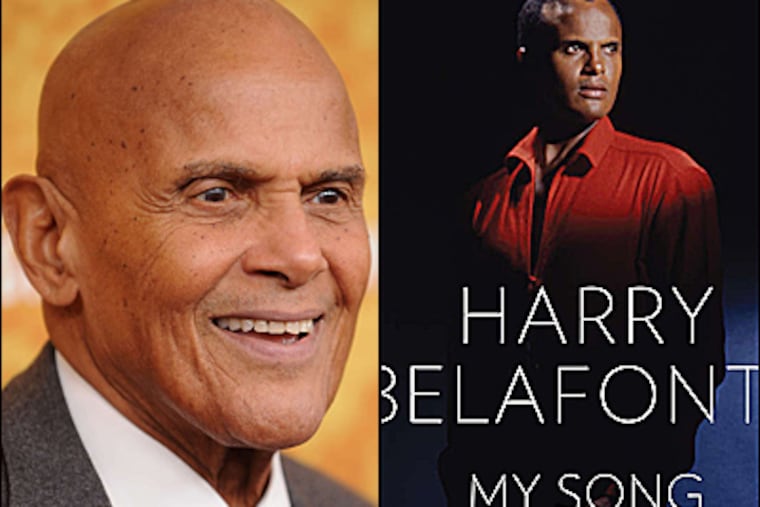
My Song
A Memoir
By Harry Belafonte
with Michael Shnayerson
Alfred A. Knopf. 469 pp. $30.50
nolead ends nolead begins
Reviewed by Kevin L. Carter
Harry Belafonte, the singer, actor, activist, veteran, sex symbol, cancer survivor, great-grandfather, and confidant and supporter to many of the most significant civil rights figures in our history, has always had a lot to say about a lot of things.
In his autobiography My Song, written with Michael Shnayerson, Belafonte shows that even at 84, he has a lot to say.
Belafonte sees the world from an unabashed leftist viewpoint. As someone who has been in the trenches for civil rights and many other issues (poverty, the incarceration of black and Latino males, education, AIDS), he looks at the president of the United States and sees missed opportunity and inexcusable neglect of this country's black and poor populations.
As a man, Belafonte has made and witnessed history from the most insider of perspectives, and he is withering in his disappointment in Barack Obama, who has had the opportunity to be the most transcendent historical figure in our lifetime.
"For all of his smoothness and intellect," Belafonte writes, "Barack Obama seems to lack a fundamental empathy with the dispossessed, be they white or black." He expected Obama to try to deal with some of the issues facing black and poor America, and he is bitterly angry that the president has not.
Belafonte was born in Harlem in 1927 to Caribbean immigrant parents Harold Bellanfanti (the surname had originated generations before, in Corsica) and Melvine "Millie" Love. Though Belafonte has fond memories of some of the prominent African Americans he observed as a kid, he also relates brutal treatment by his itinerant banana-boat-chef father and financial pressure on his mother.
Because of this somewhat unsettled situation, Belafonte's mother Millie, on a couple of occasions, sent him to Jamaica. Sometimes she went too, along with Belafonte's younger brother Dennis. But she wasn't always able to care for Belafonte in the way she wanted to, which led to him being sent, temporarily, to board with Jamaican families of greater means, placing the still very young Belafonte in a nebulous status somewhere between glorified houseguest and restavek.
After returning home to more chaos and poverty in Harlem, Belafonte joined the Navy in 1944. It was in his Stateside, segregated labor unit (his group of ammunition loaders was scheduled to work in Port Chicago, Calif., the scene of the infamous munitions explosion and subsequent mutiny) that he first began to learn what it was to be a "race man." His fellow sailors, many much older and much more highly educated, introduced him to thinkers such as W.E.B. DuBois.
After the war, Belafonte was determined to make it as a performer; he began acting at the American Negro Theater and later gigged and recorded as a jazz singer. Although fairly familiar with Caribbean music forms, he was no accomplished singer, much less calypsonian, though his "Banana Boat Song" - the "Day-O" tune - endures in many permutations to this day (samples of the song popped up on two different media while I was writing this review).
Belafonte did what many people who don't really know what they're doing do - he went to the library, in his case the Library of Congress. There, he and a couple of musical collaborators listened to calypsos recorded by folkloricist Alan Lomax. Belafonte soon was signed to a record contract, began acting on stage and screen, and became, to many, the most successful black entertainer in America.
As in his childhood, Belafonte, aided by his own instincts as well as his looks, his Latinate name and his celebrity, became something of a chameleon and a liaison between rich and poor, white and black, African American and black ethnic.
Despite controversies (the 1968 Petula Clark arm-touching furor), Belafonte's money and celebrity enabled him to break many barriers. Using white friends as fronts to rent and buy real estate, he single-handedly opened up the most racist, affluent areas of Manhattan to blacks.
And in a life full of connections with power and influence, it was his friendship and partnership with the Rev. Dr. Martin Luther King, Jr., who in the 1960s sought Belafonte's influence, personality, and money, that had the most impact on Belafonte and on society.
Belafonte tells a harrowing story about how he and Sidney Poitier raised money for Freedom Summer in 1964 Mississippi - and delivered more than $50,000 in cash themselves. Belafonte's behind-the-scenes looks at King are themselves worth reading in this book.
Belafonte's words show a man both warm and haughty, a man proud of who he is and what he has done. But Belafonte, as we all do, still has his demons. Those who might wonder why need simply to realize that he is a black man who grew up in a deeply racist America.
He refers often to Catholicism, the faith he was raised in but has largely rejected, which still spices his life just as subtly but definitely as allspice does jerk chicken. The book is full of references to "Catholic guilt." He's been married three times, and indicates, obliquely, that the combination of his roving eye and hot women throwing themselves at him throughout his adult life has done much to fuel the breakups. He admits that he's not the easiest guy to live with, much less be married to. Belafonte also admits to a weakness for gambling and alcohol, especially when he worked in Las Vegas.
His outspokenness for what he believes in and his willingness to engage world leaders that the American mainstream has seen as pariahs (Fidel Castro and Hugo Chavez, for just two examples) has subjected him to withering criticism from many sources. Indeed, he concedes that he leaves himself vulnerable to being used by dictators for propaganda purposes. He also has been criticized for his attacks, pre-Obama, on Condoleezza Rice and even his fellow Jamaican American, Gen. Colin L. Powell.
But Belafonte, more than anything, is an American patriot and icon; that he approaches his love of America from the extreme left rather than the right diminishes that fact not one iota.