Meet title character of 'Downton Abbey'
'The truth is neither here nor there," remarks the Dowager Countess of Grantham. "It's the look of the thing that matters."
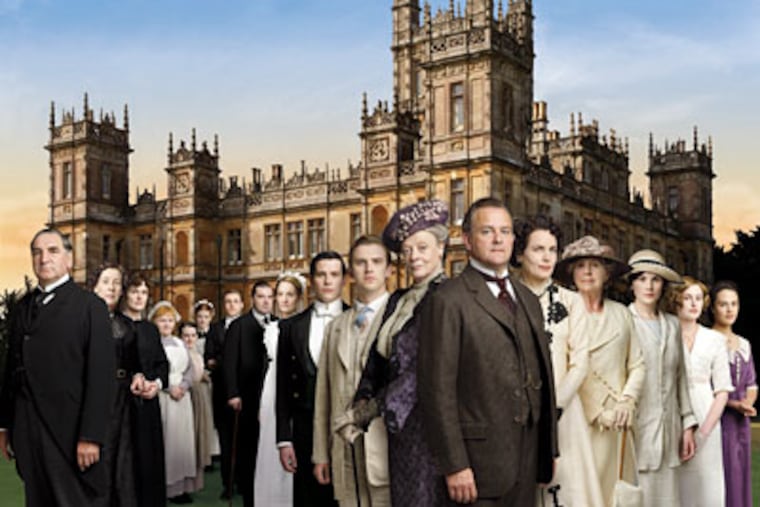
'The truth is neither here nor there," remarks the Dowager Countess of Grantham. "It's the look of the thing that matters."
Maggie Smith's Lady Grantham is the capstone on an assemblage of characters unequaled on TV at the moment - perhaps at any moment - in Masterpiece Classic's series Downton Abbey, which begins its second season at 9 p.m. Sunday on WHYY TV12.
The series, about life 100 years ago in a stately British home, looks very good, with credit going especially to the home itself, Highclere Castle, an astonishing place 90 minutes west of London, with a fascinating story. You could say it plays the title character.
"Whatever house we chose was going to be a character in the drama, and in a way, the principal character," says Julian Fellowes, creator and primary writer of the show, "so you wanted a very compelling house, not just some ordinary old big house with columns and a pediment."
There has been a building on the site for 1,300 years. Its current incarnation, "a Victorian wedding cake of a house," says Hugh Bonneville, who plays Downton's Duke of Grantham, was designed in 1842 by Sir Charles Barry, an architectural giant who built the Houses of Parliament. The castle sits on a 5,000-acre estate, with parks and a drive drawn up 70 years earlier by another British architectural legend, Capability Brown.
Like Downton Abbey, it has been in the same family for centuries, since 1679 to be precise, and is currently home to the eighth Earl of Carnarvon, George Herbert, and his wife, Fiona. Herbert's great-grandfather funded the effort that discovered King Tut's Tomb in 1922. The current Countess Carnarvon (car-NAR-von) discovered a lot of his leftovers in the attic, and has organized a fine Egyptology exhibit in the castle's cellars.
The Carnarvons may be wealthy, but they need every penny they can scrounge to keep the castle running. The castle, exhibit, and gardens are open to the public, primarily in the summer. Tickets are 16 pounds apiece (about $25). Executive producer Gareth Neame would not specify figures, but acknowledged that the Carnarvons were getting plenty of money from Downton producers, as they make what has been widely described as the most expensive TV show in British history.
You can also rent the joint for your wedding (the castle comes with a wedding coordinator), and the show has certainly increased demand.
Tour-bus bookings went from about 100 in 2010 to 600 in 2011 after the show's first season. Said Bonneville, "I think the impact of Downton has probably had quite a lot of effect on their ability to fill some holes in the roof, and that sort of thing."
It has stripped the Carnarvons of any need to sell the old pile, much of which is in bad decay, not that they were considering it. In 2010, they rejected an indirect offer from neighbor Andrew Lloyd Webber. "We are not selling up to some rich man," declared the countess. "We value the estate hugely. My husband and his family have invested money, time, love, and passion on it for centuries."
Downton Abbey has become an international sensation, playing in 200 territories, says Neame. The second season has ended in the United Kingdom. It's now opening around the world. A third season is already planned.
The show tells parallel, and sometimes intersecting, tales of the aristocrats and the people belowstairs, unfolding in the turbulent times after 1910. Two love stories are Downton's soul, but there are nearly 20 major characters and dastardly deeds and evil plots aplenty to add spice.
"Who knew it would be so much fun to watch a house of magnificently overdressed aristocrats and their servants living together under one roof?" host Laura Linney asks, as season two kicks off with the beginning of World War I, and Cousin Isobel persuades a reluctant Lady Cora Grantham to convert the house into a recovery ward for officers.
"Really," sputters the Dowager Countess, one of the most entertaining characters television has ever seen, "it's like living in a second-rate hotel where the guests keep arriving and no one seems to leave."
Cora is an American, rich as Croesus, married for her money to help support the estate. Countess Carnarvon at the time was even more exotic: the illegitimate daughter of superrich banker Alfred de Rothschild, who provided an annual dowry worth about $10 million in today's money.
Lady Almina was much more gung-ho about the war effort than the fictional Lady Cora, converting the house into a topflight hospital.
Much of Downton is filmed at studios in London - all the action belowstairs, many of the scenes in bedrooms - but scenes at the castle have an effect on the actors.
"The space is so huge above you and around you, there's something that happens to your body and voice," says Michele Dockery, who plays Lady Mary Crawley. "You can't kind of cower away and speak quietly.
"It's stunning. It's absolutely stunning. The library is my favorite room. I don't even know how far back those books date, and in the dining room, there is this huge painting of Charles I, which I think is insured for something like 18 million pounds."
Well, Michele, the books date to the early 16th century, and there are more than 5,500 of them. The portrait, by Van Dyke, was discovered rolled up in a barn after it was hidden in the mid-1600s, when Oliver Cromwell held sway and it wouldn't do to be seen as a friend to the executed king. The Australian TV show Better Homes and Gardens puts its worth at more than $90 million.
But don't you dare tell the Dowager Countess we're discussing such vulgar topics.