Ticciati shows promise in debut with Philadelphia Orchestra
The old belief that conductors don't become truly great until age 60 has wilted with so many emerging young talents whose intense magnetism leaves you unable to immediately say where they stand on the greatness continuum.
The old belief that conductors don't become truly great until age 60 has wilted with so many emerging young talents whose intense magnetism leaves you unable to immediately say where they stand on the greatness continuum.
The latest is Robin Ticciati, the 28-year-old British conductor who has ducked intense media glare with regional positions leading the Scottish Chamber Orchestra and the Glyndebourne Touring Opera - while slowly making high-visibility debuts.
The latest - with the Philadelphia Orchestra, which he conducted at the Kimmel Center Thursday night in Beethoven's Violin Concerto, with soloist Arabella Steinbacher, and Sibelius' Symphony No. 2 - was a huge success with the audience. Many ideas and much talent were evident, though the Thursday concert felt like the first encounter it was. However promising, the music-making hadn't entirely jelled.
In a way, that told you the artists were pushing themselves onto new ground - a quality particularly evident with Steinbacher. She can be emotionally reticent, but here delivered an interpretation that was full of profoundly beautiful passages, pushing the tempo boundaries to extremes with one of the slowest versions of the second movement I've ever heard.
Justifying the larger canvas created by such speeds was anything but the typical alabaster-statue approach to Beethoven. Each sequential repetition by Steinbacher was varied, creating a great sense of expressive incident, and was seconded by Ticciati. In fact, they were so much a unit that, on her own during the first-movement cadenza, she couldn't maintain the spell the two of them had cast. That was not the case in the third movement, however: She made you share the composer's hesitation to end the piece.
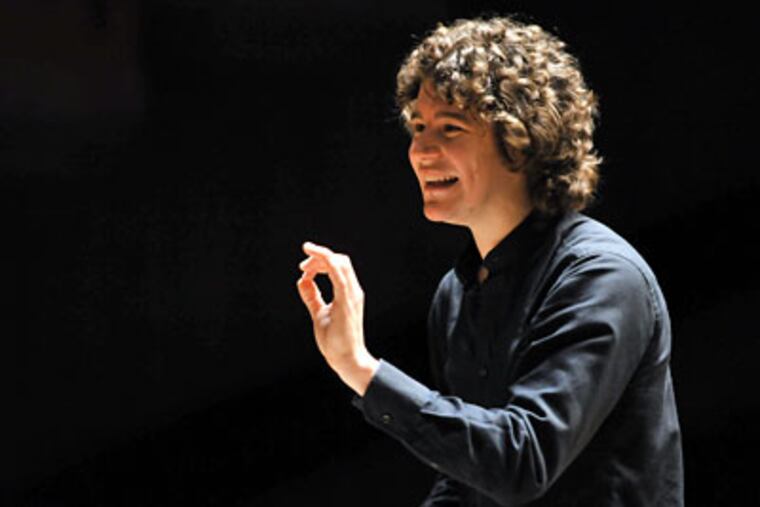
More than most conductors, Ticciati changed his conducting manner from piece to piece. Most of the Beethoven was handled by his right-hand baton and a tiny, tightly focused beat. Exuberance was summoned by his left arm. Strong accents seemed to shoot up his spine. Sibelius, in contrast, demanded as much of his physicality as is possible at this point in his development. The lanky Ticciati seems unused to how tall he is, and not entirely sure how to use all that he has.
The qualities that made you respect him were also the ones that got in his way. He's unafraid to use silence as an expressive tool - the rhetoric in the opening of Beethoven's Violin Concerto, for example. But in the second movement of the Sibelius, the silence impeded the music's fragile forward motion.
In general, the Sibelius hit bull's-eyes. The Philadelphia string sound flooded the piece (good!), while the wind solos showed you the music's proud though dark Finnish soul.
I have heard a number of Ticciati live performances on Web radio, and one consistent quality - heard also in Thursday's Sibelius - makes me treasure his youth: Many musicians experience the wonder of first discovery with great music, but few project it so completely as Ticciati. Thus, Sibelius' nature painting had an unusually intense sense of longing. Though he's likely to acquire depths in the coming years (he was recently appointed music director of the Glyndebourne Festival), one hopes that Ticciati's unguarded emotionalism stays. Long may he long.
Contact music critic David Patrick Stearns at dstearns@phillynews.com.