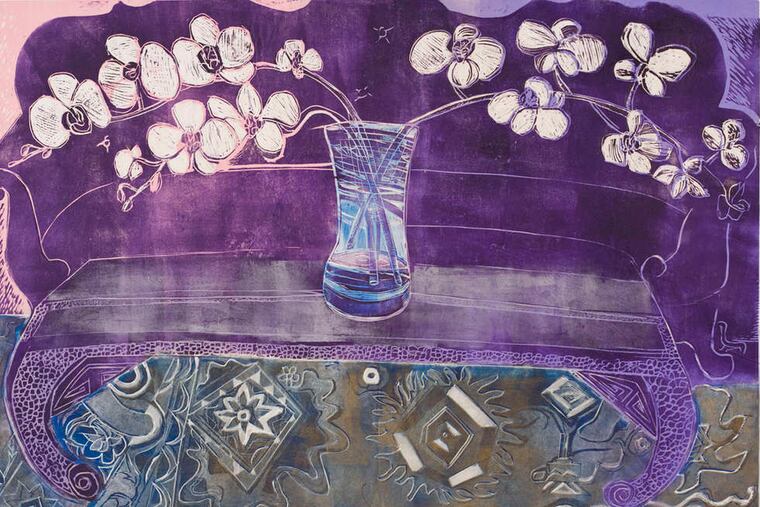
Artist Idaherma Williams shows gentle independence in the way she works: Having evolved her own private rules, she goes about the business of her art meticulously, at her own pace, on her own terms.
This is conspicuous in the one-woman show "Idaherma: A Discovery of Woodblocks in Color" at Villanova, where she is displayed as an experienced front-runner among printmakers today. Quite a few artists are taking their cues from her, returning to what's become a vital trend: seeking inspiration in ancient, seemingly primitive, color woodcut printmaking. Never having seen a complete show by this Princeton artist previously, I'm astonished at what she's been able to do in these 41 fairly large works on view, only a few of them black and white.
It's her individualistic, hands-on approach to her medium that's distinctive, yielding often-awesome results. Rather than using a printing press, Idaherma, as she prefers to be known, painstakingly hand-rubs the images from her painted and inked woodblocks onto handmade Japanese rice paper - doing so because she genuinely loves the process, "every step of it." The best results are fresh, nuanced in their color, and light-filled.
As she has made color woodcuts without relying on the buttress of critical theory, her development over the last several decades has been marked by an increasing mastery of line (actually, white outlines), color, and placement. Most striking are abundant, frequently superb floral still lifes, outdoor nature subjects, and rainy-day views. There's sometimes a message behind such beautiful pictures, with their breathtaking merging of one color into another and their enlivening light sources. Occasional hints of social consciousness in her New Jersey commuter-train series seem at odds with her whimsical sensibility. Yet she uses that tension to generate still another kind of inner liveliness. A must-see.
Words' worth
The winter exhibition about words at Temple Judea Museum of Keneseth Israel could have been called "Words: When Art Takes a Rest," except that considerable art graces this show. And, appropriately titled "WORDworks: Precious Heritage," it has an exemplary significance beyond the congregation it serves, featuring its own archival materials and objects on loan. The chief impression I came away with is how learnedly and respectfully it presents its religious and cultural heritage.
There are ordinary books, rare books, book-related objects - an antique Hebrew-English typewriter - and wonderful artists' books aplenty. A 16th-century Torah commentary bears an actual censor's mark from the Inquisition. A book teaches children sign language in Hebrew. More: a book with zippers, a Hebrew marriage contract, a copy of the sermon (in German) delivered by Keneseth Israel's rabbi the day of Lincoln's burial. For information about the closing program, "Curatorial Conversation" on Feb. 5, contact Keneseth Israel.
Conjunction
The Old City Jewish Art Center is one of the few area galleries whose exhibitions generally are related to subject rather than style. But earlier this month, both it and another gallery opened topic-themed shows featuring nine area artists.
The one in the Old City Jewish Art Center's part- gallery/part-community gathering place on Third Street is a group show called "Because," which, it can be assumed, is devoted to art originating from or reflecting some sort of moral attitude.
Meanwhile, across town at Gross McCleaf Gallery, another assemblage of nine invited artists, not from the regular stable, explores the theme "The Romantic Impulse: Currents in Contemporary Art, Part I."
Running concurrently, the former leans more toward abstraction, while the latter favors representational art focusing on figure painting, landscape, and still life. What they share is the fact that most of the 18 artists represented seem to consciously work against what can be perceived as the insincerity and skepticism of the postmodern attitude.
This is their common bond. And there's quality in both shows. Take a look and compare.