Galileo served as this painter's muse
Michael Morrill, a prominent Pittsburgh abstract painter, is introduced at Seraphin Gallery in his first Philadelphia solo. A teacher of studio art at the University of Pittsburgh, the Yale-trained Morrill became an artist when the reductive aesthetic of
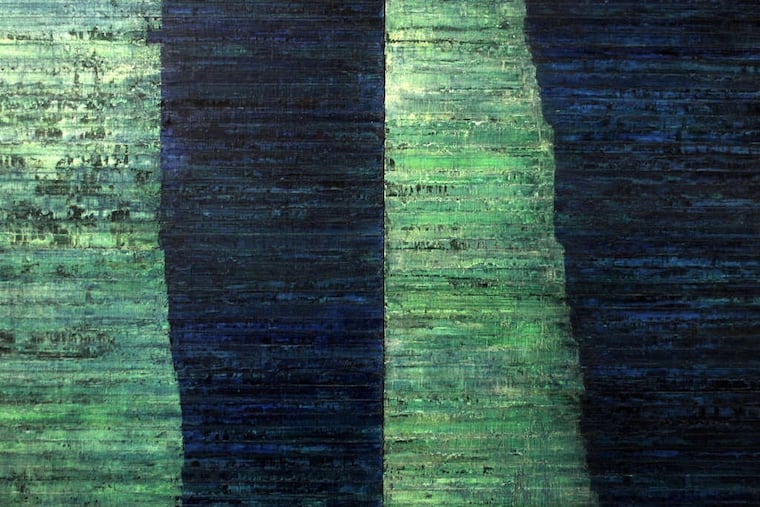
Michael Morrill, a prominent Pittsburgh abstract painter, is introduced at Seraphin Gallery in his first Philadelphia solo. A teacher of studio art at the University of Pittsburgh, the Yale-trained Morrill became an artist when the reductive aesthetic of the 1970s, not the more austere minimalism of the 1960s, was emerging and combining itself with painterly enrichment - something that characterizes his distinctive handling of this method. I'd say Morrill keeps half a foot in the reductive camp, while his paintings emphasize their expressive option with brilliance.
In "Dawn and Dusk," featuring two series of works inspired by Galileo's moon drawings, Morrill is especially aware of the tension between light and dark as well as the transitory nature of shadow, some of it deep. His canvases are actually composites of hundreds of small, narrow strips of linen laid side-by-side horizontally, attached to backing, and painted with multilayered pigment, each application sanded to give depth.
On close inspection, such abstract paintings are tense with textured involvement along otherwise flat surfaces and along straight-line edges - a reminder that Morrill had training as a sculptor. But if we pull back, there's almost an elimination of such detail as we see his overall effort to contain paint juiciness and keep it within bounds. Twin paintings are plentiful, their dominant bright contrasting colors usually well-balanced. Other successful paintings are those that transpose the dark or light color drawn to the sanded surface; such handling can soften and lubricate any dryness in color.
And while Morrill is no "early modernist" seeking spirituality in abstract art, he is having a go at exploring mysteries of the moon, of divinity and various philosophies with his paintbrush, always remembering, too, to scrape beneath surfaces. An unusual and compelling show - yours to explore as well.
Dual solos
The University of the Arts' College of Art, Media and Design's two photo galleries, the Sol Mednick Gallery and Gallery 1401 of Photography, both are housed in Terra Hall, on the 15th and 14th floors, respectively. And both are hosting wildly diverse and equally fascinating small exhibitions.
Mary Parisi's "Food" solo at Gallery 1401 features a San Francisco-area artist active in both sculpture and fine arts photography. She's lately turned to her kitchen for her large color close-ups of various edibles, each seen in an active stage of preparation. Some images may be a bit mystifying, as when one seeming abstraction turns out to be Tomato Splatter. The most compelling image of the seven here? Boiled Chicken, awesomely detailed in its glorious nakedness. There's an allure to Parisi's images, even in that homey poultry close-up.
At the Sol Mednick Gallery, Nick Kline is the undeniable heavyweight. This New Yorker, a UArts alum (class of '90) who teaches photography at Rutgers/Newark, in his 17-piece traveling show "Din of Murmurs, Mold" focuses not on moldy objects, but on rubber silicone objects used in a sculptural casting process.
For this show, which has traveled widely, he's made photos taken from castings of various kinds, including objects from now-closed St. Vincent's Hospital in Greenwich Village, which was a major treatment center for AIDS-related illnesses at a time when fatalities in New York from HIV/AIDS were sickenly high.
Kline uses photography for deep social engagement in response to various traumas, including problems with hate crimes. And he often works on this with art students and survivors - the "din" of his show's title is meant to advocate compassion and openmindedness.
It's now being said of Kline that by embracing an idea, his photos update the history of mid-20th-century abstraction. His photography refers to abstraction, all right, as we can readily see in many of his images of molds, but he goes further and offers social commentary.
It's a welcome homecoming for Kline in the Sol Mednick Gallery, still the only endowed gallery in Philadelphia dedicated to exhibiting photography exclusively.
Here on Earth
Ever wonder what present-day Korean art in the Buddhist tradition looks like? The Korean-born ceramic sculptor Veronica Juyoun Byun, in her show "A Modular Vision" at the gallery at St. Joseph's University, has explored this and come up with some answers.
Aware that Buddhist traditions have lots of symbols to suggest finding paradise on Earth, Byun set out to discover new imagery in the same vein. She then engagingly expressed it as sculptural wall panels in her medium, clay. Especially captivating among those on display here are panels of geometric shapes that capture a rainbow or primary-color scheme symbolizing protection, especially from sources of evil. The repeating curvy shapes she creates are especially impressive in Shimmering Sea at Sunset, where they represent symbolic membranes or skins seemingly tossed from their moorings by sea breezes.
Byun sees this flux of expansive space as a Buddhist metaphor for the human condition. Misty Dawn and Serenity After Summer likewise ably suggest time of day and seasonal changes. These three and several other multiunit pieces are especially serious, accomplished work suitable for a permanent wall installation.