Locomotive of love, peace and soul
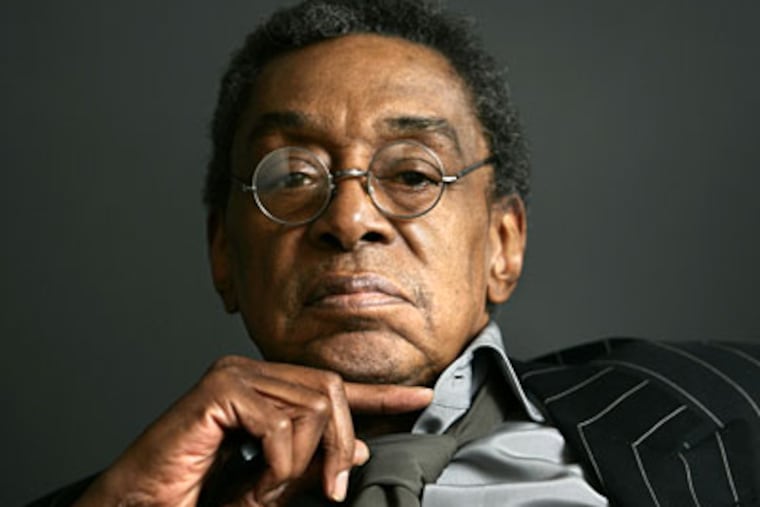
Don Cornelius and "Soul Train" transported his African American fans, showing how beautiful black could be.
When we were growing up as teens in the 1970's, Saturday mornings filled my sister and me with funky anticipation.
We'd race downstairs, flip on the Magnavox, and settle in to experience "the hippest trip in America" - Soul Train.
See, Soul Train wasn't just any television dance show. Soul Train belonged to us.
Soul Train showcased our R&B music, our artists, our dances, heck, even our black hair-care products. It was our cultural touchstone at a time when we were learning that, yes, black was beautiful - even if we weren't quite sure if we believed it yet.
But Don Cornelius, Soul Train's pinstripe-suited, haystack-afro'ed, deep silken-voiced creator and host, affirmed it for us. That's why it's so ironically sad that news yesterday of Cornelius' death at 75, from an apparently self-inflicted gunshot wound at his home outside of Los Angeles, came on the first day of Black History Month.
With Soul Train, which ran from 1971 to 2006 in 100 markets, Cornelius' pioneering efforts made history for generations of African Americans. (Cornelius stepped down as host in '93, but stayed on as executive producer.) It would become the longest running syndicated show in history.
Aside from Motown's Berry Gordy, "Don Cornelius was hands down the most crucial nonpolitical figure to emerge from the civil rights era post-'68," Roots drummer Ahmir ?uestlove Thompson posted on okayplayer.com. ". . .Yes, the idea of the young black teenager not mired in legal trouble on the 6 o'clock news getting camera time was a new idea to most, so of course the fact the U.S. really got its first vicarious look at our culture was amazing."
On Soul Train, we'd watch stars such as Aretha Franklin (accompanying herself on piano with a fawning Cornelius by her side), James Brown (who performed a showstopping live concert with his band), and Stevie Wonder (who freestyled a song for the show live, much to the delight of the Soul Train gang). But the program also provided a venue for less-known acts.
Artists like the Gap Band. The Dramatics. Frankie Beverly and Maze. And a quartet of young, harmonizing divas from Oakland who called themselves the Pointer Sisters.
"Don's vision allowed for African American artists to be exposed to people all over the world through the power of television," said Sound of Philadelphia producers Kenny Gamble and Leon Huff, in a statement after Cornelius' death. The duo created the show's theme song, performed by The Sound of Philadelphia (TSOP).
Cornelius, who began as a Chicago disc jockey and sports anchor, pitched a dance/variety show, a sort of soul-infused American Bandstand, to WCIU-TV executives in 1970. He'd name the program Soul Train after his whistle-stop revue, in which local artists would perform going from one high school to another.
In a 1995 interview with the Washington Post, Cornelius said he formatted Soul Train "to be the radio show I always wanted to have . . . . It never really slows down or engages in discussion or long interviews."
It sure didn't. Soul Train was music and dancing, straight up.
And boy, could they dance.
What I wouldn't give to move like the Soul Train gang; to take just one trip down the Soul Train line, pop-locking and leg-kicking like Damita Jo Freeman, one of the show's best dancers.
Every Saturday morning, my sister and I would jump up in our pjs, shaking our groove things down the middle of the living room floor as if there was a Soul Train line forming beside us.
Such is the power of Cornelius' influence that African Americans have adopted the Soul Train line as a cultural mainstay.
In later years, Cornelius never strayed from his mission, creating the Soul Train Music Awards to honor African American artists.
He was honored, too, with a Rock and Roll Hall of Fame induction and a star on the Hollywood Walk of Fame.
But recently, Cornelius had avoided the public, reportedly suffering from decades of health problems related to brain surgery in 1982. He also struggled with depression.
"He could be mean," radio host Tom Joyner admitted while paying tribute to his friend on his show Wednesday.
In 2008, Cornelius was arrested for felony domestic violence against his estranged wife. In a 2009 interview, he said he wanted to get his divorce finalized "before I die."
He is survived by two sons, Anthony and Raymond.
Nobody thought it would end this way. I'd rather think of Cornelius as he was, cool conductor inviting us aboard, his rich baritone promising, "You can bet your last money it's all gonna be a stone gas, honey."
His lasting legacy? Surely one of love, peace and sooooooul.