'Logan Grider: Recent Work': Abstract paintings reflecting a visceral approach
Logan Grider finds personal freedom in painting abstract forms, emphasizing the hue and texture of his painting materials in his show "Logan Grider: Recent Work" at Swarthmore College's List Gallery.
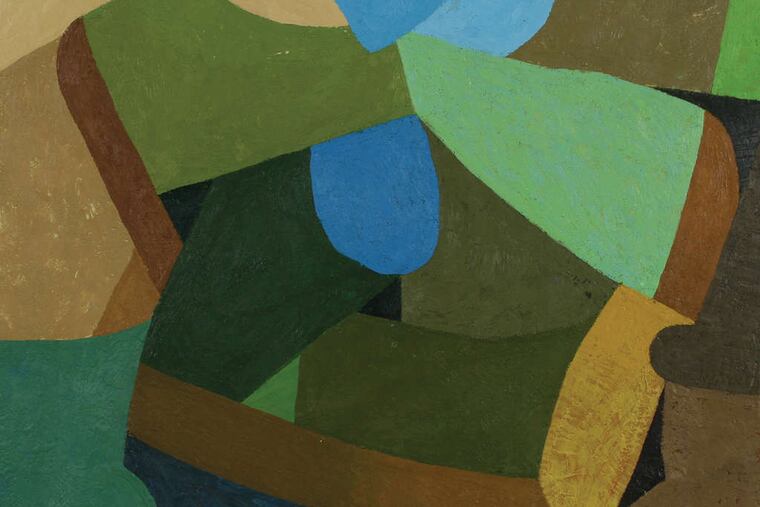
Logan Grider finds personal freedom in painting abstract forms, emphasizing the hue and texture of his painting materials in his show "Logan Grider: Recent Work" at Swarthmore College's List Gallery.
Seemingly uninterested in simply portraying what he sees from a naturalistic viewpoint, this 32-year-old teacher of painting at Swarthmore is no linsey-woolsey primitive or folk artist. Nor is he an elegant stylist. His inclination is more toward an emotional and intuitive idea of what painting is than a cerebral concept. And his paintings reflect that visceral approach, for the emphasis is on setting down immediate sensations.
The visceral approach also is evidenced by his preference for encaustic, which he uses by mixing pure pigment into heated beeswax. The resulting surfaces (they have the texture of fine kid gloves) are both painted and fused in a process combining drawn, brushed, and blended areas of saturated color in wide-ranging, often high-spirited combinations. The abstract shapes in these squarish, medium-size panel paintings are hard-edged, rounded, overlapping.
Such paintings are expressive investigations of the interior energies Grider realizes are at work in our surroundings - the particular rhythms of objects, their inclination, movement, or interior force.
Talk like that about motion calls to mind the Futurist painters, who liked to include a central vortex in their city views - something Grider often does, too, in his abstractions.
Exuberant paintings deftly handled, these decidedly colorful works are slow to reveal their meanings. For reference, we have only the most speculative meanings suggested by several titles - Household, Mother, Totem, Ancestors. But the variousness of these 16 works should be seen as the sign of an artist who's searching - and for the most part finding - ways to deepen his ambition. Good show.
Blazina at Drexel
Jen Blazina's enthusiasm for printmaking and photography, which blossomed during college and graduate school, only
seemed
replaced by her lately better-known interest in casting objects in clay and, especially, glass. Now all four competing enthusiasms are evident in her show, "Westward Ho," at the Pearlstein Gallery at Drexel University, where this Philadelphia artist teaches. But to suss out that cast objects are currently her main interest takes close looking, for the casting process she is using takes several different forms, the one involving glass being particularly inventive and interesting.
For her display of 29 found-object pocket watches, Blazina screen-printed silhouettes of family and friends onto thick cast glass she inserted into each watch. The expressive dimension counts here, but so does the idea for undertaking recycling before beginning a sculptural process. The show's title refers to a series of miniature ceramic cars and animals. Nonfunctional stoneware carrying cases, hand-printed wallpaper, and about 60 small decorative plaques (including both cast porcelain and molds) round out the display.
Play time
Bertha Steinhardt Gutman's project as a storytelling artist in her show, "Table-top Narratives, 1991-2011," at Delaware County Community College involves acknowledging the grand legacy established by the world's old-master artists, whose biblical, mythological, and historical subject matter was a framework for the canon of art-historical masterpieces.
Gutman two decades ago undertook her own painting adventure, in which the human figure was replaced by various surrogate dolls, figurines, and statues, from Barbie to Mr. Potato Head. And because, until the mid-19th century, still-life painting was the only artistic endeavor most female artists were allowed to pursue, Gutman decided to try grand-scale figure narrative - within the traditional still-life format.
In the 20 years since receiving her master of fine arts degree, Gutman, who now teaches at Delaware County Community College, produced the 32 oils on this theme - some of them large - that are currently on view in Media. When this unusual project speaks to its audience of college students and visitors, it relies on the power of suggestion, avoiding heavy rhetoric. Silently, the viewer reaches a point of understanding.
Yet it's in the realm of humor and irony that Gutman situates much of her artwork. Two of the pieces, I Live in a Doll's World and Aliens Meet the Earth Goddess, perhaps sum up her approach. The project emphasizes the whimsical and the funky over the dark or satirical. "Perception and the wondrous act of seeing and painting are always of prime concern to me," Gutman said.