Art: The glory of van Gogh in his element - nature
The moment you enter "Van Gogh Up Close" at the Philadelphia Museum of Art, the exhibition tells you that it's something special, one of those uncommon revelations of artistic soul that once seen, can never be forgotten.
The moment you enter "Van Gogh Up Close" at the Philadelphia Museum of Art, the exhibition tells you that it's something special, one of those uncommon revelations of artistic soul that once seen, can never be forgotten.
The trigger is a small painting of several sunflower heads, brilliant yellow against an azure background. Sunflowers are Vincent van Gogh's painterly signature, so why does this image, lent by the Metropolitan Museum of Art, make such a powerful impact?
It even overshadows a much larger, and more typical, still life of sunflowers in a vase that hangs within arm's length. Next to the detached flower heads, this painting, one of the Philadelphia Museum of Art's postimpressionist prizes, feels oddly reticent.
The sense of passionate engagement with nature, with everyday manifestations of life in all its profuse and glorious variety, is the difference. "Van Gogh Up Close" connects us to the artist's immersion in the natural world, which at times reaches devotional intensity.
We not only see how closely he examined nature, down to the level of butterflies and panicles, we also feel an emotional current that passes from eye to hand to canvas.
"Van Gogh Up Close" reveals the essence of the artist's mystique and of his enduring popularity more effectively than any other exhibition of his art that I can recall, including the last one in Philadelphia, a portrait show in the fall and winter of 2000-01.
To appreciate why this is so, one needs to recall the principal stages of van Gogh's tragic life and career, which I'll get to presently. But first, the particulars.
The exhibition was conceived by Cornelia Homburg, an independent scholar and expert on the artist who serves as guest curator. It's such a fruitful idea, and one that so touches the heart of van Gogh's emotional life, one wonders why it took so long to be developed.
The exhibition was organized by the Art Museum and the National Gallery of Canada in Ottawa, whither it travels after closing here May 6. Joseph J. Rishel and Jennifer A. Thompson are the Art Museum's cocurators.
Although installed in the museum's largest special-exhibition space, "Up Close" is modest in size - 46 paintings and 30 works on paper by other artists and photographers that illuminate van Gogh's possible sources.
These ancillary sections include a stunning display of Japanese woodblock prints, most by the 19th-century master Utagawa Hiroshige.
Van Gogh and some of his European contemporaries freely adapted conventions of Japanese art. Compare, for instance, his painting Rain, a view over fields from his room in the asylum at Saint-Remy, with Hiroshige's color print The Great Bridge: A Sudden Shower at Atake.
The exhibition may present only 46 paintings, but the catalog reproduces many more, affirming that nature was one of his primary themes, and perhaps the one closest to his heart throughout his life.
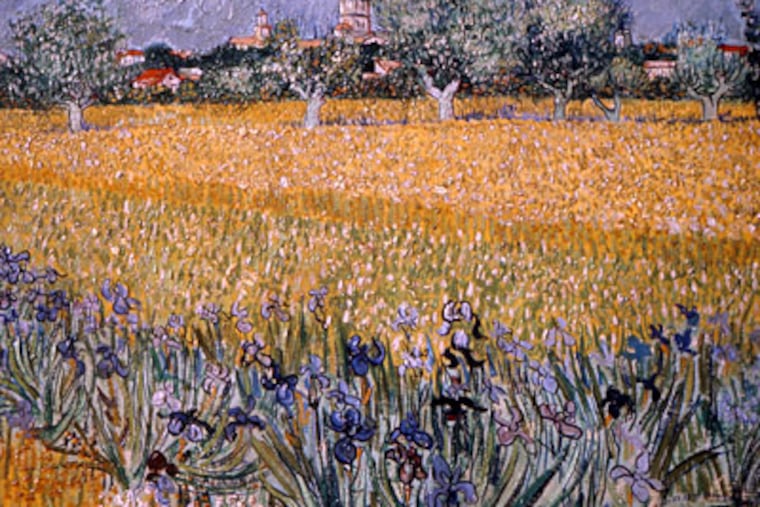
Landscapes such as Rain are probably the most familiar aspects of his dialogue with nature, but the exhibition introduces us to other, more focused subjects such as trees, individual flowers, woodland ground covers, close-ups of grass and grain crops, a memorable snippet of a flowering almond tree, even the aforementioned butterflies.
For instance, Ears of Wheat, which Van Gogh must have painted with his nose within sniffing distance of the stalks, is clinically observant of botanical detail while also recording subtle visual rhythms.
Likewise Grasses and Butterflies (which are nearly invisible) emphasizes the interlocking wave patterns created by the clumps of grass, which Van Gogh rendered with fluid, sweeping strokes.
The variation in his brushstroking after he discovered impressionism suggests a determination to recreate maximum visual impact regardless of source.
There's a lot of green in this group of paintings, probably more than you might expect from an artist known for his exceptionally vivid palette.
In later works, his green, so dark and assertive in the woodland pictures, tones down to a soft jade that makes the artist's impressions more poetic, even melancholy.
One can see this effect clearly in paintings such as Vineyards With a View of Auvers, which consists mainly of fields sweeping to the distant horizon, and in Field With Wheat Stacks, in which the scene begins to dissolve into broad, quivery strokes.
In this picture particularly, made in 1890, near the time van Gogh died, one senses a feverish impulse to record as much of nature as possible before time runs out.
Despite the fact that there have been many van Gogh exhibitions, this one feels fresh; it contains many paintings I hadn't encountered, even in reproduction.
Many are small, and not as imposing as some of the artist's more iconic images, such as Road Menders at Saint-Remy, in which a file of massive plane trees marching down a boulevard median, not the inconspicuous laborers, is the real subject.
Some of the smaller pictures are among the most compelling in the show; for instance, Trees in a Field on a Sunny Day is not only lyrical - and we don't usually think of van Gogh in these terms - but chromatically understated.
It's quiet, even contemplative. So is Park of the Asylum at Saint-Rémy Hospital, two sinuous tree trunks framing a colorful thicket of foliage that nudges reality into thoughtful abstraction.
When we look back at how van Gogh's adult life unfolded - erratically and contentiously - his eventual engagement with nature on such an intimate level begins not only to make sense but to seem inevitable.
His first job, working for the same art dealership that employed his younger brother, Theo, didn't pan out. He tried teaching, then preaching to Belgian coal miners, but again his prickly personality betrayed him. (He had thought of becoming a minister like his father, but the educational requirements proved too daunting.)
He had always drawn, almost obsessively, but it wasn't until 1883, when he moved to an isolated rural area of the Netherlands called Drenthe that he began to paint nature. Relocating to France in 1886, first to Paris, where he lived with Theo, and then to the south, where most of the pictures in "Up Close" originated, nourished the attraction.
In Holland he had committed to figuration, and painted darkly, i.e., The Potato Eaters. But after discovering impressionism in France, his palette and his technique became highly energized.
In nature, I think, van Gogh discovered the religious calling that had eluded him in the church at home. The religion was pantheism, but as we see in "Up Close" it was deeply felt, as spiritual as the angels and Annunciations of Piero della Francesca and Fra Angelico.
That's why this exhibition, so thematically concentrated and beautifully installed, brings viewers closer to the essential Van Gogh than anything that has come before.
Art: Van Gogh's Nature
"Van Gogh Up Close" continues at the Philadelphia Museum of Art, 26th Street and the Parkway, through May 6. Hours are 10 a.m. to 5 p.m. Tuesdays through Sundays, to 8:45 p.m. Fridays. Tickets are $25 general, $23 for visitors 65 and older, $20 for students with I.D. and visitors 13 through 18, and $12 for visitors five through 12. Information: 215-763-8100 or www.philamuseum.org.
EndText
Van Gogh Up Close
Philadelphia Museum of Art, 26th Street and the Parkway. Tickets: $12-25. Information: 215-763-8100 or www.philamuseum.org