Lead singers: Singers thrive at Academy of Vocal Arts
AFTER MORE than 60 years of performances, Opera Cleveland closed its doors in 2009. Then Hartford, Conn., lost its only opera company. Boston quickly followed, shutting down after a final performance of Mozart's "Bastien und Bastienne."
AFTER MORE than 60 years of performances, Opera Cleveland closed its doors in 2009. Then Hartford, Conn., lost its only opera company. Boston quickly followed, shutting down after a final performance of Mozart's "Bastien und Bastienne."
Across America, from Fremont, Calif., to San Antonio, to Baltimore, opera companies mired in massive financial debts and under pressure from underfunded arts organizations have been closing. (Philadelphia is bucking the trend, see Page 26.)
Time cannot silence Verdi, Mozart or Stravinsky, but a lack of money can.
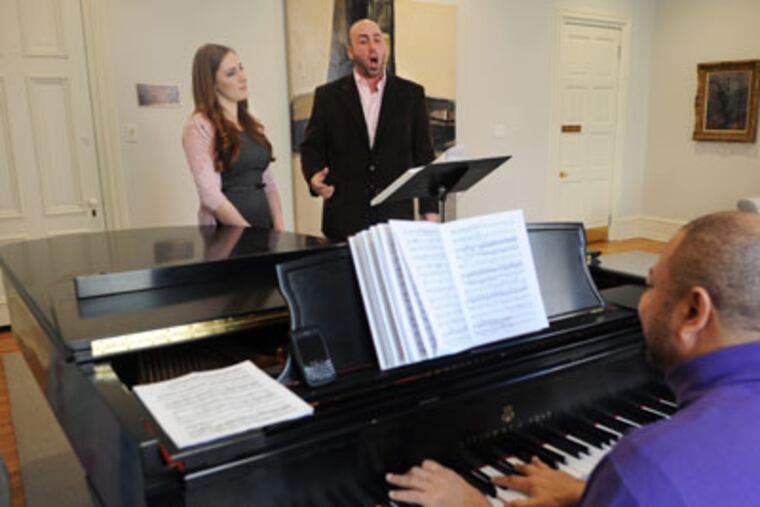
This is the unstable world facing opera singers in training at Philadelphia's Academy of Vocal Arts. One of the premier opera training companies in the world, AVA refers to its talented young students as "resident artists" as they make a four-year journey from amateur to fully formed professional opera performers.
Luigi Boccia, 31, is one of them. The tenor from Serino, Italy, has a rich voice that fills the room when he speaks. He does not so much gesture as conduct the conversation with perfectly controlled arm motions. But he does not allow himself the indulgence of the stereotypical opera persona, of the ego that stretches out further than his voice.
"This is something between a job and an artistic mission," he stated firmly. "Opera singers can be . . . delusional, when you think everything you do is genius and God touched your vocal cords."
For Boccia, opera is more a calling than a profession. "You don't choose opera, opera chooses you," he said.
In his case, the call came as a serendipitous encounter with a friend's voice instructor. Boccia accompanied his friend to a lesson, where he was invited to sing a little. The instructor immediately told him to change careers - he was studying for a degree in musicology at the time - and begin training for the opera.
So the singing hobbyist became a student of opera. And that brought him to AVA.
AVA freshman Sydney Mancasola, 25, came to the academy by an equally circuitous route. Trained as a classical violinist from the age of 2 (she saw her older sister learning the violin and threw a fit until she was allowed to take lessons, too), the soprano from Redding, Calif., switched to voice after the death of her childhood violin instructor.
Becoming students at AVA is a plum prize in the opera universe. Getting into this exclusive school isn't easy. Between 200 and 250 singers audition every year for six to eight spots. None of the residents pays tuition; an endowment that marketing director Denise Stuart describes as "secure" - supplemented by active fund raising and box-office income - means the residents train for free. That training includes live performances, including full operas, usually with piano accompaniment, at AVA's theater and at churches, schools and other venues in the region.
Recent AVA alumni have found jobs at at New York's Metropolitan Opera, the San Francisco Opera and houses across Europe. Former students include Beverly Wolff and current star Burak Bilgili, who went straight from Philadelphia to Milan, Italy's La Scala. Stuart estimates that 62 percent of AVA's alumni are actively performing.
Boccia was drawn to the school for the chance to work with music director Christofer Macatsoris. Macatsoris comes from what Boccia refers to as "the golden generation of singers" and has worked with many of the opera greats through the 1960s and '70s. "He is from the era I idolize," Boccia said. "These are the singers who made modern opera great."
But training for the opera means coming to grips with the business side of the art, too. And that's where AVA helps by providing its students with a clearer idea of the demands of a working opera singer.
Those demands can be daunting.
For example, although Mancasola is a first-year resident, she is already carrying a major opera, Claude Debussy's "Pelléas et Mélisande." Since the role is outside her normal vocal range, it's more of a challenge. By the time the opera opens on Saturday, she will have learned the score in French, as well as the history of the opera that was born out of a Maurice Maeterlinck play of the same name.
She and the rest of the players will also plan the stage design. It's a classic operatic set up: A young woman tragically falls in love with her betrothed's brother. Much of it is set in and around bodies of water. Translating a watery environment to an indoor stage without it looking hokey can be a challenge for someone new to stage design. "This is baptism by fire," she said. "It tests your vocal stamina and your mental stamina."
Much of the training of an opera singer focuses on the voice: on developing a rich timber, learning how to sing for five or six hours a day without damaging the vocal cords, expanding the reach of a voice.
But there is a lot more to learn. Each singer must have a working knowledge of the three primary operatic languages - French, Italian and German - as well as a dash of secondary languages such as Russian.
Depending on the role, a singer might have to study the art of stage fighting with a rapier or sword.
Stuart, herself an AVA alum, admitted that the residents' course load is grueling. "It's special forces training," she said. "We own you 24/7."
And while the training is intense and highly controlled, what comes after graduation is less certain.
Dreams of starring roles at the world's grand opera houses have to be tempered by the reality that eking out a living can be a challenge. And although it's hard for anyone to predict the future of opera, for now the jobs look as if they might reside in Europe, where opera is less of a niche entertainment. Mancasola is resigned to the fact that she might have to leave her family behind in order to get paying jobs.
For Boccia, the tragedy is not that opera singers may be paid less, nor that there might be more competition for fewer jobs. Boccia remains realistic about his career options. "Obviously I didn't choose this career because I want to be rich," he said.
What worries him is the future of the artistic form itself. "For a kid like me at 5 or 7, going to the opera was as important as a new bicycle or pizza on a Friday night," he said. "What worries me is that an incredible art form will be enjoyed by fewer and fewer people."