Pine Bros. throat drops, an old Philly product reborn
For some Philly brands, it seems everything old is new again. The owners of Franklin Fountain in Old City have reopened Shane Confectionery with the original fixtures and candy recipes. Goldenberg's Peanut Chews candy is back. Now, Pine Bros. throat drops are the latest addition to the Philly brand revival. They're the sweet and "softish" lozenges recently relaunched with the original recipes and a bizarre rockabilly-themed ad campaign by 3 Sisters Home Products.
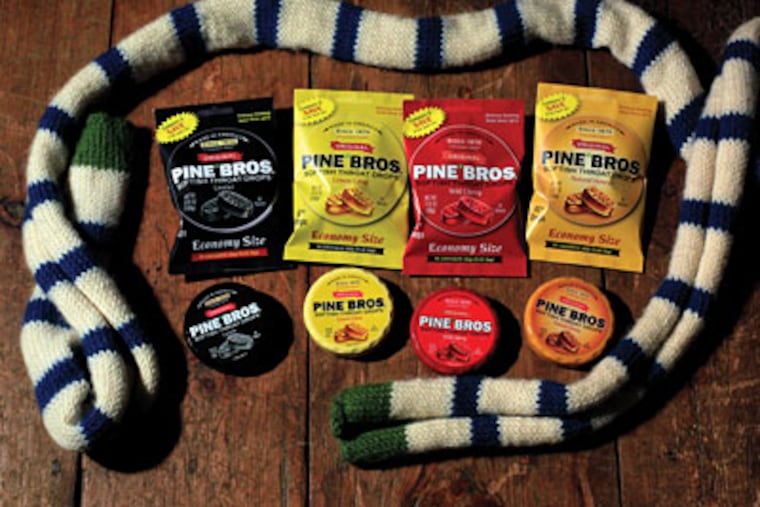
For some Philly brands, it seems everything old is new again.
The owners of Franklin Fountain in Old City have reopened Shane Confectionery with the original fixtures and candy recipes. Goldenberg's Peanut Chews candy is back. Now, Pine Bros. throat drops are the latest addition to the Philly brand revival. They're the sweet and "softish" lozenges recently relaunched with the original recipes and a bizarre rockabilly-themed ad campaign by 3 Sisters Home Products.
Behind the reboot are Victoria Knight-McDowell, who created the immensely popular Airborne immune support formula, and her New Jersey-born husband, Thomas John "Rider" McDowell.
Rider McDowell has fond childhood memories of the original drops, which were born in Philadelphia in 1870 when German immigrant candy maker J. Herman Pine combined gum acacia with glycerin to make "Pine Brothers Glycerine Tablets." "They tasted and felt like candy - at least I ate them that way - but they really soothed your throat," McDowell said recently from the home office in California that he and his wife share.
The McDowells' Airborne success story was enchanting: Victoria, a former schoolteacher, developed Airborne after getting sick from classroom germs. Rider sold a screenplay, and the two invested the money in launching the product, which was advertised as a cure for colds.
The fairy tale came to an end in March 2006, when a class-action lawsuit was brought against the company, claiming false advertising. Airborne had to change its advertising claim from "cold-curing" to "immune system-boosting" and paid about $30 million to settle the lawsuit.
Victoria Knight-McDowell calls the Airborne saga a baptism by fire. It's still a sensitive matter. "Class-action lawsuits are the scourge of American business, whether you're Airborne, Coca-Cola, or Procter & Gamble," she said. The company never admitted to any wrongdoing, and by the time a settlement was reached, the couple had sold Airborne to a private-equity company.
Now that the McDowells are out in the market with a new product for colds, the scars are visible. The new Pine Bros. drops - in Natural Honey, Citrus-Lemon, Licorice, and Wild Cherry - are marketed as "soothing," a claim that is so vague it's virtually indisputable. Any number of free things can soothe a cold: a hug, a warm blanket, a nap.
Knight-McDowell is explicit about her backing for the claim: "The active natural ingredient in it, besides the gum acacia, is glycerin, which is on the FDA monograph, meaning it has been accepted by the U.S. FDA as a natural ingredient to soothe sore throats."
So far, old-school candy fans have been over the moon about the return of Pine Bros. Old candy trades online in a kind of gray market. Buyers are enthusiasts such as Seattle blogger Mike Davidson, who recently bought a 50-year-old tin of Pine Bros. on eBay. A Pine Bros. post on Davidson's blog, "Mikeindustries.com," generated 289 comments and created a mini-community of enthusiasts. So far, Davidson is impressed with the cough-drop reboot, especially after a taste comparison with the 50-year-old cough drops. "I've tried the honey and cherry - the only ones released so far - and both are pretty true to the originals. Though I remember the old honey flavor tasting a bit stronger," he says.
"There's no difference from the original recipe. This is the original recipe," says McDowell.
To expand the brand to a younger crowd, the McDowells have enlisted the advertising help of Rudy "Tutti" Grayzell for Pine Bros.' live events (such as a December stop outside Philly's Hard Rock Cafe) and viral marketing schemes.
"It's a thrill to be out there for Pine Bros. and my music," says Grayzell. "Most of these kids haven't experienced either and they're loving them both."
Grayzell, a pioneering Tex-Mex rockabilly performer who usually wears a huge black wig and sunglasses, arrives at Pine Bros. gigs in his retrofitted "PineMobile" ambulance featuring a flip-down performance stage. He sings the tunes he played as a youth during the 1950s and hands out Pine Bros. samples. The company has also invested in television commercials featuring Grayzell.
Part of Grayzell's retro appeal has to do with his early career. "I was working at a grocery store and just had a record out [1956's "Duck Tail"] when a disc jockey introduced Elvis and me," says Grayzell, who subsequently toured as an opening act for Presley. "One day I had a little bit of a sore throat and I asked Presley how he kept his voice so smooth. He turned around and said 'Try one of these.' Turned out to be Pine Bros.," says Grayzell with a laugh.
Is it a coincidence that Grayzell, an Elvis-looking performer, just happened to have received a specific brand of cough drop 50-plus years ago from Elvis - and now that very same brand has recruited him as a celebrity endorser? "It wasn't rare back then, if you were on the East Coast or you were a singer to use Pine Bros.," says McDowell. "But having the King behind you isn't bad."