'Philadelphia Seder' performer melds Jewish music with gospel
On the other end of the phone line, Joshua Nelson is breaking into a traditional cantorial rendition of "Adon Olom," the Hebrew prayer that ends most Shabbat morning services.
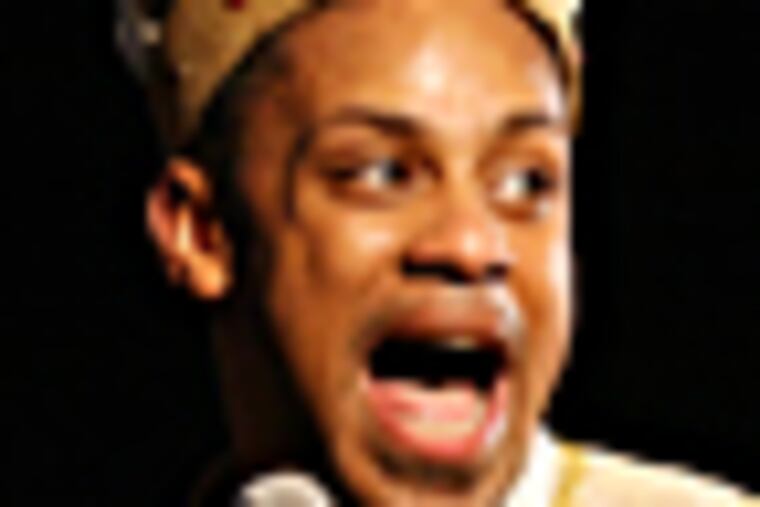
On the other end of the phone line, Joshua Nelson is breaking into a traditional cantorial rendition of "Adon Olom
,
" the Hebrew prayer that ends most Shabbat morning services.
In an instant, your whole childhood sitting in synagogue emerges vividly in deep, operatic vibrato. There's no doubt that Nelson - an African American Jew who traces his Jewish roots to Senegal and Romania - can do 15th-century traditional singing.
But then he ramps into his own version of "Adon Olom," in a style he calls "kosher gospel" - drawn from his devotion to both old-fashioned Mahalia Jackson-style gospel and traditional Jewish worship - and a whole new world of spiritual reckoning comes into being.
V'lo ha'oz v'hamis'rah - To him is the power and sovereignty. Indeed!
"I take traditional prayers and breathe life into them," says Nelson, 38, who has performed for Oprah Winfrey and Bill Clinton and will be performing Sunday as part of the "Praise" section of the Gershman Y's inaugural "Philadelphia Seder," a meal with entertainment that seeks to reinterpret the Passover seder. (The holiday begins at sundown April 6.)
"When I went to Israel, there was singing and dancing, it was powerful," he says. This led him to the epiphany that he could merge his love of gospel - an excited style with African melodies and rhythms - and the Jewish music he grew up with.
"We allow people to see Judaism as a much bigger idea than we can ever imagine," he says. "Gospel, 'Adon Olom,' what's the difference between the two? It doesn't become Christian just because I added soul to it."
In fact, some of the traditional prayer melodies used in synagogues often reflect the Greek or European musical styles of their day. And elements of many modern synagogues, such as organs and choirs, echo elements of church services. Hasidic Jews are the ones with a style most akin to gospel fervor; Nelson has performed for Orthodox crowds, with men and women seated in separate sections.
"My point was this: We can mimic Presbyterian white Christians - why can't we mimic black Christians?"
The "Philadelphia Seder" celebration - with a kosher (but not for Passover) meal by noted Passover caterers Lou G. Segal of New York City - is being billed by the Gershman Y as "a seder like no other."
Which, naturally, raises the very appropriate question, why is this seder different from all other seders? The seder (in which there will be no actual service from a Haggadah, just symbolic representations) will also feature performances by singer-songwriter Chana Rothman, the Brian Sanders Junk Dance Company, and Bible Raps, as well as readings from the Philly Youth Poetry Movement. It will be held at the WHYY studios, Sixth and Arch Streets.
"It's taking the tradition of a seder and interpreting it through music and dance and poetry through the course of the evening," says Warren Hoffman, director of programming at the Y. "There will be a meal, and wine. People are sitting at tables together. We're celebrating community. At one point, there will be a communal activity."
For Nelson, being part of a celebration themed for Passover - which celebrates the liberation of the Jews from slavery in Egypt - is especially meaningful. He is, after all, the descendant of both African American and Jewish slaves. He will perform after the meal, representing Hallel, or Praise.
"With my band, Passover is always the highlight of the year," he says.
Although he tires of having to explain just how it is that he is African American and Jewish, brought up Orthodox, a Hebrew schoolteacher, a devotee of the cantor Jack Mendelson of Temple Israel in White Plains, N.Y., the explanation is interesting: His mother, a descendant of Romanian Jews and African Americans, was adopted into a family of African American Jews who trace their Judaism to Senegal.
The seder's traditional first section, Kiddush, the blessing over wine, will be ushered in by the master of ceremonies, Rabbi Eli Freedman of Congregation Rodeph Shalom. The marking of sacred space will be represented by dance.
Following that will be karpas, dipping parsley into saltwater, which symbolizes both spring and rebirth, and the tears of slavery. Hoffman said the young poetry readers would handle those symbolic duties with their poetry.
The affliction and bitterness portion of the traditional Haggadah service will be handled by Rothman.
The telling of the story will be handed off to the Bible Raps group, who will interpret things in their manner.
Finally, in Praise, will be Nelson and his band, who will bring his own meaning to the traditional spiritual "Go Down Moses," in addition to the traditional Passover song "Dayenu" and, no doubt, his famous (and well documented on YouTube) reimagining of the "Mi Chamocha" prayer of praise, sung by the Israelites in celebration of their crossing the Red Sea into freedom: "Who is like you, O Lord?"
Nelson says his gospel version has been adopted by some synagogues to use in their regular services, in the way that the late singer-songwriter Debbie Friedman's folk melodies have found their way into the centuries-old liturgy. Let's just say, it is as soul-stirring a song of praise as you will ever hear.
"Once you break that down and people see what Judaism really is, it's what we're celebrating," Nelson says. "And that's freedom."
Event
Philadelphia Seder
6 to 9 p.m. Sunday at WHYY Studios, Sixth and Arch Streets. Tickets: $55 (students) to $75 (advance). Information: www.philadelphiaseder.com.