Bob Logue's New Market showcases local artisans, manufacturers
Bob Logue grew up on Akron Street, between Bridge and Pratt, where the Frankford neighborhood was dense with dry-goods shops, shoe stores, and corner markets. Ask him today, and he’ll rattle off 20 Philadelphia factories, easy, some right near his childhood door. Stetson Hats, Budd trains, Metlab, Milton Roy, Haydon Bolts, Globe Dye Works, Whitman Chocolates, Quaker Felt.
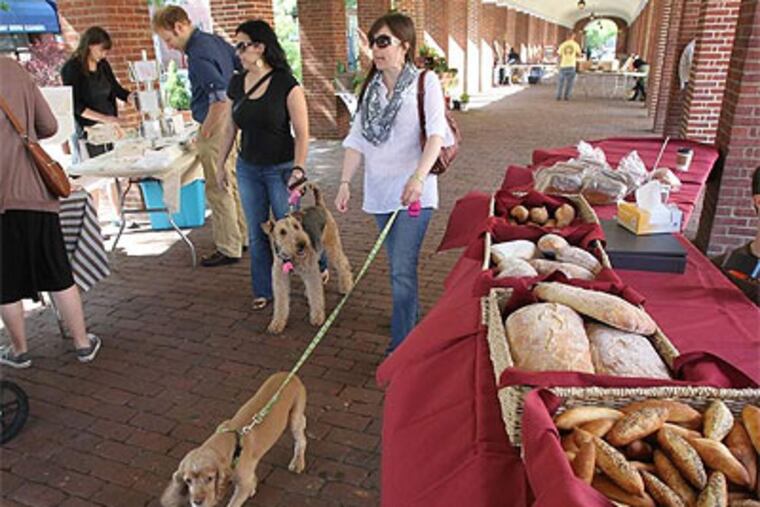
Bob Logue grew up on Akron Street, between Bridge and Pratt, where the Frankford neighborhood was dense with dry-goods shops, shoe stores, and corner markets.
Ask him today, and he'll rattle off 20 Philadelphia factories, easy, some right near his childhood door. Stetson Hats, Budd trains, Metlab, Milton Roy, Haydon Bolts, Globe Dye Works, Whitman Chocolates, Quaker Felt.
His neighbors made dresses, shoes, belts, hats, and umbrellas.
"It was an atmosphere of 'can do,'?" says Logue, 49. "Now, that can-do spirit is somewhat lost. We wait for it to fall off the container ship from overseas and to be sold at cheap prices at huge retailers. The good news is, folks are starting this process over again, making locally."
That includes Logue, who, along with his role as partner in local businesses Bodhi Coffee and Federal Donuts, has launched (or relaunched) the New Market, a showcase of craftspeople and tradesfolk, artisans and manufacturers with an eye toward the past and a hope for the future.
Set under the Shambles, the cobblestone-lined slice of Headhouse Square in Society Hill, the New Market opened nearly two weeks ago and plans to hold court from 5 to 9 p.m. every Friday until the end of October.
It's the latest "New Market" in a more than 250-year history at Second and Lombard. First held in 1745, when skilled laborers and craftsmen hawked their wares in an open-air setting, the market was a meeting spot until its structure was demolished in the 1950s. It was rebuilt in the early '60s, and by the '70s and '80s, the New Market area was a local haunt and tourist attraction with then-trendy restaurants such as Kanpai and street performers who included the Asparagus Valley Cultural Society, an act now known as Penn & Teller.
"It was a magical experience as a teenager to stroll through the New Market," says Logue. He especially remembers the man who played a rendition of the theme songs to 2001: A Space Odyssey, Star Wars and Star Trek — on beverage glasses. That is why Logue has live classical music at his New Market — another cheerful reminder of his past.
Still, it is the present that's most inspiring to Logue and to the market's inaugural class of vendors: Bennett Compost, Farm to City's farmers' market, industrial designer Tyson Boles, Carol Forman photography, Black Heart Letterpress, Capogiro, Fancy Plants, Philly Roller Girls, Agiato Bread Co., Edi Bikes, High Street Design, Jeb Wood's foundry, and Sara Selepouchin, who sells a line of housewares and also helped Logue organize the market.
Two of the vendors met Logue when they made the counters, lighting, and furniture for Bodhi and Federal Donuts, which, he said, were opened to create simple, high-quality products with "a level of craftsmanship that is reflective of the blue-collar community from which I came." Logue wanted that same vibe to rule over his new New Market.
"Bobby lives in the neighborhood and is trying to restore some of the spirit embodied in the New Market history," says Michael Harris, executive director of the Headhouse district board. "His idea was well-thought-out, and he's remained consistent: professionally showcase vendors who produce quality products locally. It's a great opportunity to serve the local neighborhoods and draw in visitors and tourists, while celebrating Philly's creative class."
That creative class now includes newbie bicycle-makers Sandeep Gopal and Jason Hoover, whose mix of aesthetics and idealism make them a perfect match for Logue's sales showcase. Gopal studied urban transportation, and Hoover explored sustainable design in developing countries.
The founders of the two-month-old business, with a studio on Lansdowne Avenue, didn't know much about their host, but Philly has a tight-knit start-up community and word of a market for made-in-Philly products spread fast.
Gopal pitched Logue on doing away with a traditional setup with wares displayed on a table. "Instead, we wanted a fluid display where customers can come up to the bike, touch them, take them for a test ride around the market, and ask us their bike-related questions. He loved the idea, and based on the response from attendees, we think it's a success."
Edi Bikes didn't make any sales, "but we didn't expect first-time visitors to drop $800 for a bike at a local fair," said Gopal. The pair did generate interest, and that was the point.
"An urban market is a great location for an urban bike," said Gopal. "We plan to be there every Friday, not only to display our bikes, but to deliver and service our customers' bikes. In short, we think of the New Market as our downtown Philly storefront."
So does Rob Nydick from Agiato Bread Co. Until now, Agiato's bread, pastries, and desserts had but one retail outlet — save being served at Nydick's restaurants — at the Main Street Market in Manayunk. The New Market gives customers an opportunity to buy his goods in their own neighborhood.
Karen Randal, director of business attraction and retention for Philadelphia Department of Commerce, sees the New Market's return as part of the growing village-center movement, where locals engage in conversation with fellow artists and, hopefully, buy each others' wares. Logue, in Randal's eyes, is the best candidate to get the conversation started."I haven't known Bob that long, but he's a whirlwind of energy, mixed with passion and great taste," said Randal. "He inhales you into the mix of all kinds of talented and exciting people looking to support one another and put Philadelphia on the map as a truly thriving city of design that was once the workplace of the world."
The future goal is to pair designers — who often use more prevalent and less expensive labor overseas — and local manufacturers so that more products can be made here at reasonable costs. Logue wants to be the guy to see that union hitting the marketplace — his marketplace.
"We're looking for companies that have made the leap to legitimacy or are ready to do so ... companies producing products of high quality ... that in the future might expand to a production facility or storefront in this city," said Logue. "If you're doing that, I want you in this market."