New film views the GOP's appeal for blacks
Director Kevin Williams' documentary, Fear of a Black Republican, which will be screened Thursday at the Pearl Theatre, investigates why there are so few African Americans in the Republican Party. Williams, the youngest of seven children, was born in Trenton and grew up listening to his enlisted brothers talk about their adventures in the military. Learning about the world from older siblings piqued Williams' curiosity about local and global politics. Fear of a Black Republican, which took more than six years to make, has been a low-budget labor of love for Williams, who is white.
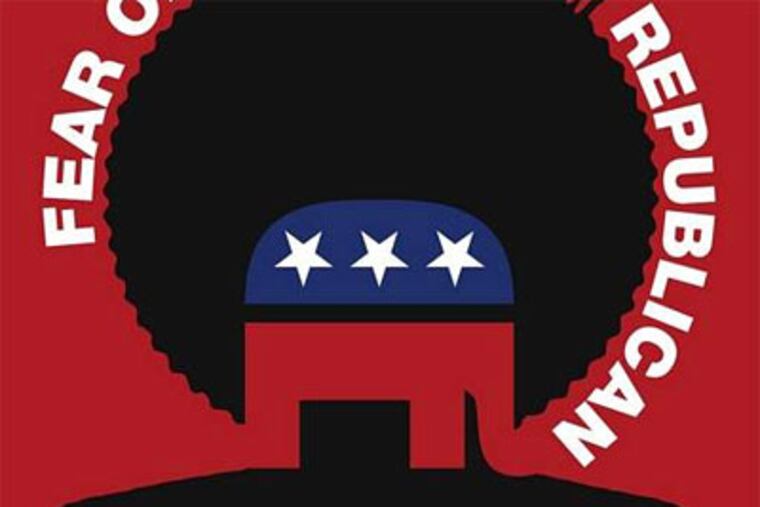
Director Kevin Williams' documentary, Fear of a Black Republican, which will be screened Thursday at the Pearl Theatre, investigates why there are so few African Americans in the Republican Party.
Williams, the youngest of seven children, was born in Trenton and grew up listening to his enlisted brothers talk about their adventures in the military. Learning about the world from older siblings piqued Williams' curiosity about local and global politics. Fear of a Black Republican, which took more than six years to make, has been a low-budget labor of love for Williams, who is white.
"The idea of making a film based on how politics and race affect my life and millions of other people has been the most amazing experience professionally," Williams said in an interview last week.
Fewer than 10 percent of African Americans consider themselves Republican. Those who do often keep their views under wraps. As a consequence, the Democratic Party may have less incentive to address black interests or be concerned about losing African American support.
"Trying to find out why things are getting worse in urban areas is important," Williams said. "I was born here. I grew up here. There are a lot of places like Trenton around the country. If things aren't going to get any better, how do I raise my children here? Is the political system telling me I have to move to get political representation, to have a safe place to live where my kids can get educated? That's what it seems to be telling me."
In 1986, Williams entered La Salle University. It was a time of upheaval in Philadelphia, just one year after the MOVE fire. Williams' experience at La Salle highlighted the contrast between youths from suburban communities and ones from urban neighborhoods such as himself. "That's where I was really introduced to cultural and socio-economic differences," he said.
Williams and his wife, Tamara, a cinematographer, settled in Trenton as homeowners in 2000. They remained interested in the politics of the suburban-urban divide, and life in under-resourced Trenton motivated the Republican couple to remain politically active. When a local Republican campaign office denied Williams the George W. Bush door hangers he wanted to distribute in a predominantly African American neighborhood, Williams said, he became confused by the reasoning that Republican outreach would only send black Democrats to the polls in even greater numbers.
That exchange led Williams to ask: Does the Republican Party actually want more African Americans?
In his film, the first response Williams gives viewers is as mystical as it is humorous. Princeton University professor Cornel West says: "The Republican Party wants to stay in power. They would solicit Martians to do so. They would solicit Negroes, too."
Williams also offers some history. Created by abolitionists in 1854, the Republican Party held the majority of the black vote until President Franklin D. Roosevelt's New Deal. Later, with President Harry S. Truman's integration of the military, and then President John F. Kennedy's making a phone call that Richard M. Nixon did not make — to Coretta Scott King when the Rev. Dr. Martin Luther King Jr. was in jail — the Democratic Party won black votes. As Democrats made more room for blacks, Republicans such as Barry Goldwater and Nixon took positions at odds with many in black communities. Garnering the white Southern vote, which was moving away from the Democrats over civil rights, was seen as more important to electoral success than the loss of black support.
While working on the documentary from October 2004 to February 2008, Williams interviewed academics such as West, pundits such as Tavis Smiley, and black politicians including Trenton's Democratic mayor, Douglas Palmer. Among the Republican candidates and politicians Williams queried were Michael Steele, the former chairman of the Republican National Committee; Christie Whitman, former New Jersey governor; and Ken Mehlman, who chaired the RNC from 2005 to 2007.
Taking his camera along the campaign trail, Williams also filmed local rallies, attended Conservative Political Action Committee meetings, and talked to National Black Republican Association members.
Those interviewed deliver a familiar message: The two-party system is failing blacks and urban dwellers because the GOP refuses to diversify. Republicans may pay lip service to the inclusion of blacks, but when it comes to supporting black candidates in local elections, the party typically won't put its money where its rhetoric is, according to the film.
Nowhere does the documentary make this more evident than in the candidacy of African American Republican Catherine Davis, whom Williams follows during her bid for a congressional seat from Gwinnett County, Ga.
Williams captures the painful moment when Davis recounts how she was treated by a top Republican official from whom she sought support. "This is hard for me," she says while driving. "We set up the meeting in advance. I had drama with AirTran. They canceled my flight. I was flying to get there just in time to meet with the [National Republican Congressional Committee]. The gentleman we met with — even though he knew in advance we were coming — didn't have the common courtesy to reserve a meeting room for me," she says as her voice cracks. "He had the janitor pull up chairs in the lobby to meet with me. It still hurts that I was treated that way."
Later, there's an on-screen echo of the offscreen slight she described. Republican Gov. Sonny Perdue of Georgia, seeking reelection, failed to acknowledge Davis' presence on the ticket at a campaign event three days before the 2006 midterm election. Only after the meeting was over, and most attendees had dispersed, was Davis invited to speak, she recalled. (Williams plans to screen his film in Georgia, Alabama, and Texas this summer, and to invite local party representatives.)
In the film, Williams keeps asking how the party can attract and support more black and urban Republicans. The responses run from people who blow him off to those who have cared deeply about party diversification for decades, such as former Sen. Edward Brooke of Massachusetts, the only black Republican elected to the U.S. Senate since Reconstruction.
West offers some suggestions about how Republicans could prioritize black concerns: focus attention on prisons and the criminal justice system, the education system, and the job market.
Garry "G" Cobb, one-time Eagles linebacker turned political candidate, also opens up. "They have to be comfortable around black people," Cobb says. "I don't think Republicans are comfortable around black people. We agree on a lot of the same issues. Most black people are conservative. They believe in having strong families, moral values. They're not in favor of gay marriage. They're not in favor of abortion. Republicans have to trumpet those and go after that vote."
Film Fear of a Black Republican Screens at 7 p.m. Thursday at the Pearl Theatre, 1600 N. Broad St. Tickets: $10. Information: http://fearofablackrepublican.com/