Forever the icon of Mayberry
Andy Griffith, 86, one of television's most beloved and enduring icons, died Tuesday at his home on Roanoke Island in his native North Carolina.
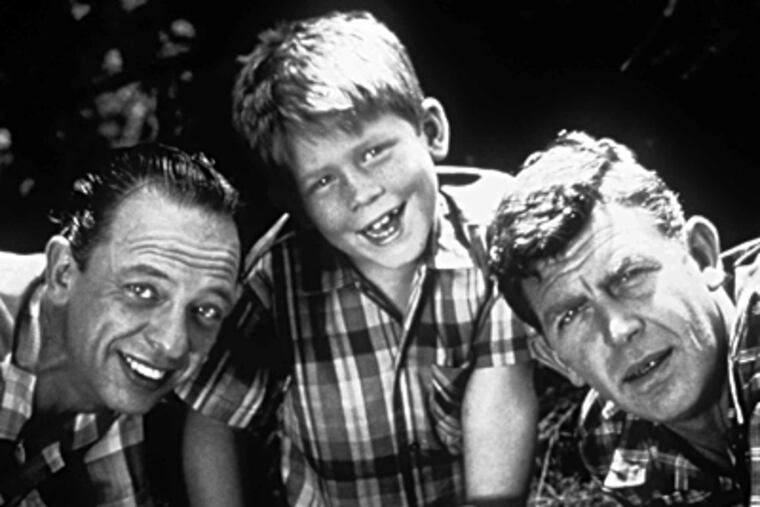
Andy Griffith, 86, one of television's most beloved and enduring icons, died Tuesday at his home on Roanoke Island in his native North Carolina.
A versatile performer, Mr. Griffith had success as a standup comedian, a singer, and an actor on stage and in TV and film. But he was always most closely associated with the classic '60s sitcom that bore his name.
On The Andy Griffith Show, he played the sweet-tempered sheriff of Mayberry, a drowsy burg in rural North Carolina. Mayberry, based on Mr. Griffith's hometown of Mount Airy, was so small that for its residents, life's biggest imaginable thrill was "goin' to Raleigh."
Sheriff Andy Taylor was a widower bringing up his young son, Opie (Ron Howard, who would grow up to be an Oscar-winning director), with the help of home-baked Aunt Bee (Frances Bavier). The opening titles - with Andy in uniform strolling down a dirt road hand in hand with his son, fishing poles slung over their shoulders, set to a jauntily whistled tune - struck a deeply sentimental chord with viewers.
Mayberry didn't have much of a crime rate. About the only person ever seen in the jail cell was the innocuous town drunk, Otis (Hal Smith). But Andy's job was complicated by his bundle-of-nerves deputy, Barney Fife (Don Knotts), and the busybody barber Floyd (Howard McNear).
Knotts won five Emmys as supporting actor for playing Fife. Mr. Griffith never won an Emmy (for lead actor), losing again and again to the likes of Dick Van Dyke and Don Adams.
In an odd way, that losing streak may have been the greatest testament to Mr. Griffith's performance. He was so incredibly natural as Andy Taylor that he practically vanished into the role.
The show aired during a period when "rusticoms" were very popular. But although series like Petticoat Junction, The Beverly Hillbillies, and Green Acres took a condescending approach to their yokel characters, Mr. Griffith held out for dignity. His Tarheel accent was genuine, but woe betide the stranger to Mayberry who thought that drawl made Andy a hick.
After all the silliness was done, most episodes ended as a learning opportunity, with the sheriff gently but firmly teaching Opie about people or life or what it means to be a good man. And that approach never lost its appeal. The Andy Griffith Show was one of the few television programs to leave the air (in 1968) atop the Nielsens.
That Mr. Griffith should be best remembered for his most self-effacing role seems amusing because he was such a vibrant and gifted performer.
After graduating from the University of North Carolina at Chapel Hill, where he was president of the glee club and considered opera as a career, Andrew Griffith tried his hand at teaching and then began developing a standup comedy routine.
That led to a 1955 Broadway play, No Time for Sergeants, in which he received glowing notices for playing a pine-knot country boy way out of his element in the Air Force.
But no one was prepared for the incendiary power Mr. Griffith brought to his first film role in 1957 as Lonesome Rhodes, the unforgettable antihero in Elia Kazan's A Face in the Crowd. As a criminal vagrant who acquires frightening power when he becomes a charismatic national TV personality, Mr. Griffith gave a performance the equal of a Marlon Brando or James Dean or any young Hollywood stud of that era.
Perhaps it was Mr. Griffith's Tobacco Road accent, but with the exception of A Face in the Crowd, the film industry was never really able to take advantage of his range.
The following year, he released a comedy album, Just for Laughs, that showcased his anecdotal style, including his best-known bit, "What It Was, Was Football," about a young innocent swept into a college football game without any idea what was going on. It was his 1954 performance of that routine on The Ed Sullivan Show that first got him noticed.
He returned to Broadway in 1959, earning a Tony nomination for playing the title character in the singing cowboy comedy Destry Rides Again.
Then TV came calling. Mr. Griffith ruled the medium twice, first as Sheriff Taylor and then as Ben Matlock, the folksy but exceedingly sly defense lawyer and title character on the long-running Matlock (1986-95).
The year after that series went off the air, he recorded a Grammy-winning gospel album, I Love to Tell the Story: 25 Timeless Hymns.
Mr. Griffith's wife, Cindi, who was at his bedside when he died Tuesday morning, issued a statement saying, "I cannot imagine life without Andy, but I take comfort and strength in God's grace and in the knowledge that Andy is at peace and with God."
"North Carolina has lost its favorite son," Gov. Beverly Perdue said. "Andy Griffith graciously stepped into the living rooms of generations of Americans, always with the playful charm that made him the standard by which entertainers would be measured for decades. . . . In an increasingly complicated world, we all yearn for the days of Mayberry."
The Twitterverse also churned with laconic salutes, including American Idol winner, country singer, and North Carolinian Scotty McCreery: "RIP Andy Griffith. We lost a legend today that provided me and my family some great quality time around the tv filled with some good laughs."
Also tweeting was Andy's TV son @RealRonHoward: "His pursuit of excellence and the joy he took in creating served generations & shaped my life I'm forever grateful RIP Andy."
It's a shame the peacemaker of Mayberry can't deliver Mr. Griffith's eulogy. You know he wouldn't let it get too flowery or long-winded. Just right to the point. Talk about the man's talent and heart and the way he touched other people. On second thought, that discussion might take even Sheriff Andy a while.