Two docs on local musical gender benders highlight QFest
Bruce Wayne Campbell and Jonathan Leitham both grew up in King of Prussia. They were both musicians. They both attended Upper Merion High School, albeit decades apart. They both became renowned in their fields, ending with very different results. Bruce Wayne Campbell redubbed himself Jobriath, a Bowie-esque glam singer and the first openly gay rock star who was touted as "rock's truest fairy." Jonathan Leitham, after a successful career as a jazz bassist, transitioned to become Jennifer Leitham. Since her transition, Jennifer hasn't been invited back to play the same major stages and festivals she was once a regular fixture on. She could not be happier.
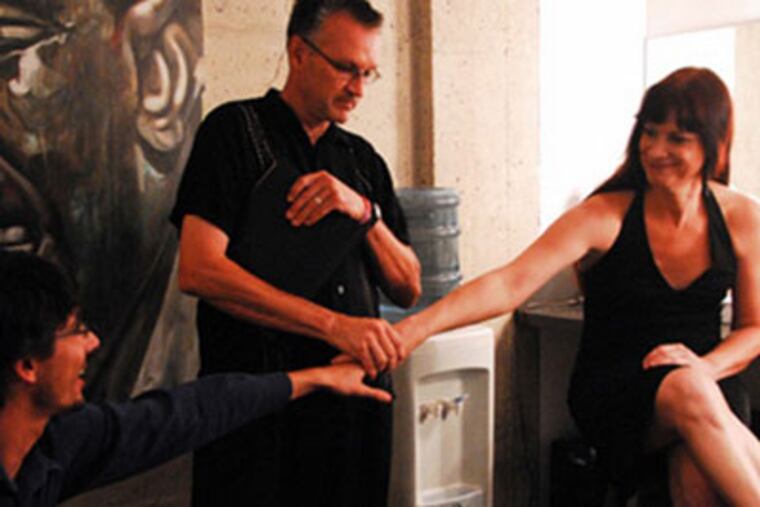
Bruce Wayne Campbell and Jonathan Leitham both grew up in King of Prussia. They were both musicians. They both attended Upper Merion High School, albeit decades apart. They both became renowned in their fields, ending with very different results.
Bruce Wayne Campbell redubbed himself Jobriath, a Bowie-esque glam singer and the first openly gay rock star who was touted as "rock's truest fairy."
Jonathan Leitham, after a successful career as a jazz bassist, transitioned to become Jennifer Leitham. Since her transition, Jennifer hasn't been invited back to play the same major stages and festivals she was once a regular fixture on. She could not be happier.
Two documentaries — "Jobriath A.D." and "I Stand Corrected" — focusing on the local pair will have their local debuts at QFest, the LGBT film festival now in its 18th year.
Jobriath rarely talked about his life as Bruce Wayne Campbell. Director Kieran Turner found that Jobriath was the product of a complicated home life and found solace in his music, attending Temple University as a music major for a year before eventually dropping out and heading to the military and, later, Broadway.
Turner had heard about Jobriath as a footnote in rock 'n' roll, always described in a derogatory manner. But when he finally heard Jobriath's music, through a re-issue released by former Smiths leader Morrissey called "Lonely Planet Boy," he was blown away. "I couldn't believe that so many people got it wrong," Turner said.
So Turner set out to set the record straight: Why was Jobriath so universally reviled?
Jobriath's fame was the product of hype machine Jerry Brandt, a slimeball svengali figure who gained prominence after booking the Rolling Stones' first U.S. tour and discovering Carly Simon. Jobriath's image was plastered on buses and articles were written touting his fame without even a record to show for it.
"Everybody's taste is different and talent is subjective. I don't expect everyone to listen to Jobriath to hear what I hear. But [music] is such a visual medium today and it is all about image," Turner said. "It's sort of a shame that back then it wasn't really the norm. People liked to discover things and think for themselves more than they do now. People didn't like to be told what to like."
Turner also cites Jobriath's open sexuality as an issue. Bowie purported to be bisexual, but he had an alien persona to hide behind and if his sexuality came under attack, he was able to point to his wife and child as a sign of heterosexuality. Other bands, like the New York Dolls or T. Rex may have worn glitter and make-up, but they were constantly surrounded by women. Jobriath, on the other hand, was always frank about his gayness and society wasn't ready for it.
What fascinated Turner was that Jobriath was not universally accepted by the gay community either. "I thought four years post-Stonewall, everyone must love people who stand up for people being who they are," Turner said. "But every gay man I spoke to said they were turned off and terrified by Jobriath because they didn't want people to think that's what all gay men are."
The backlash against Jobriath killed his career. Eventually, he reimagined himself as a Cole Porter-esque piano player, dubbed Cole Berlin. He died in 1983, a victim of the AIDS epidemic.
***
Jennifer Leitham felt reborn after she transitioned from a man to a woman at the age of 48. Before she transitioned, she was more of a hired gun, a sideman who was particularly good at her instrument but never the leader of the band.
Leitham's first big break came when her teacher Al Stauffer brought her to Philadelphia and recommended her for a gig at Palumbo's in South Philly. Despite living in L.A. for several years, she's remained a Phillies fan and tries to catch every game on MLB.tv.
"I'm a passionate person and I think that's because I spent so much time in Philadelphia," Leitham said. "Those people are passionate about everything."
The job at the now-defunct Palumbo's led her to gigs with Mel Torme, Doc Severinson, Gerry Mulligan, Peggy Lee and the Tonight Show All-Stars.
But the jazz community has not taken so kindly to Leitham's transformation. She doesn't get booked for the same studio or touring work that was a her bread and butter. "You can't just call people say, 'I'd like to be your bass player,'" Leitham said. "Because I'd gone through this gender transformation, people were just uncomfortable."
She continued, "I haven't been asked to do any large scale things, and when I ask I'm usually shot down. People can say anything they want to say but the consideration has everything to do with my gender."
But music has always been Leitham's solace, when she was going through the hell of puberty and during the complications surrounding her transition, and she simply couldn't give it up. So she was forced to become the leader of her own trio. She found her voice, literally, singing on record for the first time on her album "The Real Me."
The bass saved her, and when Leitham gives advice to others going through similar situations, she always counsels people to not let their gender rule their lives.
"Most documentaries about [transitioning] are about the pain and angst," Leitham said. "I've been through that but that's not the most important thing. It's what I do. All modesty aside, I'm good at something and that's what matters, not what's between my legs."
"I Stand Corrected," Ritz East, 125 S. 2nd St., 7:15 p.m., Thu., July 19; 5 p.m., Fri., July 20, $10, 267-765-9800 ext. 4, qfest.com.
Contact Molly Eichel at 215-854-5909 or eichelm@phillynews.com, or follow on Twitter @mollyeichel. Read her blog posts at www.philly.com/entertainment.