Franklin Institute's new permanent exhibit offers look into the human brain
Several years ago, when the Franklin Institute began visualizing an expansion, planners became captivated by the lovely symmetry they could achieve if they only had a brain.
Several years ago, when the Franklin Institute began visualizing an expansion, planners became captivated by the lovely symmetry they could achieve if they only had a brain.
The science museum's room-size heart - and, later, its transplant successor - not only connected to contemporary quantum leaps in understanding of the human body, but had also become a beloved landmark (if the term can be applied to a severely enlarged organ). The Giant Heart is reliably instructive in matters of blood transport. But kisses also have been stolen there, wedding vows exchanged.
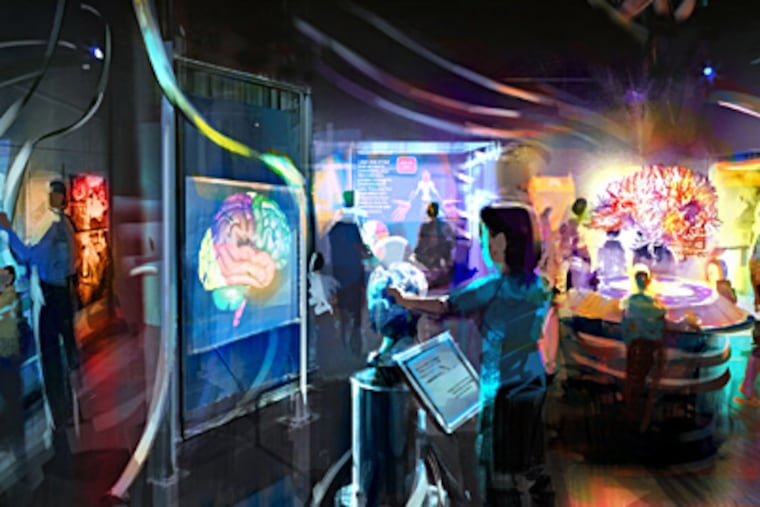
The museum broke ground in April on a new wing to house its 8,500-square-foot exposition on the brain, and although there won't be an enormous mount of gray matter through which children and lovers can climb, Franklin exhibit designers are now prototyping a strand of interactive exhibits that would unravel that organ's story - at least, as it is currently understood - in the same way the museum has done justice to the heart.
"This is the next frontier in science," says Steven L. Snyder, the Franklin Institute's exhibit and program development vice president, equating today's research into the brain to pivotal breakthrough moments by Copernicus and Darwin. "It is going to fundamentally change the view of who we are. It's quite powerful."
"Your Brain," opening in summer 2014 with the rest of the new building, will aim to transmit some of that power. The exhibit will permanently occupy the second floor of the 53,000-square-foot wing under construction on the Franklin Institute's south side. The first floor will house classrooms, and the third will augment space devoted to traveling shows - the Titanics, King Tuts, and plastinated corpses whose high gate counts and ticket prices have become integral to the Franklin's business plan.
The campaign to pay for the expansion overlapped with the severe downturn in the economy, but it is now done. The goal was $64.7 million, and with a $2.5 million donation from Teva Pharmaceuticals to be announced Thursday, the drive topped its goal with $65 million in gifts and pledges.
The campaign will continue to raise money for additional refurbishments of the original building, institute vice president Larry Dubinski said. About $50 million of the $65 million raised came from the private sector, with 20 gifts of $1 million or more. The largest chunk, $10 million, came from a local publishing and printing businessman and his wife, granting them naming rights to the Nicholas and Athena Karabots Pavilion.
"We consciously adopted a strategy of not giving up," said Marsha R. Perelman, whose eight years as board chair, when they conclude at the end of 2013, will have spanned most of the project's history. "We used [the downturn of] '07, '08, and '09 as an opportunity not so much to solicit, but to educate as many individuals and institutions as we could, foundations and representatives in Harrisburg, about the importance of what we do and the impact this project would have . . . because we knew at some point the economy would reverse.
"It worked," she said.
For the new building, exhibition, and related costs, the budget was $41.5 million. The rest of the money has been spent on other new exhibits and refurbishing of spaces such as the vast entry chamber whose centerpiece is James Earle Fraser's 20-foot sculpture of the institute's namesake in benevolent repose.
From the Franklin Rotunda, visitors to "Your Brain" will walk between massive existing columns (previously framing vitrines) and past what now is an impressive wall of marble (to be removed). Snyder says that by showing how the brain works, how it is responsible for not only basic functions but identity itself, the exhibit will give visitors "a new understanding that is going to change the way we perceive everything."
An introductory room poses questions and confronts visitors with a plastinated human brain and spinal cord. Designers took a page from electronic games, using an Xbox to capture moving images of visitors, indicating in outline where in the body the central nervous system resides and projecting those images onto a 15-by-20-foot wall.
Even if children won't be able to climb into a giant brain, they will be able to climb - though the Neural Light Show, an 18-foot-tall weblike structure studded with bursts of blue and white lights meant to represent the electrical and chemical signals of neural activity within the brain.
Concepts of how your brain creates reality are challenged in one area. "What's near is far, what appears upside down is actually right side up, what looks crooked is actually straight, and even a poster of Marilyn Monroe becomes Albert Einstein on closer inspection," says an exhibit description.
What parts of the brain control which functions can be learned by sitting in front of a model of a brain embedded with buttons and a video screen playing a cooking show. Choose a button, and one element of the video drops out - audio, color, focus - depending on which button you've pressed.
How about learning the names of those parts?
"Names are not generally meaningful for our visitors," says Eric Welch, a member of the group that is developing and testing prototype exhibits.
"Most likely, we'll have apps that will delve more deeply that you can access from a mobile device," says Jayatri Das, senior exhibit and program developer.
On a detail level, Snyder offers assurances that there will be plenty to plumb - detecting patterns in neural networking, how neural pathways work together to interpret the world. Ultimately, he says, he hopes the new exhibition - whose total cost is about $10 million - will convey several basic concepts: how the brain functions; how it creates reality, identity, and consciousness; that the brain continues to change over the course of its owner's life; and how our evolving understanding of the brain is reverberating into legal and ethical arenas.
No exhibition of the brain is complete without optical illusions, which are both fun and tease out facts about how the brain processes information. Included will be a version of the classic of the genre: is it a picture of a pretty young woman or an old witch? "Scientists actually learn a lot by studying illusions," says Das.
Deposited back out into the Franklin Rotunda, visitors can look up again at Ben Franklin, though perhaps now seeing Philadelphia's fabled biggest brain in a different light.