On Movies: Zemeckis unafraid of flights after 'Flight'
Robert Zemeckis was in Philadelphia last weekend, pre-Sandy, having jetted in from Chicago to present Flight, his riveting Denzel Washington drama, at the closing night of the Philadelphia Film Festival.
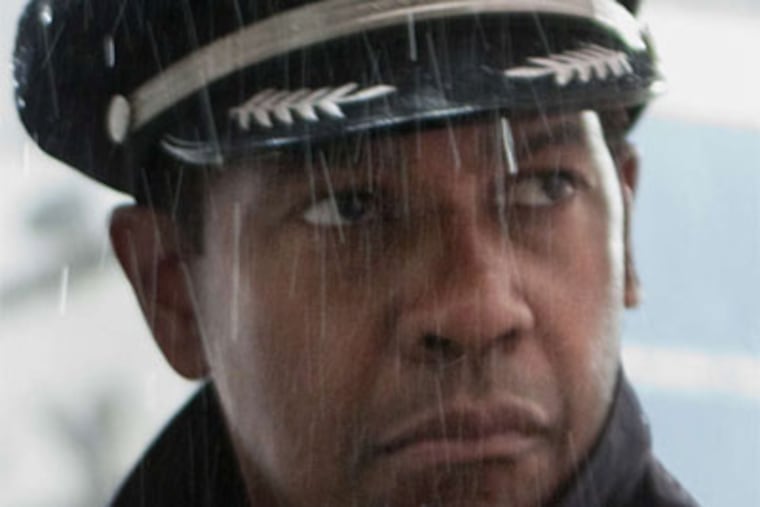
Robert Zemeckis was in Philadelphia last weekend, pre-Sandy, having jetted in from Chicago to present Flight, his riveting Denzel Washington drama, at the closing night of the Philadelphia Film Festival.
And even though the director's latest project pivots, literally, on a harrowing plane crash - a mechanical malfunction that sends a commercial jetliner plummeting nose-first to earth - Zemeckis harbored no greater concerns about flying than he had before he set out to make Flight.
"You know what they say, statistically it's much safer than driving a car," he says. Tell that to Capt. Whip Whitaker and the passengers and crew of South Jet Air Flight 227, making the short hop from Orlando to Atlanta in the movie. Washington, playing the veteran pilot, pulls off a series of miraculous maneuvers, bringing the broken plane to the ground on a stretch of curving field miles from the nearest airport. He's a hero.
And then, in the hospital, they take a sample of the hero's blood, only to discover off-the-chart levels of alcohol, and cocaine, in his system.
Flight, which opened in theaters Friday, is easily one of the strongest performances in Washington's career. And there's nothing easy about it.
"You have to ask Denzel about why he makes certain choices, but certainly he's really good at playing complex characters," Zemeckis says. "I mean, really good."
Washington, who had read John Gatins' screenplay about a pilot plagued by personal demons and addiction issues several years ago, met with Zemeckis back in spring 2011, once the director had signed on.
"We spent hours together in what I call rehearsals, where we just sort of sat around - myself, Denzel, and the writer - deconstructing everything and crunching everything down and just talking out everything.
"And Denzel really prepares. . . . It was the subtle things that amazed me, like how he was able to evoke this kind of misery of having to drink when you don't want to. You could see it in his face."
Flight, which also stars Kelly Reilly, John Goodman, Don Cheadle, Nadine Velazquez, Bruce Greenwood, and Melissa Leo, marks Zemeckis' return to live-action after a decade working on "performance capture" 3-D animation: The Polar Express with Tom Hanks, A Christmas Carol with Jim Carrey, and Beowulf, with a medieval troll.
Zemeckis, famous for his Back to the Futures, for Forrest Gump, and the cartoon/live-action hybrid Who Framed Roger Rabbit, says that he hadn't really planned on making three performance-capture films in a row, but that he didn't approach Flight any differently, anyway.
"Whatever the technique is, making a movie is making a movie," he says. "Everything has trade-offs. The thing that's nice about performance capture is that you never have to worry when an actor does something magnificent, because you've got it. You don't have to worry that they missed a focus, or somebody didn't hit their mark.
"The truth about making movies is that the technology always wins. So everyone can be very purist about performance, but at the end of the day, if you have a great performance but the camera or the lighting doesn't match, the lesser performance will end up in the movie, always. . . . It's too jarring to see something that doesn't match technically. So, that beautiful performance will just never see the light of day if there's a glitch.
"Everyone who makes movies is a slave to technology, so you have to embrace the technology or you're constantly frustrated."
Speaking of frustration, Zemeckis, who made his directorial debut in 1978 with the Beatlemania comedy I Wanna Hold Your Hand, senses that audiences are turning less enamored of movies these days.
"I just get the feeling that movies aren't as interesting to people as they were when I was coming up. . . . Certainly it doesn't help that most movies aren't very good. And it doesn't help that theaters don't present the films in the optimum way . . . . But that's always been a problem, there have always been not-very-good movies, and there's always been bad projection.
"I guess my theory is that because it costs so much money to make an average movie, and it costs an enormous amount of money to market, to get back that investment, everybody's got to go see the movie. And if everybody has to go see the movie, by definition it can't be about anything. Right?
"So that's the dilemma," he says, laughing ruefully. "You have to do what we did, which is make the movie for a reasonable price - very inexpensively, relatively speaking, for a studio movie. It's $30 million, which is a shoestring budget."
And then, he says, you're allowed to make a movie that's got complex characters, and moral ambiguity, and irony.
"All those things that really engage you, and actually entertain. See, that's the thing that depresses me the most: that all those things that supposedly are scary to present to audiences because it makes them have to think and it makes them have to feel - that's actually what they're clamoring for, because that's the whole point of going to a movie - to be entertained. It's kind of nutty, isn't it?"
"Sister's" mother. The star of Sister, Ursula Meier's heartbreaker of a portrait of a young thief, was 12 years old when they shot the film.
And Meier, the French director, knew she had to work fast to capture her star, Kacey Mottet Klein, at this fleeting moment in his life.
"I had to shoot very quickly, because when you are 12 you are no longer a child, but you are not yet grown up," Meier explains. "It's just a no-man's-land of age - a quick moment."
Set at the top of a Swiss mountain, where tourists and vacationers go to ski - and where Klein's Simon goes to steal skis and boots, wallets and food - Sister is a bracing and beautiful story of abandoned children struggling to survive. Simon lives with his older sister, played by Léa Seydoux, but he has assumed the role of provider, and provide he does. Sister is the official Swiss entry in the Academy Award foreign language film competition. It opened Friday at the Ritz Bourse.
"I was fascinated by this vertical view of life," Meier says, on the phone from Paris. "Some people come from around the world to go skiing in this beautiful place, and never go down the mountain. And then you have people who live down, just 10 minutes from the ski station, and never go up because they don't have the money.
"It's not their world, they don't belong to this world."