A lifetime of speaking through her artwork
She doesn't look like a revolutionary. Now in her early 70s, Linda Lee Alter is diminutive, gracious, and soft-spoken, with a fringe of white hair and rimless glasses. During an interview in her light-filled Center City apartment, she was dressed simply and conservatively: charcoal sweater vest, pearl-gray blouse, black slacks, flats. Yet with one bold gesture, Alter has transformed Philadelphia into a must-visit city for anyone interested in the work of female artists.
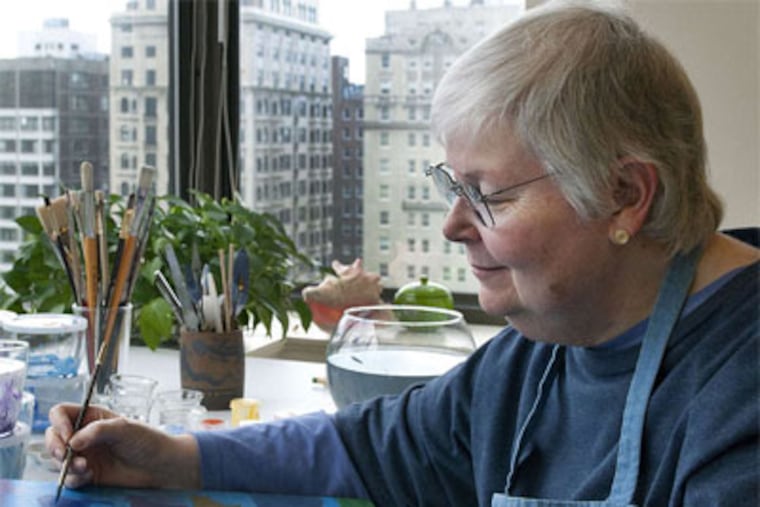
She doesn't look like a revolutionary. Now in her early 70s, Linda Lee Alter is diminutive, gracious, and soft-spoken, with a fringe of white hair and rimless glasses. During an interview in her light-filled Center City apartment, she was dressed simply and conservatively: charcoal sweater vest, pearl-gray blouse, black slacks, flats. Yet with one bold gesture, Alter has transformed Philadelphia into a must-visit city for anyone interested in the work of female artists.
Alter spent a quarter-century assembling an impressive collection: approximately 400 works made during the last four decades by more than 150 American women. They include paintings, sculptures, drawings, prints, photographs, fabric art, and beadwork, created in a broad variety of styles. Two years ago, Alter gave her entire collection to the Pennsylvania Academy of the Fine Arts. On Saturday, the academy opens its inaugural exhibition of highlights from that collection: "The Female Gaze: Women Artists Making Their World."
Although the addition of Alter's collection has dramatically increased PAFA's holdings of works by women, these are by no means the first it has owned. Established in 1805, the academy was both the nation's first public art museum and its first art school; it also was a pioneer in educating women and hiring them to teach. Visitors have long been able to view works by such distinguished alumnae as Cecilia Beaux and Mary Cassatt, and others, including Helen Frankenthaler and Georgia O'Keeffe. Still, Alter's donation to the academy's collection represents an entirely different order of magnitude in terms of art by women.
Alter is an interesting person, and an intriguing artist. A Philadelphia native (Olney High School, Class of 1957), she still gets excited when describing the picture she drew on the first day of first grade: three small birds escaping from a cage - indicating how she felt about being cooped up in a classroom. More important, according to Alter, even at 6, "I was aware that I could speak through my art."
She attended the Philadelphia College of Art (now the University of the Arts) and studied art education "because my parents wanted to be sure that I could get a job."
In the end, she taught only briefly before marrying. Her husband's career required moves to St. Louis, Atlanta, and Puerto Rico, during which time she found work in "commercial" art, doing what we now call illustration. In 1966, she and her husband returned to Philadelphia, where their daughter, Sara, was born the following year (they later divorced). Alter trained in art therapy, earning a master's degree in 1972.
But even before that, in the late 1960s, she had become serious about her own art, using fabric to produce wall hangings studded with whimsical, brightly colored animals, plants, and human figures, often with allusions to Old Testament stories. (Though she practices Buddhist meditation and mindfulness, Alter considers herself Jewish). These beautifully appliqued and stitched pieces were inspired by her maternal grandmother, Bessie, a professional seamstress to whom she was very close. Some were exhibited at the prestigious Philadelphia Craft Show in 1980 and 1984.
When she was in her 50s, Alter switched to painting - in acrylics, the medium she still favors. "Painting allowed me more freedom," she explains. "It was a more immediate way to say the things I wanted to say."
Some of her paintings evoke the same childlike wonder and exuberance evident in her fabric works. Others are surreal, with hints of dark emotion and thinly veiled references to her personal life. Four years ago, the Allentown Art Museum held a retrospective exhibition of Alter's work, including the hangings and her acrylic pieces.
In the mid-1980s, she had begun collecting other people's art - initially folk art because she found its patterns and lively colors so appealing. But after a few months, she says, she realized that everything she had bought - and nearly everything she had seen in galleries - was by men.
At that point, the modern American women's movement was still gathering steam, and it was difficult to find art by women on display anywhere. As a result, Alter decided to dedicate herself to making female artists and their work "more visible" - a recurring phrase of hers.
From the start, she planned to give these works to a public museum so they would be accessible to as many viewers as possible. She worked hard to collect a range of objects by artists from varied backgrounds and made at different points in their careers. At the same time, as she noted, "you have to set limits," so she focused on art made by American women after 1970.
(In 1991, Alter founded the Leeway Foundation to make modest but life-changing grants to individual women in the Philadelphia region. Over the years, her daughter, Sara, a foundation officer, encouraged her to broaden its focus. It now offers support to female and transgender artists, and has a large number of people of color on its staff and board. Since 2007, Leeway has been a community foundation, run apart from its founding family.)
Alter has a special fondness for artists with connections to the Philadelphia region, so her collection includes purely abstract work by Edna Andrade, expressionist stained glass by Judith Schaechter, and haunting photographs by Zoe Strauss. But she also acquired a multitude of works by non-Philadelphians: Washington native Elizabeth Catlett's politically powerful sculpture, Nebraska-born Barbara Takenaga's paintings on rose petals, and prints by the noted Inuit artist Jessie Oonark.
By 2008, after 25 years of gathering, Alter decided it was time to share her collection with the world. So, with help from two close friends, she embarked on a complicated effort to find the best permanent home for her art. For two years, she did research, making secret visits to 11 promising institutions in five states. She considered everything about the potential host museums, from signage to restrooms to handicapped access and the attitudes of guards toward visitors.
From the outset, she notes, she was impressed by David Brigham and Robert Cozzolino, the Pennsylvania Academy's president and senior curator, respectively. They expressed a strong interest, and promised - as Alter required - to fully integrate the new work into the permanent collection.
So in the end, she chose to make her gift to an institution that is also a school, where art students will interact regularly with the objects she so carefully assembled.
Ironically, her search ended at the museum closest to her home, so "I can visit any time." Though she acknowledges she misses living with these works daily, she also says, "They're like children . . . . You love them all, but at some point, they have to go off to college."