Submerged with Titanic
More than 2,000 passengers - 45 with ties to Philadelphia - embarked with RMS Titanic on its voyage into history.
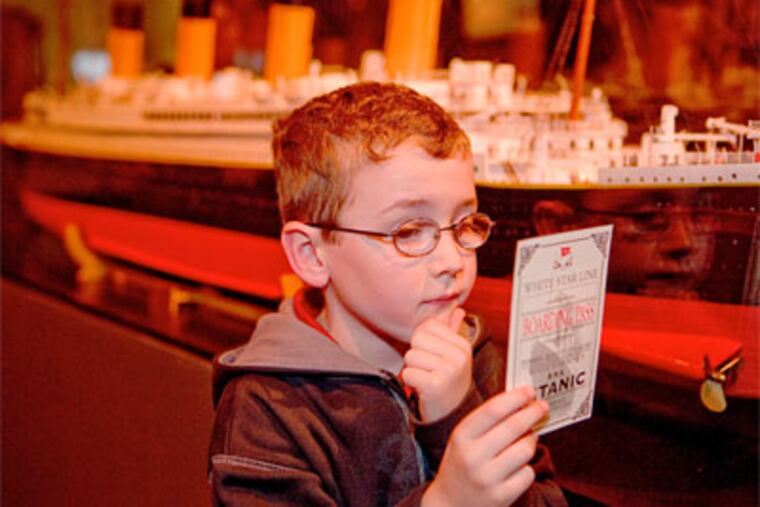
More than 2,000 passengers - 45 with ties to Philadelphia - embarked with RMS Titanic on its voyage into history.
Many, filled with entrepreneurial ideas and hopes for a better life, carried all they owned with them. Others, more affluent, traveled with the fine things that wealth can buy.
Rich or poor, their lives were inextricably linked to the fate of the "practically unsinkable ship" that sank April 15, 1912, two hours and 40 minutes after sideswiping an iceberg, and still rests a century later on the floor of the North Atlantic.
Fascination with the Titanic lingers. Is it because of the mystery around who exactly was to blame for the accident? Is it because the shipwreck is a reminder of the fragility of life and the power of nature?
"It's a very interesting story - a human story," says French archaeologist Paul-Henry Nargeolet, who has made more than 30 dives to the Titanic. "We can do whatever we want. But once nature decides to, it will win - like Hurricane Sandy."
"Titanic: The Artifact Exhibition," on view at the Franklin Institute through April 7, displays 300 artifacts recovered from the wreck. It's the second run for the exhibition, produced by RMS Titanic Inc., which first visited the Franklin Institute in 2004. This time, the exhibition includes 100 artifacts that haven't been displayed in Philadelphia previously, among them a ship's whistle, a cherub from the grand staircase, personal belongings, and a 3D video of a recent dive to the wreck.
Each visitor to the exhibition receives a boarding pass bearing the information of a real passenger - including age, origin, traveling companions, class, and reason for travel - making the voyage through the museum that much more personal. I ended up with the pass of Ida Straus, wife of the co-owner of Macy's.
"Oh, things are looking up for you," chuckles Mark Lach, creative director of the exhibit. "You're extremely rich. Not saying if your fortune will change by the end, though. You'll find out at the end."
On the way to learning their passenger's fate, visitors can view pieces of china, menus, tickets, money, and even champagne bottles that still smell like (but no longer taste like) champagne. Large pictures of the beautiful Cafe Parisien and other rooms adorn the exhibit. Letters that the passengers wrote, never knowing they wouldn't be delivered, are on display after being rescued from the leather suitcases that preserved them for decades beneath the sea.
In a red-lit room, visitors can see pictures of the ship's boiler room, where workers shoveled 600 tons of coal per day. They can also see the work of perfume maker Adolphe Saalfeld, whose product survived the sinking and has since been reproduced and sold through QVC. They can feel the temperature of the water that night by placing their hands on the museum's block of ice.
And, of course, there's the famous grand staircase. The ornate oak structure, which had a domed skylight, is clearly the pinnacle of the exhibition.
"We got very extravagant with this because that's just how extravagant it really was," Lach said. When he spoke with James Cameron, director of the 1997 film Titanic, he said he felt that the staircase gave moviegoers the sense of excitement that the passengers felt when looking at it. Lach aimed for the same effect in his re-creation.
The conservation of items was costly, and retrieving them was no casual task. Lach vividly recalls his dive in 2000, when the descent to blackness took a full two hours. The temperature in the submarine plunged from 95 degrees to 38 degrees despite its six-inch titanium hull. "Those eight to nine hours on the bottom were full of excitement, but they were also emotional. Especially when we reached Captain [Edward] Smith's cabin," Lach says.
Nargeolet, the director of the Underwater Research Program at RMS Titanic Inc., supervised the recovery of 5,000 artifacts, including a 20-ton piece of the ship's hull.
Obtaining each artifact was a new challenge for the former naval commander; some artifacts required the team to build a new tool to retrieve them.
But while the company is dedicated to preserving the recovered artifacts, the rest of the ship remains on the seabed, inevitably disintegrating as time passes.
At the end of their journey through the exhibition, visitors can go to the memorial wall to find out their passengers' fate. The thousands of names are accompanied by the devastating numbers:
1st class: 201 saved, 123 lost
2nd class: 118 saved, 166 lost
3rd class: 183 saved, 527 lost
Crew: 212 saved, 698 lost
And Ida Straus, whose boarding pass I was given?
Lost.
Titanic: The Artifact Exhibition
Through April 7 at the Franklin Institute, 222 N. 20th St.
Hours: 9:30 a.m. to 5 p.m. Sunday through Wednesday, 9:30 a.m. to 9 p.m. Thursday through Saturday.
Tickets: Daytime, $29 for adults and $22 for children (3-11), includes admission to the museum; evening, $19.50 for adults and $14.50 for children (3-11), does not include admission to the museum.
Information: 215-448-1200 or www.fi.edu/titanicEndText