New Recordings
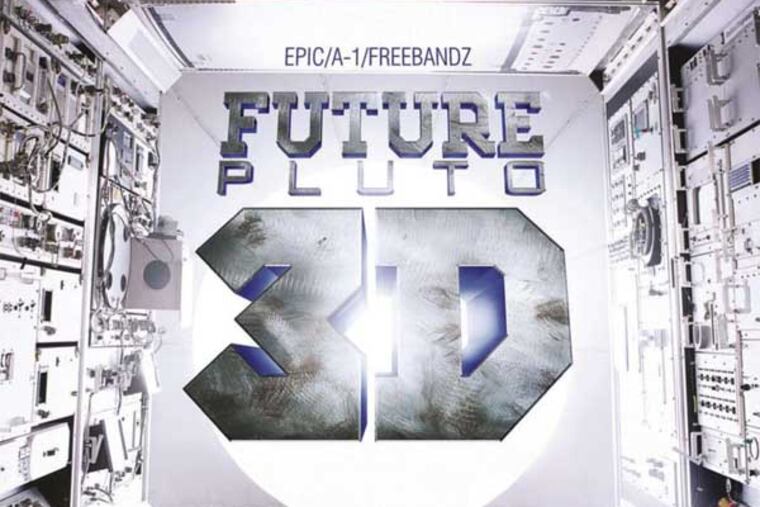
Pop Nayvadius Cash was the quiet hip-hop story of the year, as hits beamed in from his April debut, titled Pluto. Then came Nov. 27, and the rerelease, titled Pluto 3D, with three new songs and two remixes, attacked the Billboard charts. Pluto had surpris
Pop
Future
Pluto 3D
(A1/Free Bandz/Epic ***1/2)
nolead ends Nayvadius Cash was the quiet hip-hop story of the year, as hits beamed in from his April debut, titled Pluto. Then came Nov. 27, and the rerelease, titled Pluto 3D, with three new songs and two remixes, attacked the Billboard charts. Pluto had surprising critical legs, too - I wish rap fans were this open-minded about Auto-Tune when Nicki indulges it. But I can't accuse Future of selling out because he's a newbie, can't mock his singing because it's entirely cloaked, can't call his rapping a retread because it came from nowhere. Or rather, Pluto. Narrowly escaping some middle filler, only the unstoppable "Same Damn Time" and mindless "Tony Montana" come back to top the openers: "Parachute," in which R. Kelly bungee- jumps onto you, and "Straight Up," in which Future declares, "I'm-a go to Mars and take the baddest broad." Easily more fun than Drake.
- Dan Weiss
nolead begins Broadcast
nolead ends nolead begins Berberian Sound Studio
nolead ends nolead begins (Warp ***)
nolead ends From its start in the mid-'90s, the British band Broadcast seemed influenced by soundtrack music. Like Stereolab, they looked back to visions of the future, building on space-age music from the '60s and spacious electronics of the '70s to create something that sounded new and contemporary, especially on 2000's seminal The Noise Made By People. Broadcast's vocalist Trish Keenan died in January 2011, but she and partner James Cargill had already composed the soundtrack to British director Peter Strickland's Berberian Sound Studio, a film about an obsessive film sound engineer (Cargill is also working to assemble a final Broadcast album).
With 39 tracks in 38½ minutes, the album plays as a continuous soundscape: sometimes churchy and imposing, sometimes pastoral and beautiful, sometimes angelic and ethereal, sometimes punctuated by unsettling screams and eerie voices. It's uneasy listening, but it's also a fascinating blend of daydream reveries and nightmarish horrors.
- Steve Klinge
nolead begins Bonnie Bishop
nolead ends nolead begins Free
nolead ends nolead begins (Be Squared ***)
nolead ends In the second song on Free, Bonnie Bishop sings about a woman who "ain't no shrinkin' violet." You'd never mistake the Nashville-based Texas native for one, either, after you hear Bishop belt out this swaggeringly Stonesy rocker. And that's not the only bracingly organic blast the raspy-voiced singer and songwriter delivers here: There are also "Keep Using Me" and "Bad Seed," the latter fueled by slide guitar and pounding piano.
Bishop proves just as potent as a balladeer. She cowrote, with Al Anderson, "Not Cause I Wanted To," one of the standout tracks on Bonnie Raitt's latest album, Slipstream. That song is not here, but you do get the equally stellar "World Like This" and "The Best Songs Come From Broken Hearts."
- Nick Cristiano
nolead begins The Game
nolead ends nolead begins Jesus Piece
nolead ends nolead begins (Interscope ***)
nolead ends The Game has titled this album Jesus Piece, and an African American Christ graces the cover. That doesn't mean Game has become a holy roller or that his newest work is ruled by religious imagery. Instead, it's about going bad and loving God - how a rhyme-spitting MC can have a gangster lean while remaining spiritual.
There's an unadulterated bacchanalia of drugs, thugs, and carnality on "Celebration" and the barking "Ali Bomaye" untouched by the Holy Spirit. Yet Game's struggle between staying street and keeping God in his heart (and the club) is clear on bumping, dippy cuts like "Heaven's Arms," when he strolls into the VIP area with "Part the Red Sea in red Louboutins, who the don?/Packing heat like two LeBrons/ It keep you higher than heaven's arms."
The tension between earthly goods and higher ground is most palpable when Jamie Foxx goes with Game to the Lord's house on "Hallelujah." After telling the Almighty he's trying to reach Him with all his might, Game admits that thinking about young girls while in church is wrong: "I wanna live righteous and you know I love Jesus/ But you can't catch the Holy Ghost in a Prius."
Amen.
- A.D. Amorosi
Country/Roots
Various Artists
The Music of Nashville Original Soundtrack:
Season 1, Volume 1
(Big Machine ***)
nolead ends One thing you can say for sure about Nashville, the prime-time soap opera that returns Wednesday night on ABC: It gets the music right. As you can hear on this disc, even with the show's actors doing all the singing, the results are as good as anything the city's Music Row has to offer.
Perhaps that's not surprising, because (the sometimes overrated) T Bone Burnett did the bulk of the producing, along with the always- estimable Buddy Miller. They have a terrific collection of songs to work with, and they manage to strike a balance between commercial accessibility and rootsy character.
"Love Like Mine" and "Telescope," sung by Juliette Barnes (Hayden Panettiere's character), exude a spitfire attitude that would fit right in on a Miranda Lambert album. Several other numbers play up country's duet tradition, as with Rayna Jaymes (Connie Britton) and Deacon Clayborne (Charles Esten) on "No One Will Ever Love You," and Gunnar Scott (Sam Palladio) and Scarlett O'Connor (Clare Bowen) on "If I Didn't Know Better" and "When the Right One Comes Along." And Britton and Panettiere's rousing, rocked-up "Wrong Song" is every bit the show- stopper that it was in the TV show.
- Nick Cristiano
Jazz
Sonic Liberation Front
Jetway Confidential
(High Two ***)
nolead ends It feels like the 1970s on this CD from Philly's own free-jazz big band the Sonic Liberation Front. The band members reaffirm links to the city's archetypal free-jazzers, the Sun Ra Arkestra, dedicating the tuneful "Jetway Confidential No. 3" to their older confreres. (The piece was commissioned by Philly presenter Ars Nova Workshop.)
The Front, led by drummer and composer Kevin Diehl, features a percussive, African-laced undertow that dips heavy into grooves. Blurts and squeals also abound, as does an artful sense of space and sound. "Umami" is especially intriguing, with its seductive horns, and "Yemaya" emphasizes the group's Afro-Cuban roots. "One Two" has that spacey stuff covered.
- Karl Stark
New Recordings
Top Albums in the Region
This Week Last Week
Locally Nationally Locally
1 1 Taylor Swift Red 1
2 2 Les Misérables Cast Soundtrack -
3 3 One Direction Take Me Home 2
4 4 Bruno Mars Unorthodox Jukebox 3
5 7 Rihanna Unapologetic 11
6 8 Mumford & Sons Babel 7
7 6 Imagine Dragons Night Visions -
8 9 Lumineers Lumineers 14
9 5 T.I. Trouble Man: Heavy Is the Head 5
10 12 Justin Bieber Believe 16
SOURCE: SoundScan (based on purchase data from Philadelphia and Montgomery, Delaware, Bucks, Chester, Camden, Burlington and Gloucester Counties. Billboard Magazine 1/12/13 © 2013
New Recordings
On Sale Tuesday
Conor Maynard, Contrast; Dropkick Murphys,
Signed and Sealed in Blood; Solange, True;
Enrico Rava,
Rava on the Dance Floor;
Placebo,
Without You I'm Nothing
Classical
This England
The Oregon Symphony, Carlos Kalmar conducting
(PentaTone ***1/2)
nolead ends Much of the British symphonic music on this disc - Elgar's Cockaigne overture and Vaughan Williams' Symphony No. 5 - was long considered unexportable, best heard performed by Brits and for Brits. This American orchestra, however, conducted by the Viennese-trained Kalmar on a Dutch audiophile label, recently had Grammy nominations for a previous most-British disc titled Music for a Time of War, suggesting this repertoire has perfectly wide appeal, especially in vital, muscular performances such as these.
On the new disc, Kalmar takes anything but a placid, luxurious approach to British music. It's as though he perceives everything through the lens of Benjamin Britten's bonier aesthetic, in which the technical underpinning is just as important as the music's exterior atmosphere. Performances here are as thoughtful as they are incisive.
Speaking of Britten, the disc ends with Four Sea Interludes and Passacaglia from Peter Grimes, performed with an originality of vision that one would have predicted from Kalmar's many appearances during the Philadelphia Orchestra's Mann Center season. Some might find him fussy and over- bearing. But it's a performance that won't be mistaken for anybody else's.
- David Patrick Stearns