The Supremes presented glamourous black women to the nation
THERE WERE plenty of one-hit girl wonders in the 1960s. Start with juvenile cuties like "Locomotion" chirper Little Eva and come-ons like the Ronettes ("Be My Baby") and the Shangri-Las ("Leader of the Pack") - bad girls you'd never take home to meet mom.
THERE WERE plenty of one-hit girl wonders in the 1960s. Start with juvenile cuties like "Locomotion" chirper Little Eva and come-ons like the Ronettes ("Be My Baby") and the Shangri-Las ("Leader of the Pack") - bad girls you'd never take home to meet mom.
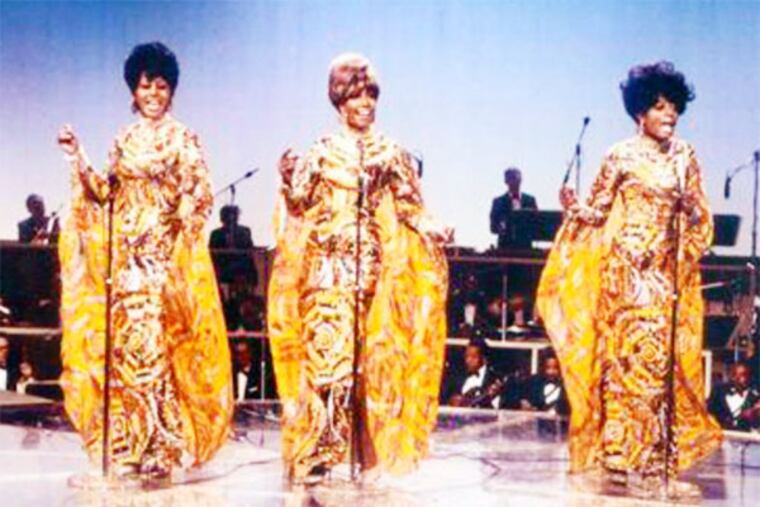
Then there were the Supremes, a glamour-girl group built for the long haul - and crossover appeal to audiences of every age, stripe and skin tone - with their low-keyed, lilting vocal tones and lush, string- and horn-endowed Holland-Dozier-Holland pop-soul gems.
Maxine Powell, who ran Motown Records' in-house finishing school and artist development department, told the teenage girls, "Be prepared to perform before kings and queens."
It was a prophecy that came true after their first and second No. 1 U.S. hits of 1964, "Where Did Our Love Go" and "Baby Love," also topped the charts in the United Kingdom, a nice salvo to the "British Invasion," the Beatles. (The Queen Mother met them following a concert in 1968.)
Ten more No. 1 hits followed in the next five years after 1964, making the Supremes the third biggest record selling act of the decade (trailing only Elvis Presley and The Beatles).
Until, that is, group founder Florence Ballard fell prey to drink, Berry Gordy changed the group's name to Diana Ross and the Supremes, and the group dynamic tragically fell apart - an emotional earthquake so seismic it would inspire two quasi-fictionalized film and stage accounts: "Sparkle" (recently remade) and "Dreamgirls."
First and foremost, the Supremes seemed built for nationwide exposure on "The Ed Sullivan Show," an old-fashioned (even in its prime) variety show where the trio appeared a staggering 17 times in their core configuration - Ballard, Mary Wilson and Ross.
On "Sullivan," the ladies might be sandwiched between the "button-down mind" of comedian Bob Newhart and a trained dog or seal act, or maybe a tony opera diva like Rise Stevens. Most entertainers dressed to the nines to go on this prime time Sunday night show on CBS - then called the "Tiffany" network.
It really was a big deal.
Sullivan's audience often constituted half of all TV viewers (there were just three channels to chose from then) and was as diverse as America itself. So that included a big chunk of the prejudiced white populace that still frowned on mixing of the races as entertainment on radio or TV.
But who could be offended by this Supremely sophisticated trio offering demure, love-conquers-all fairy tales like "Stop! In the Name of Love," "Back in My Arms Again" and "I Hear A Symphony," and looking all ladylike in gowns, opera gloves and bouffant hair styles?
Even in Motown's hometown, Detroit News arts critic Arnold S. Hirsch found it, um, remarkable that the Supremes "don't scream or wail incoherently. An adult can understand nine out of ten words they sing. And, most astounding, melody can clearly be detected in every song."
Motown founder Berry Gordy has gladly claimed credit for cultivating Motown's broad appeal and its significance in fostering integration during the civil rights era.
But Supremes founding member Mary Wilson (who actually brought high school classmate Ross into the fold) suggested recently the Supremes' look, at least, was in large part their own design.
"I do think that music, not just Motown music, all music, was definitely influential in bringing the faces of black America to the world . . . I remember there was a time when you couldn't have black faces on album covers," she said in an interview with the Daily News recently.
"I love Berry, and I think Berry gave us a platform to have great careers, all of us. But I don't think it was all his doing . . . Berry did have the idea of 'let's introduce our music to everyone.' . . . Before that it was just gospel and R&B for Afro-Americans.
"In the case of with the Supremes, we came to Motown in a certain way. Most of us grew up looking at Lena Horne, who was very beautiful, and Dorothy Dandridge, who was very beautiful, and Josephine Baker. And so we grew up with this thought of beauty. Our mothers, our aunts, all dressed up . . . If you went to a black church, you would think you were at a fashion show. We grew up in that environment. We were always like, you know, the glamorous girls."